No Answer In Aussie Horse Deaths

Despite relatively intensive efforts, no cause has been identified for the deaths of 22 horses ona Kooralbyn farm in Queensland, Australia. Readily identifiable causes have been ruled out, leaving two main theories:

As mentioned in an earlier post, one possibility is botulism It can be very hard to diagnose botulism in horses, and the disease is often presumptively diagnosed by ruling out all other reasonable options.

The other possibility is tick paralysis, which unfortunately is equally difficult to diagnose definitively. Certain types of ticks can cause progressive and severe paralysis which may look similar to botulism in some ways. Scrub ticks (the name typically used for Ixodes holocyclus) were noted on one of the first affected horses, but there's no information about whether all of the other horses had ticks too, and if so whether they were ticks that can cause paralysis. Kooralbyn is in a region where these paralysis ticks can be found and spring (e.g. now in Australia) tends to be the peak time for paralysis cases, so it's a reasonable consideration.

It's frustrating but far from unusual not to be able to make a solid diagnosis in outbreaks. Beyond the frustration factor, it's also a concern because it makes it hard to take precautions to prevent it from happening again.

Image: Two Ixodes holocyclus ticks, one before and one after feeding (photo credit: Bjørn Christian Tørrissen, click for source)

Dead birds, botulism and dogs

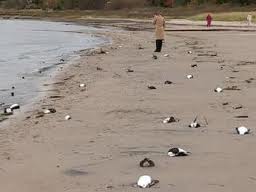
There have been a few large outbreaks of dead birds around Ontario lately, with botulism being the main suspect. In one area alone, up to 6000 dead birds have washed up on Georgian Bay beaches. While dramatic, it's not a rare situation at this time of year, and typically relates to birds ingesting fish that died of botulism. When birds eat enough fish with enough botulinum toxin inside them, they can develop botulism themselves and die. This pattern can continue if dead birds are eaten by other animals.

In response to these events, I often get calls about risks to dogs and people. When thinking about it, it's important to consider how botulism occurs. There are two main forms of botulism:

  1. Toxicoinfectious botulism involves growth of the Clostridium botulinum bacterium in the intestinal tract, and as the bacterium multiplies it produces toxin which can be absorbed  into the body through the intestinal wall. This type of botulism is rare in adults (both people and animals), since the mature intestinal bacterial population usually prevents C. botulinum from overgrowing. It's mainly a risk in young individuals.  )This is why you're not supposed to give honey to babies, since C. botulinum spores that can be present in honey can pose a risk to them.)
  2. The other form of botulism in from ingestion of botulinum toxin that's already been produced. This is the most common form. When birds eat fish that have died of botulism, they ingest both the bacterium and its toxins, but it's the toxins that make them ill and ultimately lead to death. Dead birds will probably have some C. botulinum in their intestinal tracts, but the main concern is the botulinum toxin in the rest of their tissues.

Dogs (and cats) are quite resistant to botulinum toxin, and reports of botulism in these species are rare. It would take a pretty large amount of toxin to cause disease (at least compared to many other species) but it's not impossible. Casual contact with areas where birds have died is of basically no risk. Eating dead birds could pose some risk to the dog, depending on the amount eaten and how much toxin was present in the bodies. Ingestion of some C. botulinum bacteria in the birds is of limited concern.

So, walking in an area where birds have died is very low risk. People should ensure that their dogs don't have uncontrolled access to areas where birds have died, so that they can't eat lots of dead birds.

I also get questions about whether dogs that get exposed to beaches where birds have died pose any risk:

  • Even if a dog ate a lot of dead birds and got botulism, a person could only be exposed to that toxin by eating the dog - an unlikely event. The dog could ingest some C. botulinum bacterium, but this also poses minimal risk since the bacterium is pretty widespread and people can be exposed to it from many different sources. Even if a dog had some C. botulinum in its intestinal tract, avoiding contact with feces will reduce the risk of exposure. Even if there was some ingestion of C. botulinum from the feces, there's little risk, especially to adults. Perhaps the main public health concern (which is still very low) would be exposure of infants to C. botulinum from dog feces or perhaps from a dog's contaminated haircoat.

Bottom line: Keeping dogs and cats away from dead birds is a good idea, for several reasons, including botulism exposure, but there's limited public health concern.

Image: Dead birds washed up on the shore of Georgian Bay, on the eastern side of Lake Huron (click for source)

Botulism Suspected In Aussie Outbreak

A couple of days ago, I reported about a deadly outbreak on a Queensland farm that had killed a significant number of horses. A definitive diagnosis has still not been made, but it is starting to look like botulism might be the cause. In my previous assessment, I said botulism was a potential cause of an outbreak like this, but that this particular disease has a pretty consistent clinical presentation so it was probably unlikely if no one was talking about it as a leading option. It looks like now they are, with the owner stating "I've been talking to vets all over Queensland and they're saying the symptoms are spot-on for botulism." It's unclear whether the first vet(s) didn't consider it or whether there wasn't much veterinary involvement at all initially. Regardless, botulism makes sense, particularly with the description of the type of illness that's now being provided.

Botulism testing is underway, but it's often hard to get a positive lab test for this disease in horses. Often, it's a presumptive diagnosis made based on the clinical appearance and lack of any other identifiable cause. Botulism outbreaks on horse farms can be devastating, as in this case. They are often associated with feeding improperly fermented silage or haylage, but there are a variety of ways horses can ingest feed (or water) contaminated with the toxins produced Clostridium botulinum.

The good thing that comes out of this, if botulism is diagnosed, is that there's not much risk to other horses in the region, or at least not any higher risk than is always present. Whenever a large number of horses die from an unknown cause, it's always a concern that a new disease might be involved, something that fortunately does not seem to be likely here.

Image: Poor tongue tone is one of the classic signs of botulism in horses, which results in difficulty eating and drinking (click image for source).

Botulism from a pet reptile

I've been slow getting around to this topic, which has been covered elsewhere (on Barfblog), but it's an interesting report and one that's still worth discussing. The report from Ireland involves diagnosis of botulism in a baby that was associated with a pet turtle and/or the turtle's feed.

Botulism is a very serious disease caused by a toxin produced by the bacterium Clostridium botulinum. Typically, botulism occurs when a person (or animal) eats food that was contaminated with the bacterium and then was stored improperly, allowing the bacterium to grow and produce its potent neurotoxins. The other form of botulism, one that is largely restricted to infants, occurs when the botulism bacterium itself is swallowed and starts to produce its toxins while it's in the intestinal tract. It rarely occurs in older individuals because their natural intestinal bacterial population helps suppress overgrowth of the C. botulinum.

Not much information is available about the case in Ireland. It involved quite a rare strain of C. botulinum, Type E, and there's no information provided about how the link to the turtle was made. I assume it was toxicoinfectious botulism, whereby the infant ingested the bacterium (as opposed to eating something already containing the toxin) but the reports aren't clear. Fortunately, the child is recovering, since botulism can be fatal.

Botulism isn't high on my list of potential infectious diseases you can get from reptiles, but it can happen - and it has the potential to be very, very bad. Salmonella is the main focus of reptile-associated diseases, but this report should be taken as a reminder that there are other diseases of concern as well, and that reptiles are inappropriate pets for households with children under five years of age.

Cold weather + iguanas = botulism in dogs?

The Associated Press is reporting a concern about botulism in dogs in Florida that might be linked to dead iguanas. The facts are pretty sparse at the moment, and it sounds like both the diagnosis of botulism and the link with iguanas are hypothetical, but it's an interesting story.

Botulism is a very serious, hard to treat and rare disease in dogs. It's also very hard to definitively diagnose, which is one of the problems in a situation like this. It seems that a veterinary neurologist first raised concerns after seeing paralysed dogs (and no evidence of typical causes) and a common history of exposure to dead iguanas.

The recent and prolonged cold weather in south Florida has apparently resulted in widespread death of iguanas (who do not tolerate cold weather). The iguanas presumably didn't die of botulism, but if they had Clostridium botulinum, the bacterium that causes botulism, in their intestinal tract (something that can be common in some animal species), then theoretically dogs could ingest the bacterium or (more likely) botulinum toxin produced by the bacteria in the iguana carcasses after death. Botulinum toxin is extremely potent, and ingestion of even minuscule amounts is enough to cause serious or even fatal disease.

Testing is pending on some of the affected dogs. It would be nice if someone would test some dead iguanas as well, to see if there is really a link. This type of outbreak, however, often passes without a definitive diagnosis because of the difficulties diagnosing the disease. Regardless, keeping your pets away from dead iguanas (and other dead critters) is a good general rule.

Image source: www.cafepress.com

Equine Infectious Disease Information Sheets

Click on any of the highlighted links below for more information about these horse-related infectious disease topics. Topics that are not highlighted are in development and coming soon. New information will be added as it becomes available, so be sure to check this page regularly for the latest updates.

Bacteria Viruses Parasites Other
Clostridium difficile Rabies Bots Pleuropneumonia
Clostridial Myonecrosis Eastern Equine Encephalitis Equine Protozoal Myeloencephalitis (EPM) Neonatal Diarrhea
Strangles (Streptococcus equi) Equine Herpesvirus Cyathostomes
(Small Strongyles)
Needlestick Injuries
Methicillin-resistant Staph aureus (MRSA) Equine Influenza Large Strongyles Colostrum
Lawsonia West Nile Virus Tapeworms  
Rhodococcus equi   Pinworms  
Tetanus      
Botulism -
Feed-Associated
     
Botulism -
"Shaker Foals"


All information sheets found on this page can be freely downloaded, printed and distributed. The authors only request that this website (www.wormsandgermsblog.com, previously www.equIDblog.com) is acknowledged as the source.  The downloadable files on this page can be opened with Adobe® Reader®.  To get the latest version of Adobe® Reader® for free, click here.