
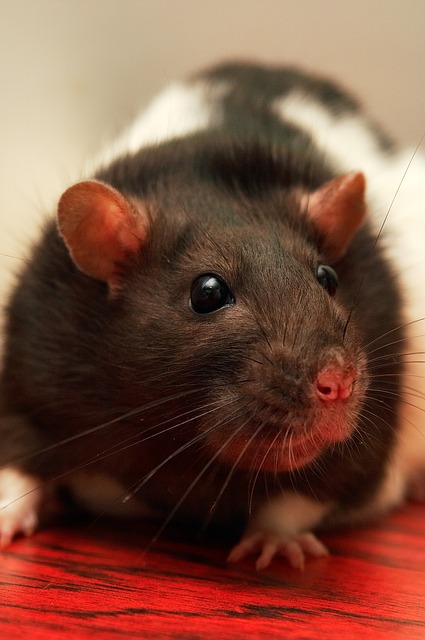
 Rat bite fever is a bit of a niche disease but one that I talk about a fair bit because it’s often missed, or at least diagnosed a lot later than it could (and perhaps should) be. It’s not an issue with technology or testing – it’s an issue of human behaviour and failing to
Rat Bite Fever in the US
 Rat bite fever (RBF) is an uncommon disease in people, but one that I nonetheless spend a lot of time talking about with owners, veterinarians, and physicians (and sometimes lawyers). It’s a bacterial infection spread by (you guessed it) rats. The causative agent of RBF is an obscure bacterium called Streptobacillus moniliformis, which lives
Rat bite fever on Vancouver Island, Canada
 When I talk to veterinary and public health audiences about zoonotic diseases, I often talk about rat bite fever because it highlights some common issues that are important to keep in mind.
Usually, I start by presenting a case of a child with a fever and rash.
Then, I mention that someone finally asked about
Rat bite fever death
 A recent rat bite fever death in a six-month-old Pennsylvania baby raises several issues that parents need to consider.
The child died of meningitis and myocarditis (inflammation of the heart) caused by the bacterium Streptobacillus moniliformis. This bacterium is present in the mouths of virtually all rats, and is the cause of rat bite
PetSmart employee worried about rabies after rat bite
 As reported on WKTR NewsChannel 3 in Virginia:
“An employee at PetSmart [in Williamburg, Virginia] says she was bitten by a rat on display and is now worried she has rabies. She feels the store isn’t doing enough to help her find out if she has it.
Victoria Verbeeck says she was working at the
Rat bite fever…who’s to blame?
 A couple months ago, I wrote about a family suing PetsMart over a case of rat bite fever in a child.
Now, a San Diego family is suing PetCo after their ten-year-old son died of the same infection. Rat bite fever is a bacterial infection caused by Streptobacillus moniliformis, and it is almost
Rat bite fever…who’s liable?
 A Colorado family is suing PetsMart and a rat supplier after their son developed rat bite fever (RBF), following a bite from a newly acquired rat. Lawsuits seem to be increasingly common after zoonotic infections, which is probably more of a reflection of an increasing tendency for people to sue, not an increasing occurrence
Rat bite fever info sheet
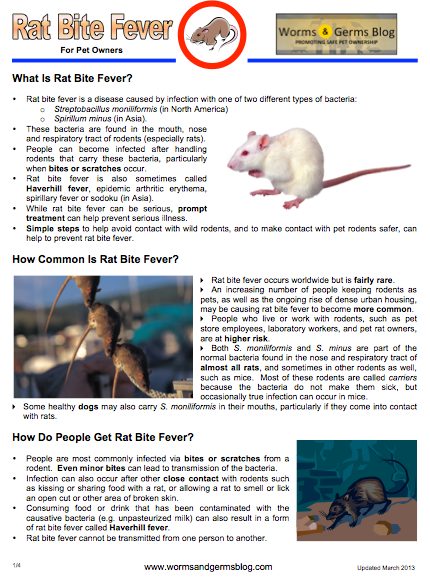
The latest Worms & Germs info sheet is about rat bite fever. It’s available by clicking here, and you can also find it along with all of our other info sheets on the Worms & Germs Resources – Pets page.
Rat bite fever in a person with HIV/AIDS
 A recent report in the journal Infection (Chean et al. 2012) describes rat bite fever in a patient with AIDS. I’ve written about rat bite fever before, and it’s not really a surprising case report. Streptobacillus moniliformis, the bug that causes the disease, is found in the mouths of most rats (and
Another rat bite fever warning
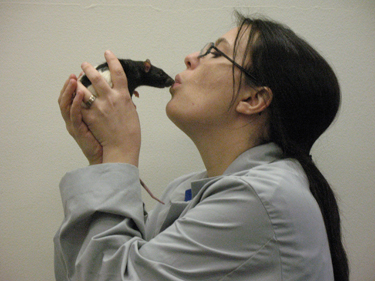 A case report in the Medical Journal of Australia (Pananicolas et al 2012) describes a case of rat bite fever and comes with the typical warning about this uncommon but concerning disease.
Rat bite fever is an infection caused by the bacterium Streptobacillus moniliformis (the main cause in most countries) or Spirillum minus