I periodically get calls from concerned veterinarians (none recently from Ontario, thankfully) along the lines of “We did surgery on a dog with a liver mass that was diagnosed as Echinococcus multilocularis (EM). What is the risk to the staff and what do we do to decontaminate the clinic?”
Depending on how well I know the veterinarian (and my mood), I sometimes start my reply with “Unless your staff are secretly canids AND snacked on the dog’s liver, everyone will be fine.”
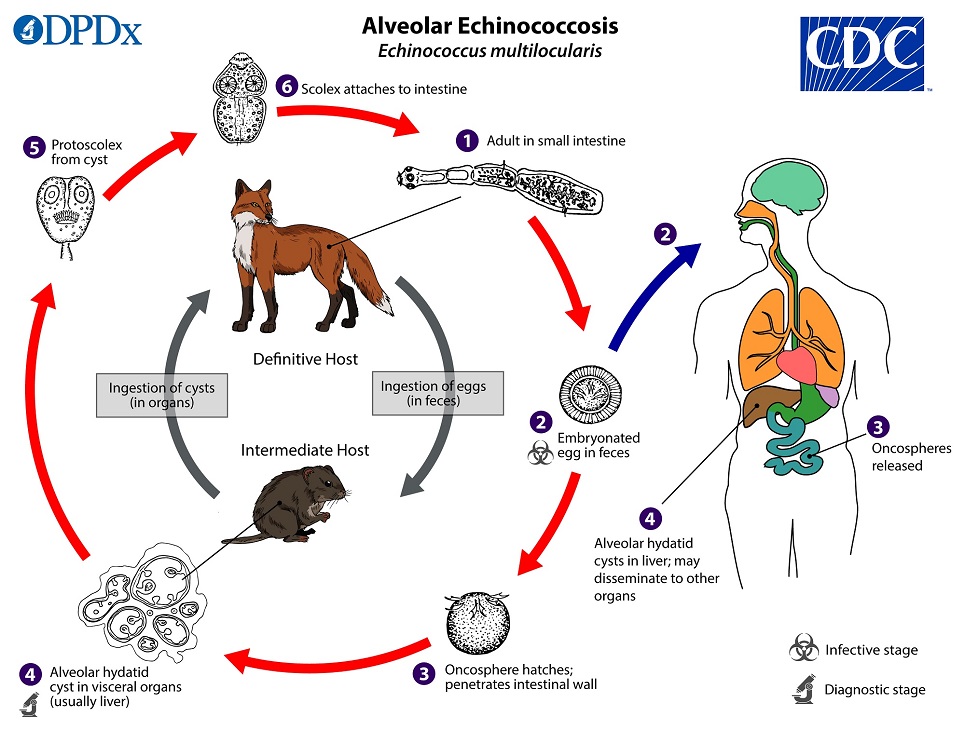
The reason for this is based on one key aspect of the biology of EM: infection in dogs can occur from two different life stages of the parasite. (For more basic background on EM (aka the fox tapeworm), check out our Worms & Germs Echinococcus infosheet, or the Ontario Animal Health Network EM infosheet).
Dogs are primarily definitive hosts for EM:
- As definitive hosts, dogs harbour adult worms in their intestinal tract, which are effectively harmless to the dog (they are very tiny!), but result in parasite eggs being passed in the dog’s feces, which are infectious to other animals, including people.
- This form can also occur in other canids (e.g. foxes, coyotes) and rarely in cats.
- Dogs get this form of infection by eating an intermediate host (usually a rodent) that was harbouring immature tapeworms in the form of cysts its body (known as alveolar echinococcosis (AE).
Sometimes dogs develop alveolar echinococcosis, which is the form of EM infection typically seen in intermediate hosts:
- Intermediate hosts develop AE after ingesting E. multilocularis eggs from feces of a definitive host.
- The immature form of the parasite migrates through the body and ultimately forms large budding cysts, most often found in the liver, that can spread like a malignant tumor. The disease can be fatal.
- AE can occur in a wide range of species, including people.
It is relatively unique that dogs are a definitive host but they can also develop the intermediate host form of the infection, and that’s where the confusion typically lies. Only one form poses a risk to people.
- A dog with intestinal infection sheds tapeworm eggs in feces which are infectious to people and other animals that ingest the eggs.
- The AE form is only infectious to other definitive hosts (generally dogs and other canids) and only if they eat parasitic tissue from the dog. A person could snack on a raw sample of that dog’s liver and they’d be fine (at least in terms of the parasite, but still… yuck).
We can’t say dogs with AE are completely zero risk, because if the dog has been exposed to EM eggs, then it’s also possible the dog could have ingested an infected rodent with the intermediate form of EM in the same area, and may therefore have a concurrent intestinal infection. We really can’t say zero risk for shedding of EM eggs in any dog that lives in an endemic area (including southern Ontario) and spends time outdoors (because dogs will be dogs…). The fact that the dog has AE doesn’t influence that risk or make it higher risk than any other local dog.
We often test or empirically treat dogs with AE with praziquantel (an anti-tapeworm drug that is effective against the adult worms only) out of an abundance of caution, but other dogs from the same area (and with the same lifestyle risk factors, like catching rodents) are likely at just as much risk.
So… if you’re in contact with a dog with AE, relax. If you’re in contact with a dog with intestinal EM infection that may be shedding parasite eggs, then don’t eat poop and you’ll be fine. In Ontario, EM (in any form) in a definitive host (i.e. cat or dog) is immediately reportable to the local public health unit, and they will assess the risk to anyone who has been in contact with the dog (or its feces). Understanding and differentiating the different types of infections, how they occur and the different risks they pose is a key aspect of EM control and communication.
Life cycle diagram below from US CDC DPDx website.