
Short answer? I don’t know (but probably not, and it could potentially harm).
I get asked a lot about splitting vaccines, meaning not giving combinations of vaccines at the same visit. Often, it’s about small breed dogs, as those are more prone to adverse events from vaccination. Sometimes it’s because of owners that are concerned about adverse events or dogs that have previously had a vaccine reaction.
The theory is that less antigenic stimulation would lead to a lower risk of adverse events.
On one hand, that’s true. Data from a really large study of vaccination (Moore et al 2023) adverse events in dogs showed that as you add more vaccines, the adverse event rate goes up.
See the graph below from that paper.
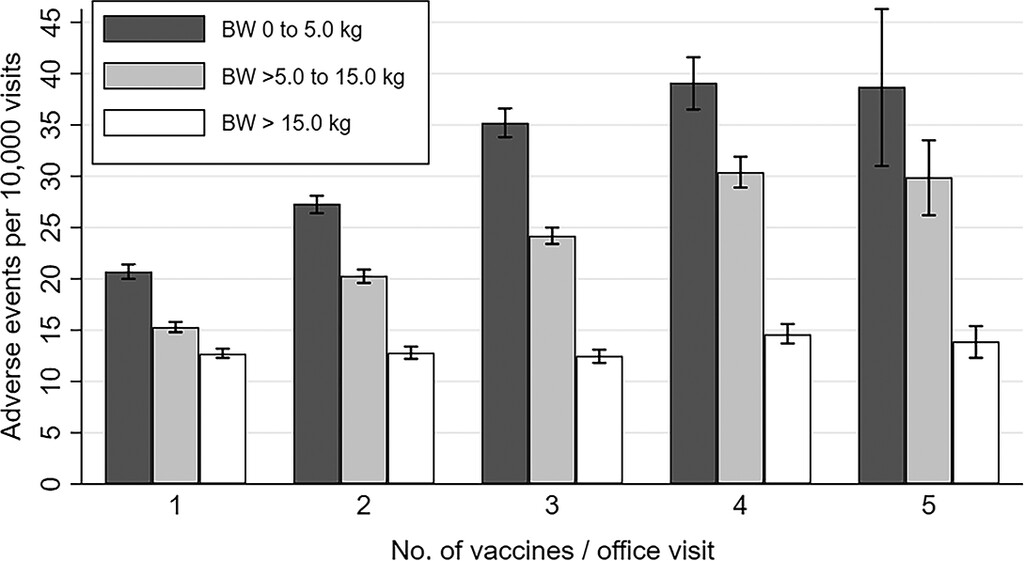
So, why do I say I don’t know?
It’s because we have to think about the dog, not the single vaccination event.
If we give only one vaccine today, we have a lower risk than if we gave two. However, if I still want to make sure that dog gets the 2nd vaccine, I need to vaccinate it again. That’s another vaccination event that comes with its own risk of adverse events.
Looking at the numbers from the graph above, let’s spitball a scenario with a small breed dog that is due for DAPP (distemper, parvo) and rabies vaccines.
- That’s two vaccines, so if we look at the figure (admittedly it’s crude data but it’s the best we have), the risk of an adverse event would be roughly 27 per 10,000.
- If we only gave DAPP today, the risk would be lower, at around 21 per 10,000.
- But this dog still needs a rabies vaccine. So, we’re going to bring it back later for that vaccine. That means we have another day with a 21/10,000 risk for an adverse.
If we look at the risk on a single vaccine day, the risk is lower: 21 vs 27/10,000.
However, if we look at the risk to this dog, its cumulative risk over two separate vaccination events would be 21+21= 42/10,000, higher than if we’d given them both at once.
How solid are these numbers?
It’s hard to say…the data are crude but they are the best we have. It makes sense, though. Splitting vaccines would have to drop the risk by at least 50% to achieve a net benefit when we have to add extra vaccination events. That also doesn’t consider the added stress, hassle and normal general malaise you can get after vaccination.
I got flu and COVID vaccines at the same time this year. I did that on purpose since I figured I’d rather have one episode of having a sore arm and maybe feeling crappy than two. The same applies to our canine patients, I assume.
It’s not that there are no valid reasons for splitting vaccines. It’s possible that some dogs that are particularly reactive to vaccines would benefit more. We don’t know.
The main benefit of splitting vaccines is to understand what vaccine a dog is reacting to, if they have a reaction. If I give DAPP one day and the dog is fine, then follow up with rabies vaccine and the dog has a reaction, that suggests we have to focus on issues with rabies vaccine. It’s not a guarantee since many vaccine reactions are just random, non-repeatable events that don’t indicate longterm risk, but it can be useful.
So, split away if you want, but realize that’s it’s a bit more complicated than it might seem at first glance. We might not be reducing the risk to the dog, and we may actually be increasing it.