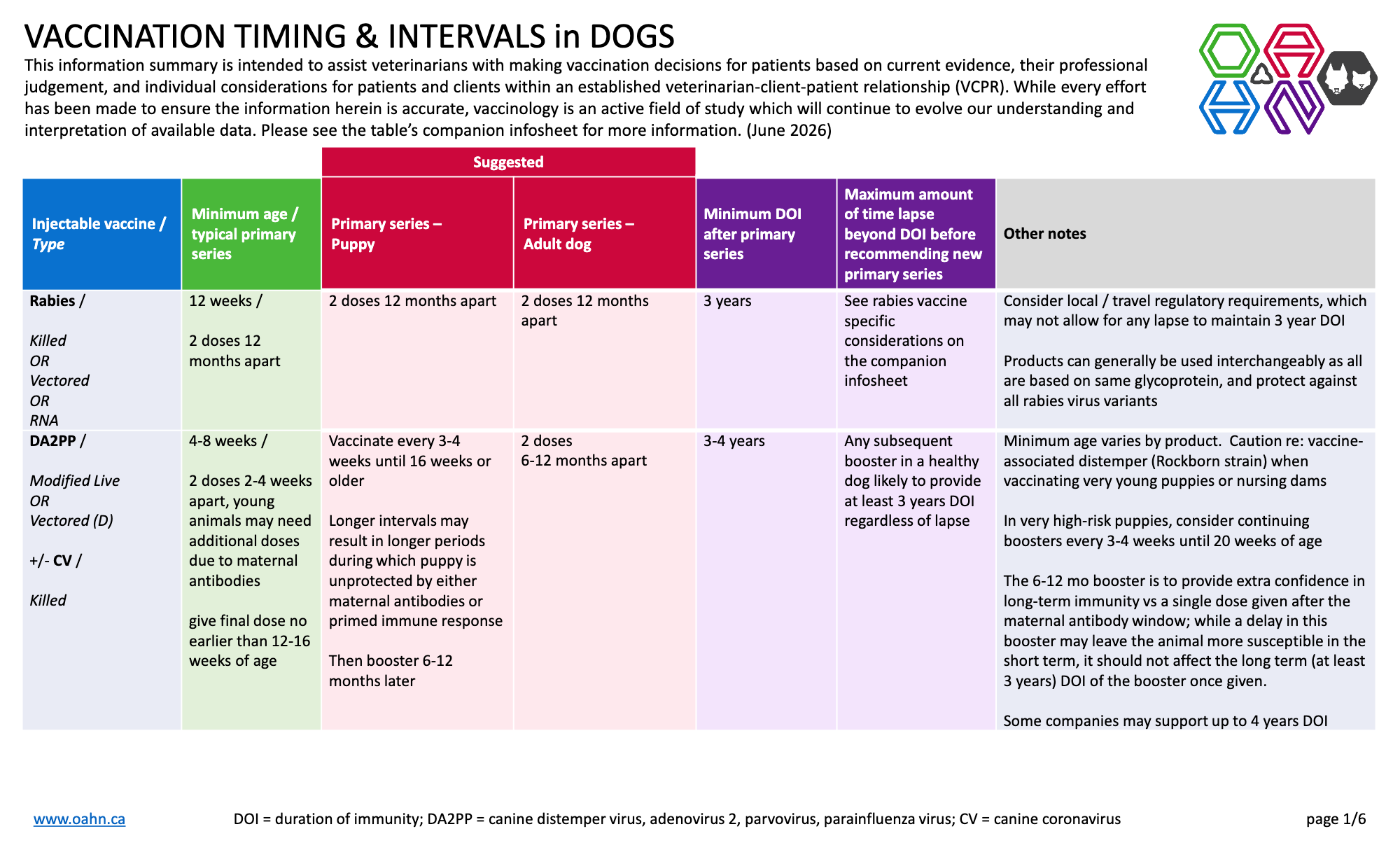
Let’s face it, approaches to vaccination in companion animals are based partly on direct evidence, partly on extrapolation from other species, partly on expert opinion, and partly on “this is what we do because it’s what we’ve always done.” The evidence base for much of what we do is incomplete, and for a lot of things the evidence base is actually sparse to non-existent. We typically have good basic information about most of our vaccines and what happens with them in the specific “textbook” scenarios, but we also need to know what to do when animals and owners don’t follow the textbook (which happens a lot).
Label instructions on vaccines have traditionally described those ideal / textbook scenarios, but more recently they are getting much less specific. That’s useful in some ways, because it provides room for flexibility and gets away from rigorous, dogmatic approaches, but it doesn’t necessarily help someone know what to do instead.
That’s where veterinary vaccination guidelines can be useful too, and these have been critical to the advancement of preventive care over the years, but they also need to evolve. Current veterinary vaccination guidelines have a lot of recommendations that aren’t supported by any data, but sometimes we have to make recommendations even when we have very little evidence. More recent approaches to guideline development use rigourous evidence synthesis (to make sure we are basing decisions on what’s known, not just the parts we like) and provide insight into how certain we are about each recommendation: Some recommendations are very clearly evidence-based and solid; many are reasonable but not strongly supported by evidence; some need to be rethought altogether. If there’s no transparency about what we know versus what we think versus what we’re guessing, it can lead to confusion and other issues (like guesses being treated as fact).
- That’s me wearing my guideline methodologists hat, but I’ll take that off now, since I’m about to make some recommendations without that degree of evidence synthesis and structured decision-making process. It’s a blog post, after all. But hopefully it might entice some of the groups that make those guidelines to evolve.
Today I’m going to tackle what to do with pets that are overdue for their scheduled vaccine boosters. (I’ll try to cover some of the other scenarios in subsequent posts – this one will be long enough as it is!) Vaccines usually have recommended re-dosing intervals. In the past these have typically been very specific (e.g. every 12 months), but the trend is now toward much looser statements. For example, one Canadian canine vaccine label now reads “Historically, annual revaccination with this product has been recommended. The need for annual booster vaccination has not been established for this product. For advice on revaccination frequency, consult your veterinarian.”
Here’s an example: An 8-year-old Bichon (let’s call him Teddy) was vaccinated as a puppy, and then got core (distemper, parvovirus) and rabies vaccines at approximately 1 year of age, and then again 3 years later (around 4 years of age). He was due for re-vaccination a year ago (7 years old). Teddy was also consistently vaccinated against leptospirosis every year, but missed that one last year too.
What do we do with Teddy?
- To be honest, my thoughts on this have evolved as I’ve put more time into looking at evidence and thinking about vaccination. I’ll admit I had a lot of ingrained approaches that were based on historical norms and not data and evidence. Changing behaviours is hard for people, and even I’m not immune to that, but we have to evolve.
A common response to this scenario would be to say that Teddy is well overdue for everything, so we need to restart all of his vaccine “series,” meaning a dose now and (for some of the vaccines) as booster in a few weeks. But that doesn’t make sense to me immunologically. Most (not all) of our canine vaccines are quite good at what they do, and the immune system of most animals has an effective long term memory. While protection against some diseases may wane over time (which is why the boosters are still needed), the ability to respond well to a booster vaccine often endures for much longer (a concept sometimes referred to as boostability).
In human medicine, there are very few situations where it is recommended to restart a vaccine series, and none of them apply to the kinds of vaccines we use in dogs and cats. If a person misses their scheduled booster and is overdue – whether by a day, a year, or 10 years – the recommendation is typically to simply revaccinate them. According to the US CDC guidance on Timing and Spacing of Immunobiologics: “Vaccination providers should administer vaccines as close to the recommended intervals as possible. However, intervals between doses that are longer than recommended typically do not reduce final antibody concentrations, although protection might not be attained until the recommended number of doses has been administered. With some exceptions (e.g. oral typhoid vaccine) an interruption in the vaccination schedule does not require restarting the entire series of a vaccine or toxoid or addition of extra doses.”
So for Teddy, I’d recommend simply revaccinating him as usual, with the exception of the rabies vaccine… That exception is due to regulatory issues around rabies vaccine, because regulators don’t like to take any chances when it comes to very deadly zoonotic diseases (which is somewhat understandable).
- Rabies vaccine works very well, and many animals respond extremely well to a booster vaccine even if they’re overdue by several years (Moore et al. 2015), but it’s impossible to know (in advance) which animals will and which won’t respond well to a booster, or how long an animal may be protected beyond what has been tested by the vaccine manufacturer. But even rabies vaccines labels have become less prescriptive; for example, one such label now says “Duration of Immunity is at least 3 years after a repeat dose” but does not specify an interval for the repeated dose.
- A pet’s rabies vaccination status therefore impacts what happens if that animal is potentially exposed to rabies. Different jurisdictions have different rules about this; Ontario’s rabies management guidelines for domestic animals are one example. If an overdue dog like Teddy was revaccinated today, I would have absolutely no concern about the dog being protected for at least the next 3 years, but some regulators would only consider that booster valid for 1 year. So if Teddy was exposed to a bat or an abnormal raccoon 18 months from now, that could mean a long confinement period (instead of easy observation).
- Knowing what the rules are in your local area is important. Some jurisdictions now may worry less about the previous vaccination intervals (but knowing the pet has had previous rabies vaccines at some point), and focus mainly on the interval from the last dose (e.g. within 3 years). Some will accept a 3-year duration of immunity if there are only short lapses in the history (e.g. as long as the dog was boostered within 3 months of when it was due). Some remain very strict, meaning as soon as a pet is overdue, it’s next rabies vaccine is only good for 1 year, and only after getting another booster within 12 months can the pet go back on the 3 year revaccination schedule. While it could be helpful for regulators to have some more flexibility, “regulation” and “flexibility” are difficult concepts to marry along with “consistency”.
- Animals that travel overseas may encounter the strictest rabies vaccination requirements. Border authorities may look very closely at vaccination history, any lapse in vaccination (even by a day) could invalidate a claim to a 3 year duration of immunity (meaning if it’s been more than 1 year since the pet’s last vaccine, it will be stopped at the border).
Knowing what rules may apply to a certain pet (based on where it lives or where it may travel) is key. If in doubt, I’d revaccinate Teddy now and give a booster in a year, even though it’s likely overkill for many pets (but better than a rabies quarantine or interrupting the owner’s vacation plans).
Even if we get veterinarians (and owners) on board with the immunological basis for not needing to restart vaccine series in overdue pets, some veterinarians will still worry about liability and vaccinating “off label.” But consider that giving a single dose now is no more off-label than restarting a series, because neither of those scenarios is described on the label (or even in the R&D from the vaccine manufacturer). Yet we convince ourselves that the historical norm (e.g. what we did before, as per the label) is the safer / better approach, but we don’t know if that’s actually true.
For me, at this point, overdue animals are easy: Vaccine them as you normally would, but also think about (and discuss with the owner) if the pet might run into any regulatory issues if it’s not revaccinated again in 1 year (instead of 3 years).
I’ll be a little more concise (I almost promise) when I cover other vaccination scenarios (stay tuned). For more information (and a sneak peak of what’s to come), check out the new paired resource from the Ontario Animal Health Network (OAHN): Vaccination Timing and Intervals in Dogs and Cats (infosheet and infotable). If you don’t have an OAHN login, veterinarians and RVTs can sign up for free.