A new canine importation checklist infographic for veterinarians has been released by the Canadian Veterinary Medical Association. English and French versions are below.  To download the pdf files, use the links at the bottom of the post.  While intended for veterinarians, the checklist would also be useful for rescues and other organizations (or even individuals) that are involved in the movement of dogs, particularly across borders.

English pdf: CVMA_CanineImportChecklist_FM_05-28-18

French pdf: CVMA_CanineImportChecklist_FR_FM_05-28-18

By Dr. Michelle Evason, University of Prince Edward Island

We’re all worried about ticks. Ticks on dogs, ticks on cats, ticks on horses and ticks on us. The reason for this concern is twofold: no-one wants to get sick (or have a loved one get sick), and ticks are quite simply “gross.” In dogs and cats, tick and subsequent disease prevention consists of two major agreed upon components: 1) tick checks, and 2) veterinary approved tick prevention products applied properly (and consistently, i.e. on schedule) to prevent ticks from transmitting disease.

For the first of these, while we all know we SHOULD do tick checks on our pets… Practically, it’s TOUGH to do tick checks on dogs (not to mention cats) and even harder to do so consistently. For example, we own two large breed, long-haired (ridiculously spoiled) dogs who regularly join me on runs through the woods. All three of us come home from these bursts of nature filled joy covered in the evidence of Atlantic Canada’s booming baby (nymph) and adult tick population, mainly Ixodes scapularis. Although I try hard to practise what I preach (i.e. do the tick check!), it is next door to impossible to pick through one (let alone two) long-haired dogs’ fur or find the time to do so while keeping all of life’s various trains running, e.g. kids to school on time, holding down a job, etc. As such, articles on practical and timely ways to help locate tick attachment “hot spots” in order to remove them from pets are welcome additions to the scientific literature.

Ticks can be even harder to find when they are “babies,” immature or in the nymph stage – especially for those of us who own long-haired or dark-coated animals. This group of researchers from the UK reviewed over 450 records from dogs and over 100 records on cats (the bulk (>60%) submitted by veterinarians), in order to determine tick attachment site locations, among other things. On dogs, ticks were found on the following sites about 80% of the time: the head (almost 50%), followed by legs, neck and chest (all close to 10%). Ticks on cats were found in the same locations and with similar frequency (i.e. about 80%): head (43%), neck (32%) and legs (6%). The article also has graphics of locations on the cat or dog’s head where ticks are more often found, e.g. near eyes, ears. etc.

Similar to simple daily hand hygiene practices, small things (i.e. tick checks focused on the more likely (80%) locations) done quickly on a daily basis can help keep us and our beloved pets healthier and happier – and are a vast improvement over not doing any tick checks at all. Not to mention that anything that helps turn what seems impossible task (i.e. a full body pat-down on an active English Setter) into a focused, and more rapid tick check is a helpful resource.

More information about ticks can be found on the Worms & Germs Resources – Pets page or at PetsAndTicks.com

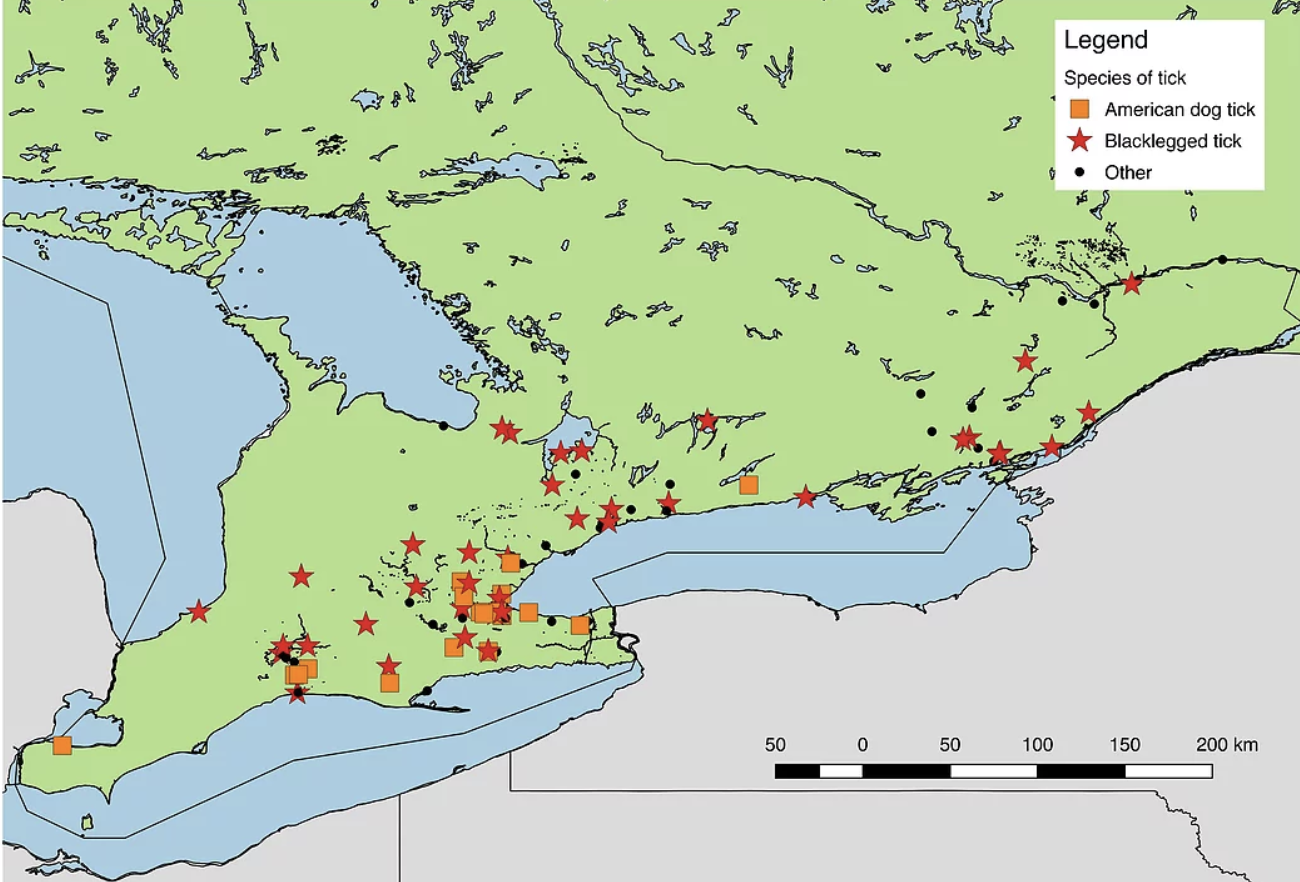
Our first set of tick maps are available at PetsAndTicks.com. I don’t think there are any great surprises so far, but it’s interesting to see where black legged ticks are being reported.

The Ontario map is copied below but the website has maps from submissions from across Canada.

  • To answer a recent question…yes, we accept data submissions from outside of Canada but cannot accept ticks that have to cross the border in the mail. So, feel free to enter tick information from other regions.

More maps (with hopefully a lot more data) will be posted as the year progresses.

Check out the recent CBC news story about the Pet Tick Tracker and how to keep you and your pets safe from ticks and the diseases they carry!  You can read the story here or watch the video here.

Chicago has a city bylaw banning pet stores from sourcing dogs from puppy mills (i.e. selling commercially-bred pets).

So, what’s an enterprise puppy mill owner to do?  Apparently they start a rescue as a way to get their dogs sold instead.

No, they didn’t see the light and decide to get out of the puppy mill business. Rather, they took advantage of a loophole that allows dogs sourced from nonprofit rescues to be sold, even if the dogs are “rescued” from a puppy mill. All they have to do is register a rescue, transfer all their mass produced dogs to the rescue, and then sell them.

It’s creative, I’ll give them that.  It also requires a few pet stores with questionable ethics since they clearly know what’s going on, as they’re getting the dogs from the same source at the same price but under a different name.

This shows how well-intentioned exemptions can create unfortunate loopholes that can utterly undermine the spirit of the original ban.  It also puts a new twist on the whole “rescue” label. It’s no longer enough to say “this puppy is from a rescue.” People need to do some due diligence to make sure the dog really is a rescue and not from a commercial breeder. (Hint: if you’re paying $1000+ for a purebred “rescue” puppy, think twice since someone’s likely making money off that deal.)

From a disease standpoint (I have to get back to that somehow given the nature of the blog), puppy mill dogs imported as puppy mill dogs or rescues carry the same disease risks. If people are worried about the health and welfare aspects of puppy mills, they should be equally concerned about those issues in rescues from puppy mills, especially when purchasing such dogs may be finance puppy mill operations.

A recent report from the Netherlands in Emerging Infectious Diseases (van Dijk et al 2018) describes a new twist on raw feeding concerns, Brucella suis infection.  Here’s the short version of the story:

A dog in the Netherlands developed fever, ascites (fluid free in the abdomen) and inflammation of the testicles.  After failing to respond to antibiotics, it was taken to surgery to be neutered.  In the process, culture samples were collected from the epididymis (tissue adjacent to the testicle) and from the abdominal fluid. Brucella suis was identified in both samples, which presumably caused a bit stir in the lab and the clinic since this bacterium is a rarely identified, can also infect people and is federally notifiable in the Netherlands (i.e. the government has to be contacted when it’s found). Ultimately, the dog was euthanized after failing to respond to further treatment.

Because this is a notifiable disease, there was an investigation. The dog did not have any of the typical exposures that would increase the risk of Brucella infection, such as contact with wildlife or livestock, breeding, or travel to brucellosis-endemic areas.  The dog’s raw, rabbit-based diet that was imported from Argentina therefore became the leading suspected source. Brucella suis was ultimately identified in samples from a 30,000 kg batch of raw rabbit imported from Argentina, a country where B. suis is present.

It’s a single case report so we can’t get too worked up about it, but it’s noteworthy for a couple reasons:

  • Reason 1 is the disease – brucellosis is a nasty. It can be hard to treat, is potentially zoonotic, and sometimes results in public health-mandated euthanasia of the dog.
  • Reason 2 is the importation aspect. The dog wasn’t imported but the bacterium was, via food. We’re trying to increase awareness of the need to query travel and importation history in pets, as it can significantly impact disease risks. Querying diet origins is even tougher.  While most people know where their dog has been in the past few weeks, they may not know much about where their dog’s diet has been. With commercial processed food, it’s not a big deal, but with higher-risk food like raw meat, importing food can be similar to the dog visiting the country of origin, from a disease standpoint. With raw meat, knowing where the meat came from and the disease risks in those areas may be important, but often not easy to find out.

The incidence of disease in dogs and cats associated with raw meat feeding isn’t clear, and is probably low. Nevertheless, I recommend avoiding raw meat feeding, especially in  high risk households (e.g. with elderly individuals, kids less than 5 years of age, pregnant women or immunocompromised individuals). However, if raw meat is to be fed, some basic precautions can used to help reduce the risks.  For details, see the raw meat infosheet on the Worms & Germs Resources – Pets page.

The latest IDEXX Laboratories maps and case list are below. Canine flu continues to cause problems in some parts of the US, and is spreading in some states. California and Nevada have had active flu for a few months, but it may be abating. New clusters are popping up in other areas, most notably in Brooklyn, NY. Whether that’s a small contained cluster or the sign of a new large outbreak (especially considering the number of dogs in that area) remains to be seen.

The Canadian situation has shown what can happen with good surveillance and infection control (or, I guess, despite that, with some good luck). Regardless of the result, our flu outbreaks have been confined and as far as we can tell, canine influenza has been eradicated in the country, since we have seen no new cases for a period well beyond the incubation and shedding period for this virus.

If you’d asked me a few years ago, I wouldn’t have said that’s a question I’d expect to get (daily). However, we’re in a different world tick-wise now, so it’s a common and understandable question, particularly because of our tick tracking efforts.

  • The answer is no/possibly/maybe later.

How’s that for a straight answer?

We are not testing all ticks that we get through tick tracker submissions, but we will be testing some for specific reasons not related to patient health.  It’s important to understand why we don’t test for the sake of the patient.

For a dog (or person) to get Lyme disease, several things all have to happen:

  1. It has to be bitten by a tick.
  2. The tick has to be a species that carries B. burgdorferi, the bacterium that causes Lyme disease.
  3. The tick has to actually be infected with the bacterium.
  4. The tick has to be attached long enough to transmit the bacterium during feeding.
  5. The bacterium has to escape the immune system and cause an infection.

We cover #1 and #2 with our tick tracking. If the tick isn’t a black legged tick, then Lyme disease isn’t an issue (and testing the tick for that bacterium makes no sense).

If it is a black legged tick, does testing of the tick help?

  • Not too much.

A positive test from a tick means that the tick carried the bacterium. It still had to be transmitted to the bitten individual and it had to escape the individual’s host defenses. That obviously happens in some cases, but in dogs, it’s estimated that Lyme disease occurs 5% of the time, or less, when an infected tick has been attached long enough.

A negative test means the tick was probably negative. However, if the dog was exposed to one tick that was tested, it’s reasonable to assume that there may have been undetected ticks too.

The most important things are:

  • Was it the right tick species?
  • Is Lyme disease endemic or emerging in the area where the dog picked up the tick?
  • Was the tick attached long enough to transmit B. burgdorferi if it was infected?

If the answer is yes to all of these, then there’s risk. Testing the tick provides more information, but it doesn’t change what we do. Post-exposure prophylaxis is something that is done in people in certain circumstances, particularly when the answer to the 3 questions above is “yes” AND the tick was removed within the past few days. Tick testing isn’t necessarily that quick, dogs are less likely to develop disease than people after exposure and we have no evidence regarding whether prophylaxis is useful in dogs.

So, my approach to finding a tick, from a clinical standpoint, is to:

  • Emphasize the need for good tick prevention in the dog
  • Emphasize the need for Lyme disease awareness

Testing doesn’t change what I do to manage a canine patient. However, it can be useful from a research standpoint to let us know about infection rates, what other pathogens might be present, the strains of Borrelia that might be involved, and similar (often poorly investigated) areas).

Tick testing is available commercially but I don’t recommend it because it doesn’t change what I do.

  • If the tick was positive, I’d say “you need to do good tick prevention” and “you should be aware of Lyme disease” and “we need to consider Lyme disease if your dog develops signs that could be consistent with that disease.”
  • If the tick was negative, I’d say “that tick was negative, but what about any others?” Then I’d say “you need to do good tick prevention” and “you should be aware of Lyme disease” and “we need to consider Lyme disease if your dog develops signs that could be consistent with that disease.”

Since it’s the same answer in either case, there’s not a lot of use for routine testing, from my standpoint.

So, keep the tick reports coming to our tracking site at PetsandTicks.com and feel free to send any to us for identification (as described through that site). However, don’t expect routine testing for Borrelia since it won’t change what we recommend for your dog.

As part of our recently launched PetsAndTick.com information and tick-tracker website, we are offering a pilot tick identification program.

We will be offering identification of ticks that are removed from animals (non-human animals, to be specific). The program will complement our tick-tracking efforts and help gather more information about expanding tick ranges and incursions of new ticks within Canada.

Some disclaimers:

  • We can only accept ticks from Canada. (Importing foreign ticks without a permit wouldn’t go over well.)
  • We cannot pay for shipping. We are doing this with no funding so we will try to identify any ticks that show up, but we cannot pay to get them here.
  • We will identify ticks (e.g. by genus +/- species), but testing of ticks for tick-borne pathogens or provision of medical advice is not part of the program. We are always happy to work with veterinarians on tick-borne disease cases or tick exposure issues, but we cannot offer medical advice directly to pet owners.
  • We’ll be as quick as we can, but there’s no guaranteed turnaround time.
  • We won’t be doing this forever. We will indicate on PetsAndTicks.com when we are planning to stop the program when we get close to that point.

Disclaimers aside, we encourage pet owners to submit ticks.

Submission information for tick identification can be found here.

After a particularly miserable spring here (to put it mildly), it’s finally warming up, and the snow’s almost gone. That’s the good news. The bad news is that ticks are also going to start coming out and looking for food – that means looking for animals (including us).

I assume there will be lots of tick posts on this site over the next few months. That’s for good reason, since tickborne diseases are an important topic and the risk of tickborne disease exposure continues to increase in many areas.

To help increase tick awareness and surveillance, we’ve launched a companion site: petsandticks.com. This website will (surprise, surprise) focus on ticks, and has a re-tooled version of our PetTickTracker that was originally launched in May 2017. The new tick tracker has an easy  online submission process and we’ll hopefully soon have more real-time plotting of tick tracker results on the map.  You can also still access last year’s PetTickTracker maps by clicking here.

I’ve been holding off saying “it’s gone” but based on all the information we have at the moment, there’s no evidence of ongoing canine flu activity in Canada, at least for now. No new cases have been identified in a few weeks and we are now beyond the 28-day recommended quarantine period for all of our known cases.

We can never say with 100% certainty that there are no cases left in Onatrio, since not every sick dog gets tested. However, it looks like the clusters we’ve been tracking and containing have been controlled.

There is still a lot of canine respiratory disease activity in the province though. Most of this is probably due to canine parainfluenza virus (a completely different virus), which isn’t surprising since it’s our main cause of infectious respiratory disease in dogs in this region. It complicates flu surveillance, since paraflu (and a few other respiratory pathogens) cause disease that’s indistinguishable from influenza. That’s why we’re still continuing surveillance in some areas, and we need to stay vigilant.

While we may have successfully contained these clusters of canine flu (a pretty impressive feat, actually) there is ever-present risk of new introductions of the virus from imported dogs. Large numbers of dogs continue to be imported from areas in Asia where canine flu is rampant. There’s also risk from dogs from some regions of the US, as canine flu continues to circulate in some parts of that country.

I think this shows what the combination of good communication, good surveillance, a quick response and responsible owners and veterinarians can achieve. Whether it’s flu or something else, these simple factors can be the key to effective control of infectious diseases. We presumably haven’t seen the last of canine flu, but we’ve learned a lot about how to control it (and other diseases).