
I remember the first case of fly myiasis (aka fly strike, maggot infestation) in general practice. I was a very new grad called to look at a lamb owned by someone who had a few sheep. The complaint was that the lamb wasn’t doing well. It was laying down when I arrived and I grabbed it’s back… and immediately off came a big patch of skin, revealing hundreds of maggots underneath, and a smell that you never forget.
The owner threw up. I fortunately managed to avoid doing the same, but we euthanized the lamb. That wasn’t even a case of New World screwworm (NWS), but provides some idea of what these infections can be like – gross, potentially devastating, and not something we want to see in any animal (or person).
New World screwworm 101
New World screwworm myiasis is caused by the larvae (maggots) of a particular species of fly (Cochliomyia hominivorax). It’s estimated to cause billions of dollars in loses in livestock production, unquantified impacts on companion animals and wildlife, and hundreds of human infections each year.
This image illustrates the general life cycle of NWS:
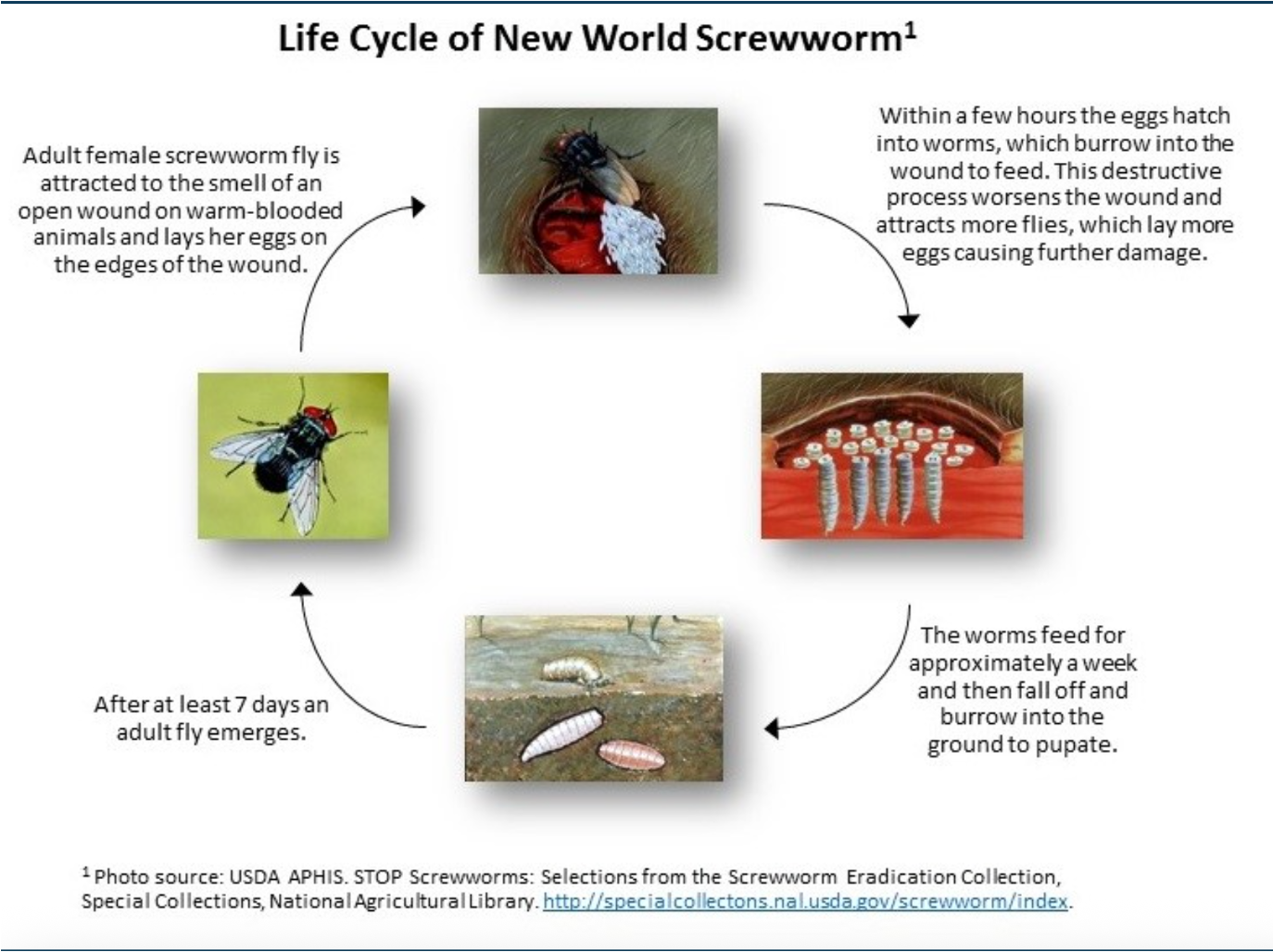
The adult fly is attracted to wounds or even minor skin lesions on warm blooded animals (i.e. mammals and birds). It doesn’t need to start out as a big wound wound or an infected wound, although those kinds of breaks in the skin provide a much larger target for the female flies, and that is where they lay their eggs. When the eggs hatch, the larvae (maggots) burrow into the tissue, causing lots of damage as they grow. Unlike “regular” maggots from other kinds of flies that only feed on tissue that is already dead / necrotic, these maggots will destroy previously healthy / living tissue, so they can cause a lot of damage, and the infection can even be fatal. After a week or so, the larvae drop out of the wound and finish maturing in the soil, emerging as new adult flies. The wounds they leave behind can be very painful, and can be prone to secondary bacterial infections too (not to mention being attractive to more adult screwworm flies).
A couple of pictures from the USDA-APHIS NWS photo gallery illustrate just how devastating these infections can be:
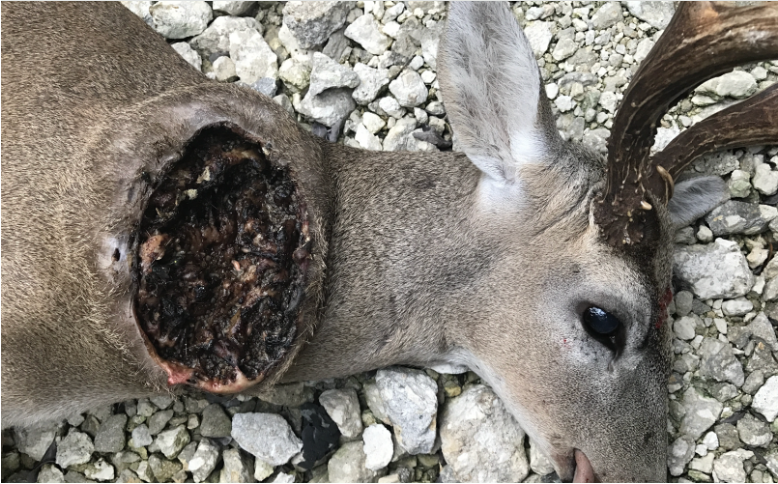

For decades beginning in the 1950s, massive efforts were undertaken to eradicate NWS from the Southern US, Mexico, and Central America. The eradication programs relied heavily on the release of millions upon millions of sterile male screwworm flies. As a fortunate happenstance of this fly’s biology, females only mate once in their lifecycle – if they mate with sterile males, they lay sterile eggs, and there are no maggots or new adults produced. While it still took a lot of hard work, this technique was highly effective, and NWS was gradually pushed all the way back to Panama. The fly remains endemic in South America, and unfortunately eradication there isn’t likely achievable because the fly’s range is so large and much of the area is very remote. So there is always the potential for NWS to re-invade Central America (or to be imported via people, animals or products) and begin to move north again, which appears to be exactly what’s happened. Starting in 2022 it was detected again in Panama, and has now come within a few hundred kilometers of the Mexico-US border.

Having NWS once again so close to the US border has caused a lot of concern, as it’s estimated that re-establishment of NWS in the US could result in economic losses of close to $2 billion in Texas alone. The US has initiated more surveillance, increased border controls (including bans on livestock importation from at-risk areas) and is significantly ramping up sterile fly production. Cattle producers have also asked for permission to feed ivermectin (an anti-parasitic) to their animals as a preventative control measure.
- While ivermectin and some other drugs can be given prophylactically to help prevent myiasis, injectable or topical treatment of individual animals in extremely large herds is logically difficult, so that’s why daily in-feed treatment has been discussed. While it could be effective for NWS, it also brings up potential for development of resistance issues in other parasites… but that’s a topic for a different day.
A silver lining to Canadian winters
However, it’s one of these things that should be aware of in Canada but fortunately don’t have to be too concerned about because of our climate.
While we sometimes complain about the cold weather in Canada, a cold climate helps us avoid a lot of infectious disease risks, particularly where insects are involved. We are well outside of the plausible geographic range for this insect, even with a changing climate. It can’t survive our winters, or even most of our springs and falls. Development of the larvae in the soil is slower the colder it gets, and when the temperature drops below ~8C, larvae in the soil die. Of course we have periods of the year when these flies could successfully reproduce here, but it would be limited, local transmission that would end with the first cold snap. It won’t be able to establish itself here long term.
But we still need to be aware of the problem given the amount of people and animal movement between Canada and some of these affected areas, especially if it reaches the southern US again. The potential impacts on individuals animals and even short-term local transmission during warmer months (which could be long enough to see several generations of flies) should not be ignored. If a cow in Ontario got infected in early summer, there could be transmission to other cattle on the farm, other species on the farm (including people and pets) and spread to wildlife. They could do a lot of damage before the cool fall weather finally stops the fly’s lifecycle again.
While the focus of attention regarding NWS is on Central America and South America, it’s also endemic in some Caribbean countries (e.g. Jamaica, Cuba, Dominican Republic), and we import lots of dogs from those areas, so the potential for an infected dog to reach Canada is very real. If an infected dog or other pet was imported into Canada, the odds of further transmission are likely limited, since a veterinarian would hopefully see and treat the animal before it could seed the environment with maggots, but it’s not impossible. The more important concern in these cases is the health of the individual infected pet, because of the tissue damage these maggots can cause if the infection is not identified and addressed immediately.
What Canadian veterinarians and animal owners should do
Just being aware of the risk of NWS is a good start. It’s unlikely any given veterinarian or animal owner will see an infected animal here, but all it takes is one to be an issue, so we want to maximize our ability to detect and respond quickly and efficiently.
Addressing health problems in recently imported animals is important for many reasons, and this yet another one. If we identify infested animals early, we can manage them better, both to reduce the risk of severe disease and to prevent transmission (i.e. not letting any larvae make it to the soil).
Flagging importation history is the key. Too often, we have animals with health problems and we don’t find out relevant importation history until later in the course of disease. Owners of recently imported animals should have a low bar for seeking veterinary care if there are any issues. Ideally, we’d see every imported animal shortly after they arrive, to give them a good health check and review vaccination and other preventative care needs.
If maggots are found on an animal imported from an area endemic or at risk for NWS, larvae should be removed immediately, placed in ethanol to kill them (NOT thrown in the garbage or on the ground outside!) and they should be submitted for identification via the Canadian Food Inspection Agency (because NWS is a federally immediately notifibale disease in Canada, and is also notifiable to provincial health authorities in some provinces). Physical removal of as many maggots as possible is the mainstay of treatment, though anti-parasitics are often used in parallel to try to kill any deeper embedded larvae. Significant wound care may be required, depending on the location and severity of infection.
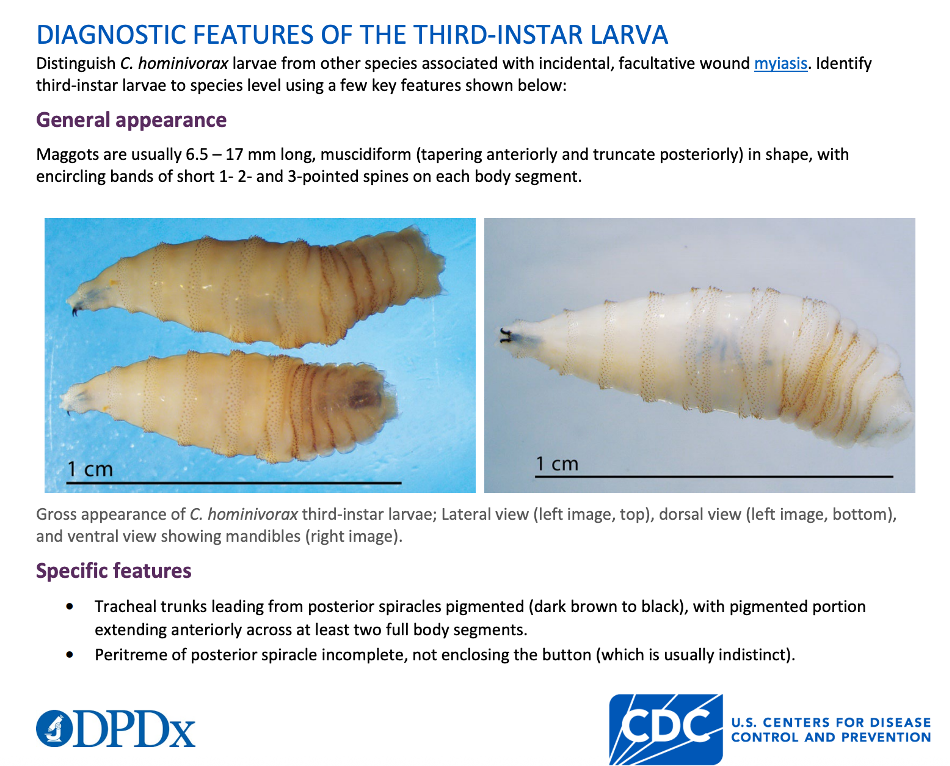
These larvae can also infect humans, as I mentioned briefly above. In Canada, it’s a travel-associated disease, a case of NWS was reported earlier this year in Ontario in a patient who had recently travelled to Costa Rica. As with many infectious diseases, the key is basic awareness.