After being a relatively rare problem in most regions over the past few years, West Nile virus (WNV) case numbers have boomed lately, with large outbreaks in some US states.

Canada

Forty-nine (49) confirmed or probable human cases have been reported in Ontario, the largest number in a decade. Considering we’re just heading into the typical peak WNV season, it’s quite concerning as the worst may be yet to come.  At this time last year, there were only 24 reported cases.

Human cases have been reported in at least four other provinces: Alberta, Manitoba, Saskatchewan and Quebec.

Two equine cases of WNV have been reported, one in Saskatchewan and one in Quebec. It’s hard to have a lot of confidence in this number because of the poor surveillance and reporting for this disease in animals in Canada, given that the CFIA has largely washed their hands of dealing with it. Infection with West Nile virus has been pretty much a non-entity in most regions over the past few years, at least in terms of diagnosed cases, and it remains to be seen whether equine cases will mirror the spike in human cases this year. Typically the trends are similar each year, so the next few weeks will tell us a lot.

United States

The US is in the midst of its largest WNV outbreak ever. At least 1118 human cases have been reported so far in at least 37 states, with at least 41 deaths. Typically less than 300 cases are reported by this time of year.  Texas has experienced a huge outbreak, accounting for about half of the US cases.

There hasn’t (apparently) been a surge in equine cases, with less than 100 cases of WNV reported in horses as of August 18. Whether that’s because of infrequent testing, biological or geographic factors resulting in less equine exposure or vaccination of horses (remember that there is no WNV vaccine for people) isn’t clear.

Concern is being raised about risks to pets, but the true risk is very limited. While WNV infections have been reported in dogs and cats, these are extremely rare and dogs and cats are failry resistant to the virus.


Often, when a new infectious disease emerges, the first year or two are the boom years, after which things settle down. That was the pattern with WNV in most areas; however, this year in on track to meet or surpass the numbers from those early years.

Why is this happening? No one knows for sure. Changing weather patterns, by chance or through the larger spectre of global warming, are probably playing a major role. Warmer temperatures let mosquitoes mature faster and allow the virus to grow quicker in the mosquitoes. Milder winters help mosquitoes survive. Any factor that fosters more mosquito numbers and growth, particularly the subset of mosquitoes that bites both birds (the reservoir of the virus) and people, can increase the risk of human and animal exposure. Changes in rainfall, wetland management, climate and human proximity to mosquito breeding sites can all play a role.

‘Tis the season for ringworm, I guess.

The Guelph Humane Society has closed to visitors, and adoptions have been suspended in response to concerns about the potential for a ringworm outbreak. Implementing a proactive response, all animals are being tested for ringworm and all cats are being treated. While the scope of the problem isn’t yet clear (and hopefully it’s minimal), this type of response is the optimal approach because waiting to "see what happens" and waiting for culture results (which can take a long time) before deciding to take aggressive measures results is a much greater chance of things getting out of hand.

In an outbreak like this, the first week or so is critical. Introduction of an animal that’s carrying ringworm is hard to prevent, as is limited transmission within a shelter (even with good routine infection control practices) from that first case. That’s the non-preventable component of shelter diseases. However, it’s the 2nd generation of transmission (transmission of ringworm from that initial animal or group of animals to the broader population) that leads to things getting out of control. That’s the preventable fraction of infections, on which we can have the biggest impact. It’s during this early phase where intervention is critical  It’s always better to have an overly aggressive response and simply tone it down after a few days, than to have an inadequate response that lets things spiral out of control.

More information about ringworm can be found on the Worms & Germs Resources – Pets page.

A few years ago, I looked out my kitchen window one holiday morning and saw a newborn foal running outside of a fence line. The foal had been born to my neighbours’ mare, a maiden mare, and they were out of town. The mare had rejected the foal and wasn’t interested in any of my attempts to get them back together. She also had little colostrum (the first, antibody-rich milk that foals need to drink early in life to survive). To make a long story short, I ended up doing a field transfusion, collecting blood from another horse on the farm to give to the foal, to provide it with those much-needed antibodies. The donor horse was healthy and I didn’t know of any disease issues in the area, so I was pretty confident that there wasn’t a significant risk of disease transmission, but you never know. Ideally, equine blood donors are screened for infectious diseases, particularly equine infectious anemia (EIA), since EIA is a rare but nasty disease that can be spread by blood.

When I started to read a report the other day about a transfusion-associated EIA infection in a German foal, my first thoughts were "that’s bad," followed by my ever-optimistic side thinking "well, maybe it was an emergency transfusion and it was a bad but unavoidable consequence" or "maybe it the donor was properly screened but was infected with the EIA virus after it’s last test" (the latter situation is an ever-present risk when you are screening donors in advance (days, weeks or months) of collecting the blood for transfusion, since test results only tell you what their status was at the time of testing).

Unfortunately, it didn’t take long to see that this wasn’t an unfortunate or relatively unavoidable infection. Rather, I can only interpret this as stunning negligence.

Here’s the story

  • On August 2, EIA was confirmed in a 3-month-old foal in North Rhine Westphalia. When the foal was two days old, it had a septic joint (and probably an overall deficiency in antibodies) and was treated with a plasma transfusion, which is a pretty standard procedure in such a case.
  • EIA antibodies were then detected in the donor.
  • Since 2009, 20 other horses had received plasma from this horse. Four have been confirmed as infected, and horses that live with these infected animals have been quarantined until test results are back. Positive horses are typically euthanized because they pose a lifelong risk of transmission of the virus to other horses.  The four positive horses in this case have been euthanized (and presumably the foal as well).

So, this wasn’t some random emergency field transfusion, or a donor that got infected after testing. It appears that this donor has been used for years with no testing, despite the fact that it’s well known that EIA transmission is a risk from blood transfusions and the virus is present (albeit rare) in Germany. While there are no standards of care for equine blood transfusions (as opposed to dogs), EIA testing is a standard recommendation in anything I’ve seen written about equine blood donor programs (click here for one example). Sometimes you get put into situations where testing can’t be done in time for logistical reasons, but I can’t see how anyone would not test horses that are to be used for a formal donation program or repeated transfusions. Failure to do low cost and easy EIA screening of that donor horse has resulted in the deaths of multiple horses, with the potential for even broader secondary transmission of this virus to additional animals.

As expected, the KW humane society ringworm outbreak has gone from "we’ll be open in a couple days" to "it may take months to clear it up."

The scope of the outbreak isn’t really clear from press reports, but "a couple" of other animals now have signs of the skin disease. Investigation of the timing and likely sources of exposure of new cases is crucial. They may just be animals that were infected early, before the problem was recognized (the best case scenario) but investigating these "new" cases is very important because if these animals were exposed after the outbreak was identified, then there are problems with containment.

Shelter personnel have declared that they aren’t planning on euthanizing more animals, but the shelter remains closed for adoptions. Stray animals will continue to be accepted. This creates a tricky situation where new animals (e.g. fuel for the fire, if things aren’t under control) come in and can actually propagate the outbreak. It also creates overcrowding issues since the shelter was probably pretty full to start with, and continuing admissions with no adoptions can’t be maintained for long. The shelter is looking at renting units in which to put animals – this is a relatively common approach for creating more contained spaces, and one that can be useful if good infection control practices are in place (although I’ve seen too many outbreaks where the offending pathogen quickly makes its way into the new units). Clear policies, sound training, careful supervision, exquisite planning and good communication are critical for making a situation like that work.

While the shelter has gone from an unrealistically optimistic time frame to a warning about long-term efforts, as with most things in life, the middle ground is usually the most accurate. Ringworm outbreaks can’t be declared over in a few days (it’s possible to contain it in a short period of time, but not declare an outbreak over). A few days isn’t even enough time to get culture results back to figure out exactly what’s happening. Testing, isolation, cohorting, mass treatment, evaluation of training, evaluation of infection control practices, and similar measures are needed, but if done right, an outbreak can be contained in a reasonably short period of time. Given the need to repeatedly treat all animals (affected animals are being bathed every three days with a medicated solution) and the time lag for ringworm culture, it’s going to take at least a few weeks, but let’s hope this outbreak ultimately gets measured in weeks rather than months.

This week an article on TheHorse.com discussed the current situation in the western provinces of Canada with regard to equine infectious anemia (EIA).  The prairies are seeing the highest number of EIA cases in years, with more than 70 horses affected on 22 different properties.

Also commonly called "swamp fever," EIA is caused by a retrovirus, similar to the human HIV.  There is currently no vaccine against virus, and once infected a horse carries the virus for the rest of its life.  Although EIA can cause severe clinical signs (including high fever, weakness, swelling of the lower limbs and along the ventral abdomen, and even sudden death) most horses that are diagnosed are not showing any signs of illness at the time, or may show milder, non-specific signs such as exercise intolerance and intermittent fever.  Affected horse of course also have varying degrees of anemia as the name suggests.  Episodes of more severe signs can occur even years after the initial infection, and during these episodes an infected animal poses the greatest threat to other horses because the viral load in the bloodstream is very high.  The virus cannot be transmitted directly between horses though – it is transmitted by blood, typically via blood-sucking insects like like deer flies, horse flies and stable flies (hence the association of the disease with swamps) or by reuse of needles for injections.  Fortunately EIA does not affect humans or any other animal species.  It has also not been shown to be transmitted by mosquitoes.

Because infection is life-long, in order to control the disease the only options for positive horses are euthanasia or life-long quarantine in a building with rigorous insect control to prevent spread.

The question is, why the sudden spike in the number of cases out west?  There are a few possibilities:

  • Possibility #1: There’s been one, or a few, small local outbreaks that were initially caused by a very small number of positive horses that likely brought the virus back with them from somewhere to which they had traveled.  Hopefully this is the case, and testing has identified all the horses that were subsequently infected so that the virus won’t spread further.  EIA testing is required prior to travel to many places and prior to participating in many competitions or shows.  Regular testing of animals that travel frequently helps to identify infected animals more quickly.
  • Possibility #2: For whatever reason, there are a bunch of horses being tested this year that have not been tested in the past, and they’re coming up positive.  This would be much more concerning, because there’s no way to tell how long a horse has been infected if it has not been tested in the past.  The longer an infected horse is around outside of a fly-proof quarantine, the greater the chance that an insect (or a needle) will transmit the virus to another horse.
  • Possibility #3: There are number of infected horses across the prairies that have not been tested, and the virus has been slowly spreading from these index cases and has finally reached part of the horse population that does get tested regularly.  This would be the worst case, as it would mean that there’s a reservoir of infected horses that is still not being identified, and could continue to perpetuate the infection.

In the end, only time will tell which of these scenarios (or a combination of them) is playing out in western Canada.  Although a relatively low population density (of horses as well as people) in provinces like Saskatchewan helps to decrease the transmission pressure (simply by making it harder for an insect carrying the virus in its mouth parts from one horse to find another horse to bite), gatherings of horses for shows, trail rides and the like (particularly when EIA testing is not required) still create prime opportunities for transmission of the virus.

There are also a few things you can do to help decrease the chances of your horse contracting EIA:

  • Protect your horse from biting insects that transmit EIA (which will simultaneously help protect your horse from insects like mosquitoes that can transmit other viruses).  Use fly repellants, fly sheets, and avoid turnout during times of peak insect activity (dusk and dawn).
  • Never reuse needles, especially between different horses.  Also ensure that any other equipment that may be used on your horse (e.g. mouth gags) are always properly cleaned between animals and free from any blood contamination.
  • Avoid proximity to horses of unknown EIA status.  This can be tough to do if your horse goes to shows where EIA testing is not mandatory, but particularly with the current problems out west (or anywhere else that EIA may be circulating) testing for EIA prior to any event where there will be a gathering of horses should be strongly promoted.

Testing for EIA can be done with a simple blood test.  This used to be called a Coggins test, but now a more accurate ELISA-type test is used to test for the disease instead.

Image: Cross-section of the EIA retrovirus (source: USDA Animal and Plant Health Inspection Service)

It might just be my perception, but it seems like there are a lot more reports of nasty dog bite infections in the news lately, particularly infections caused by the bacterium Capnocytophaga canimorsus. I don’t know whether that’s because they are becoming more common, more commonly diagnosed (since the bug is hard to identify), more commonly reported in the press or a combination of all three (or whether my perception is simply incorrect).
The latest report is from Omaha, Nebraska, where a 50-year-old man died four days after suffering a minor dog bite on the cheek. The cause of infection wasn’t reported, but the article says that he was unable to fight the infection because he didn’t have a spleen. For me, minor bite + fatal infection + no spleen = Capnocytophaga infection until proven otherwise, since this is a textbook description of such an infection, and Capnocytophaga can be found in the mouth of virtually every dog.

This follows the high-profile case of a cancer survivor who lost her hands and feet from Capnocytophaga infection complications and a UK inquest into the death of a man caused by infection with this bacterium, among other cases.

Here are the simple take home messages:

  • Avoid bites and any interactions whereby dog saliva may come in contact with non-intact skin.
  • Know if you are at high-risk for an infection caused by a bug like Capnocytophaga.  This bacterium typically doesn’t cause disease in healthy individuals but can produce rapidly fatal disease in certain people.
  • Realize that minor bites can cause major problems (even if you are otherwise healthy).
  • Use good first aid practices if you or someone you’re with is bitten, including careful washing of the wound and seeking medical care if you are at increased risk of infection, or if the bite is over the hands, feet, face, joints or other sensitive areas.

The latest info on the ringworm outbreak at the KW Human society come from the Waterloo Record (unfortunately there’s still no information on the Humane Society’s own website…).

The facility was closed to the public on August 4th because three cats and one dog were showing unspecified signs of ringworm.

Samples were collected for testing, but they decided to euthanize the 4 animals.

"You’re kind of under the gun to decide what you want to do,” said their operations manager. I can certainly empathize. It’s not easy to deal with an outbreak. However, from my standpoint, if you feel like you’re under the gun in that kind of situation, you’re likely to make (or to have already made) mistakes. If you’re managing the situation well, getting advice and following standard practices, you may be stressed, exhausted, humbled and concerned, but you shouldn’t feel "under the gun." Maybe euthanasia was warranted here, but with a small number of infected animals, the ability to potentially isolate and treat them, and lots of information about how to manage ringworm to avoid further spread, it’s important to avoid a panic response that leads to premature euthanasia decisions.

The three cats that were euthanized apparently did not have ringworm, but the shelter is "certain" (not sure how) that the dog had ringworm. Sudden onset of skin lesions in dogs and cats at the same time is certainly suggestive of ringworm, and if the dog was truly infected, it’s hard to believe the cats were not (especially since cats are most often affected in ringworm outbreaks compared to dogs). So I wouldn’t be too quick to rule out ringworm in the cats. Ringworm culture can take a couple of weeks, so it’s not clear to me whether this interpretation is based on culture results or not. 

"With the results being better than expected, the humane society will not have to move larger numbers of possibly infected animals to a different facility — the usual procedure in an outbreak." While I can’t say too much from a distance, I can say that moving animals to another facility is certainly not a typical outbreak response measure. It’s an effective outbreak propagation measure, since it can easily disseminate ringworm to other places, so it’s good to hear that they are not planning on moving animals. It’s much better to manage things well at one site than to have to manage things at multiple sites.

They state that "the situation now appears to be under control." Hopefully that’s true, but it’s way too early to say. You can’t declare an outbreak over a few days after you declare that it started. There hasn’t even been enough time for any animal or environmental ringworm culture results to come back. Closing, testing, treating all exposed animals and thorough cleaning and disinfecting of the environment can be a great start, but trying to say "we won" too early often leads to inadequate response and continuation of the outbreak.

"We’re keeping our fingers crossed and hoping that everything comes back negative so we can be open for business sometime next week" Again, I’m not involved and I’m working with sparse information, but this seems to be way too early to reopen the shelter. You need to make sure things are really under control before you get out of "outbreak mode" and before you can be "open for business" again. That’s especially true with a disease like ringworm that is highly transmissible and can be spread to people. Too often, a small outbreak is identified and declared over prematurely, only to be followed by a big mess in short order. Let’s hope that’s not the case here.

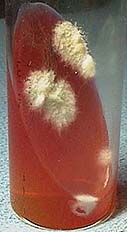
Image: Photo of a dermatophyte-positive culture specimen, which can take two weeks or longer to grow.

If I was reincarnated as a mosquito, I’d want to live where I do now (convenient, eh?). I live in the country surrounded by areas of "protected wetland," which, in many cases, is a fancy word for swamp. I try to avoid mosquitoes, but getting bitten is a regular (daily) event. As I was getting swarmed last night, I was thinking that the mosquito-borne disease I’m really concerned about is Eastern equine encephalitis (EEE). While quite rare in Ontario, with only a handful or no cases in horses every year, it’s a worry because it’s almost always fatal. It also affects people, not via transmission from horses but from being bitten by mosquitoes that pick up the virus from birds. It’s very rare in people, but it’s highly fatal.

This is the time of year that we start seeing mosquito-borne infections in Ontario, and a Disease Alert from the province re-inforces concerns about EEE. The alert was issued in response to a case of EEE in a horse in New York state, not far from the Canadian border. The horse, from the Ogdensburg, NY area, showed signs of illness on July 23 and died the next day (a pretty typical progression for this disease). Since mosquitoes don’t respect borders, cases in this neighbouring region suggest that infected mosquitoes might also be active in Ontario.

EEE isn’t the only mosquito-borne virus that we worry about – West Nile virus being the other main issue around here – so mosquito control and avoidance are important. While you can never guarantee that you or your animal will not encounter a mosquito, various things can be done to reduce mosquito numbers (e.g. eliminating sites of standing water (which are mosquito breeding sites) wherever possible… swamps being a logical exception) and to reduce the risk of being bitten (e.g. avoiding high risk areas and times, long clothing, mosquito repellants). Vaccines are available for EEE and West Nile virus in horses (but not people), and the risk of these diseases should be considered when designing a horse’s vaccination program.

A short distance down the road from here, the Kitchener-Waterloo Humane Society has been quarantined because of an apparent ringworm outbreak. There’s no information on the facility’s website and information in the press has been pretty vague (both concerning aspects), but it sounds like a ringworm outbreak. Adoptions have been ceased and the Humane Society will apparently "reassess its safety protocols by the end of the week.The outbreak appears to have been going on since at least last week, so hopefully they’re getting on this and have a strong outbreak investigation and control plan in place.

I haven’t been involved in this outbreak so I know nothing more than what is in the press, but ringworm can be a big problem in shelters. It’s a controllable disease, but the situation can get completely screwed up with a poor outbreak response. It’s also sometimes an overblown problem (or not a true problem at all) in some situations, so it’s critical that the outbreak is properly investigated and managed. That’s not always the case, and the consequences can be serious.

There are a lot of factors that go into good outbreak management that are hopefully being done at the KW Humane Society. These include:

  • Good communication both internally and externally.
  • Transparency.
  • Sound containment practices.
  • Getting good advice.
  • Actually listening to the good advice (and not bad advice).
  • Taking the time to do it right.
  • Ensuring one is acting on correct information.
  • Spending money where it needs to be spent, be it testing, treatment, personnel or other factors. Trying to save money during an outbreak response often ends up costing much more in the end.

The independent report of the 2010 ringworm debacle at the Newmarket OSPCA should be important reading for any shelter trying to figure out what to do, and what not to do.

Rabies is most commonly reported in dogs, skunks, raccoons, bats and a few other species. However, any mammal is susceptible, and sometimes unusual cases are identified.

1. In a serious take on Monty Python’s "killer rabbit," a rabid bunny has caused a lot of problems in Chom Thong, Thailand.

The pet rabbit, Poko, had been purchased last year and starting biting the feet of people in the family on June 10. The rabbit was eventually put in a kennel and died July 28. The other rabbit in the house died the next day (no word on why). The time frame is a bit strange, since if the rabbit was biting because of rabies, it should have died a lot quicker. Once an animal is showing signs of rabies, death occurs quite quickly (usually within 10 days), not over a period of 7 or 8 weeks. So, most likely the rabbit wasn’t biting because of rabies, at least at the start.

In response to the diagnosis, authorities have launched an investigation and 120 health officials are fanning out in the area to look for other rabid animals, since where there is one, the are others. Dogs and cats within 5 km of the rabbit’s home are being vaccinated against rabies. Family members are being given post-exposure prophylaxis. The father has expressed concern that the treatment was too late since they were bitten several days before, but it’s not really much of a risk. Rabies typically has a long incubation period, especially with bites to lower extremities, and starting treatment a few days (or even weeks, in some situations) after exposure can still be effective (albeit the sooner the better). The key is for treatment to be started before any signs of rabies develop – after that happens there’s very little that can be done.

The source of rabies isn’t clear and I haven’t seen any speculation. If the rabbit was caged, then there aren’t too many possible sources, with bats probably being the most likely.

2. Swimmers beware… it’s not just rabid otters you need to worry about.

A man swimming in eastern Pennsylvania was bitten by a beaver that was subsequently identified as rabid. The beaver apparently attacked a canoeist earlier that day, before encountering the swimmer, a Boy Scout leader. The man suffered 15 lacerations from the attack, and the beaver remained firmly attached to the man’s arm as he was helped to shore. The stubborn critter wouldn’t let go until the resourceful (and brave) Scouts got it off by hitting it with "anything they could find around them, sticks, rocks…" The beaver was killed and confirmed as rabid.

It’s another reminder that any bite from a mammal should be considered a possible rabies exposure. It’s also a reminder to avoid contact with wildlife, although that can be easier said than done when a rabid animal is involved.