Dangerous dogs need to be addressed. Actually, it’s dangerous dog-owner pairs that are the issue, since there’s almost always a major human component to this kind of behaviour.  Unfortunately, we can’t mandate common sense.

Cities have taken a variety of approaches to the issue of dog bites and dangerous dogs, ranging from nothing to breed bans. Dangerous dog designations are another approach. Toronto enacted a bylaw earlier this year that defines a dangerous dog as one that has severely bitten or attacked a person or pet, or that has delivered non-serious bites twice (or more). In the first 6 months, this has resulted in designation of 91 dangerous dogs (with German Shepherds leading the way).

Do bylaws like this have an impact on dog-related injuries? I’m not sure we know.

A concern I have with a designation based on the number of times a dog has inflicted a bite is that it risks driving things underground in terms of reporting. While rabies in dogs is very rare in Canada, we have to think about it with any dog bite. That means that every bite should be reported, so that the proper measures can be taken.  The first option is almost always to observe the dog for 10 days – if it’s normal at the end of that period, then it couldn’t have transmitted rabies virus with the bite at the beginning.

Bringing in penalties for dogs that bite complicates matters, as it makes people less likely to report such incidents. I had a conversation with an owner the other day about a bite. It was a minor bite that occurred during a veterinary procedure (not at our hospital) and we were talking about the need to report it. One of the things I said was “It’s not a big deal. Public Health needs to know but it’s not like the police are gong to be called or anyone’s going to call your dog a dangerous animal.” I can’t necessarily use that line with people from Toronto now, and I suspect it will lead to people who are aware of the new bylaw to be reluctant to report bites. As a veterinarian in Ontario, I’m bound by provincial legislation (as are others) to report bites, but we know that these injuries are massively under-reported, including by vets. In Toronto, this could make it worse.

I’m not against dangerous dog designations, and a clear, objective approach is nice, but if it takes and thought process and wiggle room away, that’s a problem.

A dog that lunges at someone and bites them while on leash as they’re walking dog the street.

  • That’s a problem

A dog that bolts from its yard or owner to attack a kid.

  • Yep, big deal.

With both of these, if the dog only inflicts a “minor” bite, it wouldn’t be captured under the Toronto policy (until the next bite). That’s not ideal.

A dog that has a sore leg that someone grabs and it nips in pain.

  • Not good, but perhaps understandable and not an indication of a lifelong threat. Yet, it’s one strike out of two for the dog, and if it’s deemed a severe bite (no definition provided), it’s an automatic designation as dangerous.

Each bite and each dog are different, and I guess the take home is there’s no perfect approach. A case-by-case approach directed by someone knowledgeable would be the best way to handle this, but it’s unlikely to happen.

Countless people have asked me to comment about the movement of Hurricane Harvey dogs from Texas into Ontario (and other regions). Okay… I’ll bite.

As frequent readers know, risks posed by importation of animals is an interest of mine. A large reason for this is the infectious disease problems that occur, including things I’ve seen here in Ontario (e.g. widespread distemper in rescue dogs from China, heartworm in dogs from the southern US) and broader issues (e.g. importation of H3N2 canine influenza into the US from Asian rescue dogs, importation of rabid dogs). Anytime animals are moved from one region to another, there’s a chance that infectious diseases go with them. The farther apart, both geographically and in terms of the infectious agents that are present in the area, the greater the risk. That doesn’t mean movement is always bad, but it means we need to think about the when, why and how of the process.

I have no doubt about the sincerity and good intentions of most groups that are involved in shipping dogs out of Texas. They see a problem that they want to help address. But do they adequately understand all the issues?  That’s an important question.  Infectious diseases are a big concern because we know they get imported with dogs in situations like this.

Another thing to consider is the potential disruption caused by having even more volunteers in a disaster zone. I’ve talked to emergency responders and disaster relief coordinators in the past, and often the well-intentioned people who come to help end up causing more problems, simply because they add more people to an already chaotic situation and they take up more resources (e.g. food, housing, fuel).

While it shouldn’t always come down to money, the cost benefit needs to be considered. A local rescue agency announced they had raised another ~$30,000 and wanted to go back and get more dogs. The shelter system in Canada isn’t exactly flush with cash (or depleted of animals). How much good could that money do at home, and how many more animals could benefit? As one writer to me stated, the US is the wealthiest country in the world. Do they really need Canadians driving down to help them with a few dozen dogs?

It’s great for the dogs that are adopted, no question. There tend to be massive waiting lists to adopt dogs from high profile rescues like this (with less interest in the “boring” local dogs).

Is it great, in the big picture?

  • Does importation of dogs result in more dogs going into homes, or does every imported dog that finds a home mean that one local dog in a shelter is euthanized because there’s no one to take it? (Or even that more than one dog is euthanized because there aren’t enough funds to care for them?)

At a minimum, there needs to be more attention to how these dogs are obtained, how they are screened prior to importation, and how they are managed after they get here. Unfortunately, odds are good that problems will be imported along with the dogs.

Cute. Frustrating. Cuddly. Biohazardous

All of these apply to puppies. It’s well recognized that puppies (and kittens) pose increased infectious disease risks, for a few reasons. These include a higher likelihood of shedding various pathogens, greater environmental contamination when they poop on the floor (or anywhere else) and a tendency to cause minor bites and scratches. That’s not meant to deter people from getting a puppy or a kitten, but it’s important to understand risks to mitigate risks.

Another issue with puppies (and other pets) is the potential for widespread dissemination of certain pathogens when animals are mixed in large breeding operations, warehouses and other mixing points. This allows for more transmission of pathogens and dissemination over wide areas when the animals are sold/dispersed. The way some of these animals are handled and shipped also contributes to stress, which can presumably increase the risk, when compared to low animal density individual breeders with more hygiene, less mixing and less stress.

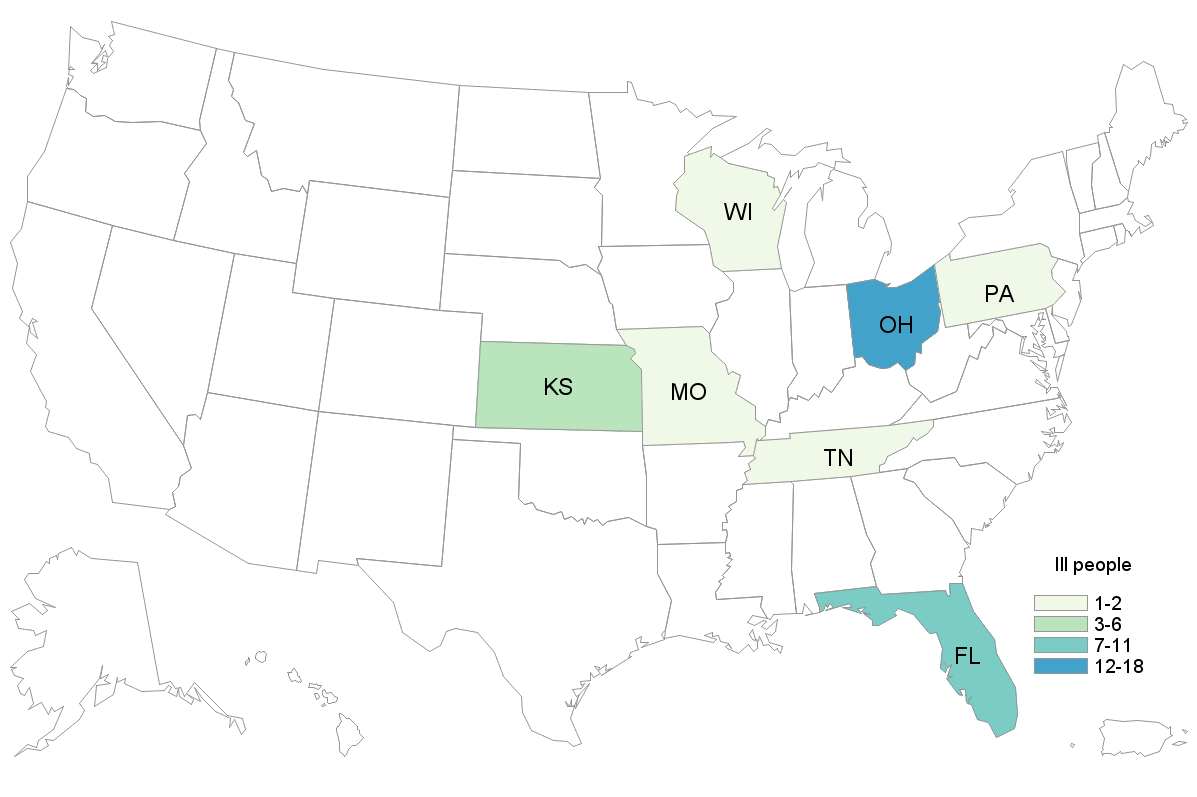
An ongoing outbreak of (human) Campylobacter infections in the US brings some of these issues to mind. As of September 11th, 39 cases have been identified in 7 US states (see map below). Interestingly, a link to Petland, a national pet store chain, has been made. Twelve affected individuals are Petland employees, and 27 purchased a puppy from Petland, visited a Petland or visited a home where a Petland-origin puppy was present. Whole genome sequencing of Campylobacter isolates from puppies from Petland in Florida indicated that the isolates were closely related to those from a sick person in Ohio, supporting interstate dissemination and a related source.

The link to one pet chain is interesting, since it would suggest that there was some common source, be it a large breeding operation, animal distribution centre or other mixing place. No information about the puppy sources or handling is provided, so it’s hard to say what the sources might be.

Regardless of the specific Petland situation, it’s a useful reminder that any puppy or kitten can be biohazardous. I suspect that puppies from large pet distribution systems, puppy mills and pet stores pose more risk because of the stress and mixing, along with potentially dodgy background, but any puppy will pose some risk. We’re also more likely to identify cases from large operations since a common link can be established, so we shouldn’t focus too much on just reported outbreaks.

That means there’s a need for good hygiene practices, such as hand washing, proper fecal handling, good cleaning and disinfection after fecal accidents in the house, and a concerted effort to house train pets ASAP. Recognizing who is at higher risk (young kids, elderly individuals, immunocompromised persons, pregnant women) and having them take special care around puppies (and kittens) is also important.

More information about Campylobacter can be found on the Worms & Germs Resources – Pet page.

A series of strange but rare infections or the sign of a new problem? That’s always the question we have to think about when there’s a report of a new disease. Determining that can be a challenge, and often “time will tell” is the true answer.

A paper in the most recent edition of the New England Journal of Medicine (Ramakers et al. 2017) gives us one more for the list, and involves a species we don’t talk about much in terms of zoonotic diseases: guinea pigs.

The report describes 3 people with Chlamydia caviae infection, a bacterium associated with guinea pigs that has been considered pretty harmless to people. However, the case series details 3 cases of infection in otherwise healthy adults in their 30s, a group that’s not high-risk for infections from low-risk bacteria such as C. caviae. All 3 developed severe pneumonia, and two of them ended up in ICU on ventilators. This compounds the surprise and concern, because infections by bacteria that rarely cause disease in people usually manifest as mild disease. That was the situation with the only previous report of C. caviae infection in a person, where mild conjunctivitis was the only clinical problem.

Fortunately, all three patients ultimately recovered.

There was no link between the individuals themselves, and the cases occurred over a three year period. A guinea pig link is assumed because of the association of this bacterium with guinea pigs. One patient’s guinea pig had signs of respiratory tract disease before the person got sick, and (unlike most reports), there was an investigation of the animal. C. caviae was isolated from the guinea pig, and it was identical to the strain found in the person. That’s pretty convincing evidence.

A few questions remain:

  • Were there more people affected? Most people with respiratory tract disease don’t get tested for the presence of bacteria like this. That’s especially true with milder disease. So, are these cases a unique series, or do they represent a small subset of the total number of infections that occurred?
  • Is this a new problem or was it simply found because of better current-day diagnostic testing? Surveillance bias (i.e. the apparent increase in a disease because we are looking more or looking better) is a common issue.
  • What do we do now? Does this change how we approach guinea pigs?

The last question is an important one, and one that doesn’t come with good answers. For me, the take home messages would be:

  • Guinea pig contact poses some infectious disease risk, like contact with any animal.
  • Animals that are sick usually pose more risk.
  • A guinea pig with respiratory disease should be approached with an increased level of hygiene and infection control (e.g. no kissing, good hand washing) in case it’s C. caviae.
  • Veterinarians should be aware of the risk (albeit probably very low) so that they can counsel owners and take necessary precautions themselves when handling guinea pigs.
  • Physicians need to query pet ownership/contact and recent events of pet illness when presented with a sick patient.
  • Contact with a guinea pig with respiratory disease should be reported to the physician if a person develops signs of respiratory disease, and C. caviae infection should be considered.

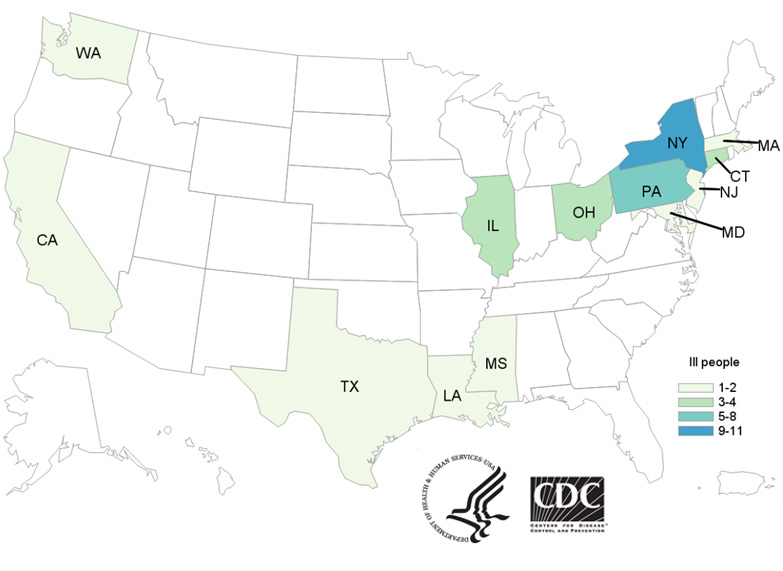
It’s not a shocker, but another multistate turtle-associated outbreak of salmonellosis has been ongoing in the US. CDC has reported on an outbreak of Salmonella Agbeni infections involving 37 people in 13 states. As is almost always the case, the number of reported infections is probably a small fraction of the number of people who actually got infected.

Here are some of the highlights:

  • Cases were reported between March 1 and August 3, 2017 (and are probably ongoing).  The map below shows the case distribution by state.
  • Almost half of infected individuals have been hospitalized. That’s a pretty high percentage for an outbreak like this.
  • As is typical, kids bear the brunt of the problem, with 32% of infected individuals being 5 years of age or younger.
  • Contact with turtles or their environments in many of the infected individuals was identified. Those without reported turtle contact probably still had direct or indirect contact somehow that they either didn’t know about or didn’t recall.  This Salmonella strain is rare and the close genetic relatedness of the Salmonella isolates from affected people is consistent with a common source. Furthermore, this Salmonella type was found in turtles from a street vendor in the US in 2015.

Salmonella is not uncommon in reptiles, particularly turtles. Turtles are often implicated in outbreaks because they are common pets (despite a long established and flouted US ban on the sale of turtles with shell lengths less than 4 inches). Small turtles are a major issue because they can be handled easily by small children.

The report concludes:

All turtles, regardless of size, can carry Salmonella bacteria even if they look healthy and clean. These outbreaks are a reminder to follow simple steps to enjoy pet reptiles and keep your family healthy. This outbreak is expected to continue since consumers might be unaware of the risk of Salmonella infection from small turtles. If properly cared for, turtles have a long life expectancy.

More information about turtles and Salmonella can be found on the Worms & Germs Resources – Pets page.

Two Ontario horses have recently been diagnosed with West Nile virus infection, prompting the equine health advisory below from the Ontario Ministry of Agriculture Food and Rural Affairs. That’s not too surprising, as now is the typical time of year that we start seeing this mosquito-borne infection in Ontario. West Nile numbers in both humans and horses tend to vary year-to-year. There’s been some suggestion that this might be a bad year for West Nile virus based on mosquito pool testing, but predicting West Nile infections is far from an exact science, as a multitude of different factors are involved.  Only time will tell whether it’s going to be a bad year or not.

Regardless, West Nile remains a relatively rare disease in Ontario, but one that’s best avoided if possible. That involves mosquito control and mosquito avoidance, for both horses and people.

Here’s the latest map of the terrestrial rabies cases in southwestern Ontario.  Raccoon-variant cases still centre on the Hamilton area.  It was never assumed that this particular outbreak would be eliminated quickly, given the case numbers seen in the first several months and the additional challenges of trying to control the spread of the virus in an urban (vs rural) wildlife population. The Ontario Ministry of Natural Resources and Forestry (MNRF) has a multi-year plan to hopefully (re-)eradicate this rabies virus strain from the province. Over 270,000 oral rabies vaccine (ORV) baits have been dropped so far in 2017 alone as a major part of the control program, with more to come in the fall.  In 2016, over 1.6 million ORV baits were dropped, and over 4500 animals were tested.  The map also shows the much smaller number of fox-variant rabies cases that have been detected in Perth County, Huron County and the northern part of Waterloo region. Baiting will be done in all of these areas as well.  For more information on rabies in wildlife and the baiting schedule, visit https://www.ontario.ca/page/rabies-wildlife.

I’m not sure I wrote about it at the time, but last spring we adopted Rumple (technically Rumpelstiltskin, pictured below… rough life) from the Guelph Humane Society as part of their Barn Cat Adoption program. He quickly migrated from the barn and set up shop as a garage and deck cat (which also lead to an unintended 12 hr, 100 km round-trip excursion when he hitched a ride from someone who left their car door open for a minute while at the house… but that’s another story and an example of the value of microchips).

Out of the goodness of his heart, Rumple adopted a wayward young female feral cat this spring. Not long after, she kept getting bigger and bigger, disappeared for a couple days, then came back much smaller. That answered the “pregnant vs abdominal disease” question.  (For the record, Rumple’s not to blame for that, since cats are neutered, vaccinated and microchipped as part of the barn cat adoption program.) We weren’t sure where the kittens were or if they were alive.  Five weeks later, I saw her trotting in from the field with a kitten in her mouth, relocating them from the birthing spot to our attic (which also required maneuvering up an extension ladder to get there).
So, we now have 6 kittens living above our garage, and we need to think about a preventive medicine plan.

I’ll start with deworming. These kittens look pretty healthy so far – actually very healthy for feral kittens, probably because of limited cat density in our rural area. They don’t have the classic pot-bellied (worm filled) appearance, but they are presumably harbouring parasites. Neonates are the highest risk group for a variety of parasites. They can be exposed early in life, develop significant parasite burdens in a short time, and are at greatest risk of health complications as a result. They also pose the greatest risk of transmission to people since they are often handled very closely, and more apt to poop just about anywhere. (That doesn’t mean they should be totally avoided as biohazards. My kids are having a great time trying to socialize the kittens – a little common sense and handwashing are key.)

Because of the greater risk during this period and the likelihood of a greater worm burden, we’re more aggressive with deworming youngsters. I was able to (semi-effectively) treat their mom during what we now know was pregnancy, with a topical dewormer. Ideally, we’d have started deworming the kittens starting at 2 weeks of age, and repeating at 4, 6, and 8 weeks, followed by monthly treatments until 6 months of age. This obviously wasn’t possible since they weren’t accessible for those first time points. Now that we have access to them (when we can catch them… another potential issue at the moment), the process can start. There aren’t specific guidelines for what to do when you start deworming older kittens, but every two weeks for the first 3-4 doses, then monthly until 6 months of age is reasonable. Hopefully they’ll all be re-homed by then anyway. Mother cats can get reinfected during this period from kitten feces, so Alice will get treated a few more times as well.

Among the future priorities… corralling the kittens so they can be treated and socialized more easily, vaccinating, finding homes for them (despite the daily requests from my kids to keep them) and getting Alice spayed, since as much fun as kittens are, there’s not exactly a shortage.

I’ve had this paper from One Health (Chan et al 2017) on my “to blog” pile for a while, since it’s an interesting story. Like any case report, it’s a bit of an oddball infection, and not likely indicative of a major or new risk. However, there are often a few good general take-home messages from reports like this.

The paper describes five human cases of psittacosis (Chlamydophila psittaci infection) linked to contact with fetal membranes of a horse. Psittacosis is a potentially nasty bacterial infection that is usually linked to psittacine birds (parrot family). This bacterium can be found in other species periodically, but it’s rare, and horse contact doesn’t trigger much thought about psittacosis.

The mare foaled on a stud farm, where two people were in attendance and a 3rd examined the fetal membranes after foaling. That’s a common procedure to make sure they are intact, since any membranes left behind in the mare can cause serious complications. The membranes appeared abnormal and the foal died a week later (but testing of the foal was not performed).

The fetal membranes were taken to the local vet school by one of the farm personnel (who was also a vet student), and they were examined by two staff and three students.

Five of the nine people that had contact with the fetal membranes developed psittacosis, and the timing of when they got sick was consistent with exposure at the time of fetal membrane contact. Risk factor analysis was performed and direct contact with the membranes was the only thing that was significant, and no other reasonable sources (e.g. bird contact) were identified.

Two of the five affected individuals were hospitalized, but everyone recovered.

Anytime there’s an outbreak, it’s good to look back and see what could be done differently. It doesn’t make much sense to look at psittacosis-specific prevention measures around horses since this is such a rare problem.  There has to be a balance between what’s practical, what people will actually do, and what might help (e.g. farms aren’t going to have biosafety cabinets to examine fetal membranes, so looking to recommendations for handling infected bird tissues has some limitations). Therefore, we’re left focusing on more general practices that could potentially protect people in a scenario like this, but that are also more broadly useful. A lot of it comes down to attention to hygiene, especially hand washing. Wearing routine personal protective equipment or dedicated clothing to reduce contamination and tracking around of microbes, handling items in a manner to reduce splashes (e.g. gentle handling, not tossing the placenta around), cleaning and disinfecting equipment and areas that might be contaminated, and hand washing would go a long way.

It’s commonly been stated that it’s important to finish your course of antibiotics (whether “your” refers to a person or animal), as a means of reducing the risk of developing antibiotic resistance. That’s never made much sense to me, since more antibiotic exposure is more likely to lead to a risk of resistance emerging. However, it’s been dogma.  The issue was addressed a few years ago in the ACVIM Consensus Statement on Antimicrobial Use in Animals. It also comes up in some working group that I’m in regarding antimicrobial use in humans and in animals, as messaging is starting to move away from “complete the course.” It’s a challenge though, since we don’t want treatment stopped too early (reducing effectiveness), but we also don’t want treatment to continue for days after it’s not needed.

A recent article in the BMJ, “The antibiotic course has had its day”(Llewelyn et al 2017) hits on the same topic. I’d recommend reading the whole article if you’re interested in the subject. Some of the more interesting aspects and comments are outlined below (italics are verbatim text from the paper):

  • However, the idea that stopping antibiotic treatment early encourages antibiotic resistance is not supported by evidence, while taking antibiotics for longer than necessary increases the risk of resistance.
    • Yet, there is often clinician fear. Basically, sometimes (consciously or not) people think that if the patient fails to respond to treatment, it’s a failure and is the clinician’s fault if they went with a short treatment course. If antibiotic resistance developed because of an excessive course of antibiotics, that’s seen as the drug’s fault, forgetting it’s the clinician that prescribed it. Fear of immediate and obvious patient outcome problems (even when unsubstantiated) typically overwhelm less obvious concerns about resistance.
  • Fundamental to the concept of an antibiotic course is the notion that shorter treatment will be inferior. There is, however, little evidence that currently recommended durations are minimums, below which patients will be at increased risk of treatment failure.
  • Historically, antibiotic courses were set by precedent, driven
by fear of undertreatment, with less concern about overuse. For many indications, recommended durations have decreased as evidence of similar clinical outcomes with shorter courses has been generated.
    • This applies in veterinary medicine too. I work with a few guidelines initiatives and getting people to buy into shorter durations has been a challenge. We’re making progress but fear of undertreating persists in some people.
  • For most indications, studies to identify the minimum effective treatment duration simply have not been performed.
  • Of note, a recent clinical trial found that using fever resolution to guide stopping antibiotics in community acquired pneumonia halved the average duration of antibiotic treatment without affecting clinical success.
    • This raises some interesting thoughts about when to stop. Focusing on how people feel or what they see in their animals as an indicator to stop may provide a more appropriate, tailored treatment, by stopping when the infection is gone. Sometimes. For some diseases, the time to stop is probably the time that the patient feels better or signs such as fever abate. However, there are probably others that need slightly longer treatment, since improvement in signs of disease doesn’t necessarily mean the infection is completely controlled. Here’s where more research is needed.

Their conclusion:

Research is needed to determine the most appropriate simple alternative messages, such as stop when you feel better. Until then, public education about antibiotics should highlight the fact that antibiotic resistance is primarily the result of antibiotic overuse and is not prevented by completing a course. The public should be encouraged to recognise that antibiotics are a precious and finite natural resource that should be conserved. This will allow patient centred decision making about antibiotic treatment, where patients and doctors can balance confidence that a complete and lasting cure will be achieved against a desire to minimise antibiotic exposure unimpeded by the spurious concern that shorter treatment will cause antibiotic resistance.