
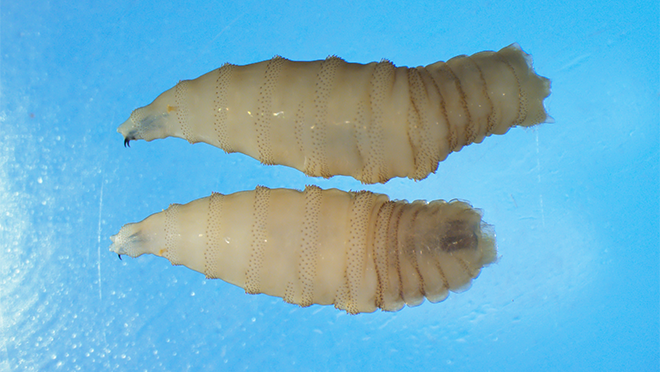
New World Screwworm (NSW) is a nasty parasitic infestation (with a very high ick factor) that’s back on the radar in North America, re-emerging after several decades of highly successful control and eradication efforts that had pushed its northern reach back as far as Panama. It has now made to back as far as northern Mexico, within a few hundred kilometers of the US border, and there’s significant concern that it will continue to move north, despite concerted efforts to halt its progression. The primary risk is to livestock, which can be infected when the flies (Cochliomyia hominivorax) lay their eggs in any tiny wound or break in the skin. Importing animals from affected regions, including much of South America and some Caribbean countries, is a huge risk for moving NWS to new area, which is why the US closed its border to livestock from Mexico months ago. But NWS can also infected companion animals, and lots of dogs also get imported to the US and Canada from endemic countries. While the parasite can’t establish itself in the northern US or Canada thanks to our cold winters, it’s still very important for veterinarians here to be on alert for NWS in imported animals.
Treatment of NWS infections involves first and foremost physical removal of the maggots (ick), followed by administration of anti-parasitic drugs to try to kill any deeper maggots we can’t see or remove. Some anti-parasitics can also help to prevent disease by killing developing larvae after the fly eggs hatch, before they start destroying the living tissues of their host.
There isn’t a licensed drug for NWS in Canada or the US, not necessarily because nothing works, but because manufacturers haven’t sought this approval for any existing products, because it’s a very time consuming and expensive process to do so, and the disease has been eradicated from the region for decades.
Fortunately, we do have some off-label options. A few different antiparasitic drugs that we routinely use in dogs and cats can be effective. This would classically focus on ivermectin (shown to have some effect in cattle) and the related drug, moxidectin. There are also a variety of drugs that are authorized for flea and tick prevention / treatment which could be effective.
- It’s important to note that the label doses of ivermectin and moxidectin that we use for heartworm prevention in dogs are substantially lower than the doses that might be effective for treatment of parasitic infections like NWS, so having a dog on heartworm preventative won’t prevent screwworm infection.
Earlier this year, the US FDA posted information for veterinarians on a few drugs that may be potential options for off-label treatment of NWS, including ivermectin, moxidectin, nitenpyram, afoxolarner, lotilaner, sarolaner, milbemycin and spinosad, mostly based on an assumption that they could work, rather than any hard data showing they do (or don’t) work.
New EUA for Credelio (lotilaner) for NWS in dogs
New this week, the US FDA issued an Emergency Use Authorization (EUA) for Credelio (lotilaner) for the treatment of NWS in dogs and puppies. They concluded that:
- “Based on the scientific evidence available to the FDA, including data from published scientific literature, it is reasonable to believe that Credelio may be effective for the treatment of infestations caused by NWS larvae (myiasis) in dogs and puppies, as described in this authorization, and when used under the conditions described in this authorization, the known and potential benefits of Credelio outweigh the known and potential risks for dogs of all ages and weights because NWS is potentially fatal in dogs if left untreated, therefore justifying including dogs less than 8 weeks of age or less than 4.4 lbs in this authorization.”
The authorization is based largely on a 2023 study of dogs in Brazil with naturally occurring NWS infection (Vale et al. 2023). It was a very small, single arm, open label study that involved treatment of 11 naturally infected dogs with a single dose of lotilaner, which showed 100% efficacy at expelling and killing larvae after 24 hours. It’s a small study, but still very useful, as such a high success rate provides pretty good confidence in the efficacy of the drug.
Does having this EUA for Credelio (lotilaner) in the US change anything?
Yes and no. Veterinarians have always been able to use the drugs on the FDA list in an extra-label manner in companion animals, so in that sense having the EUA doesn’t change this kind of access. However, it’s an impetus to consider lotilaner first since it’s now authorized and has some supporting data. That provides more confidence and backing when it’s used to treat an infected dog.
It doesn’t necessarily mean that lotilaner works better than the other drugs on the list for treating NWS? It just means the drug has been given an EUA. Presumably that could have happened for other drugs with some efficacy data, such as ivermectin, but since ivermectin is off-patent and available in a variety of products, it’s unlikely a manufacturer would go through the time and effort to get an EUA. Nonetheless, it’s ideal to use authorized drugs whenever we can, so this should lead to preferential use of lotilaner for treatment of NWS in dogs.
Should lotilaner be the tick preventive of choice now, since it also helps treat screwworm?
That’s a tougher question, and presumably will be a big talking point for all companies marketing ectoparasite preventatives. The EUA is for treatment, not prevention of NWS, but the two go hand-in-hand to some extent as treatment of early infection is basically the same as prevention. Since NWS is (hopefully) going to be a very rare occurrence in dogs in the US (and even rarer in Canada since our climate prevents the fly from living here much of the year), it’s to use this as a reason to say lotilaner should be the ectoparasite preventive of choice. However, it would be a fair consideration in areas where the risk of NWS is high (e.g. if it establishes a foothold in southern Texas).
It’s great to have an EUA for a treatment product for dogs, to help guide treatment choices and provide veterinarians with some backing when managing a case, but the EUA isn’t really a game changer. It’s nice that the manufacturer pursued it, even though it might have been driven by marketing advantages more than anything else. Emerging and rare diseases are often neglected and efforts by companies and the FDA to support their management are useful.
Image from https://www.cdc.gov/new-world-screwworm/about/index.html