
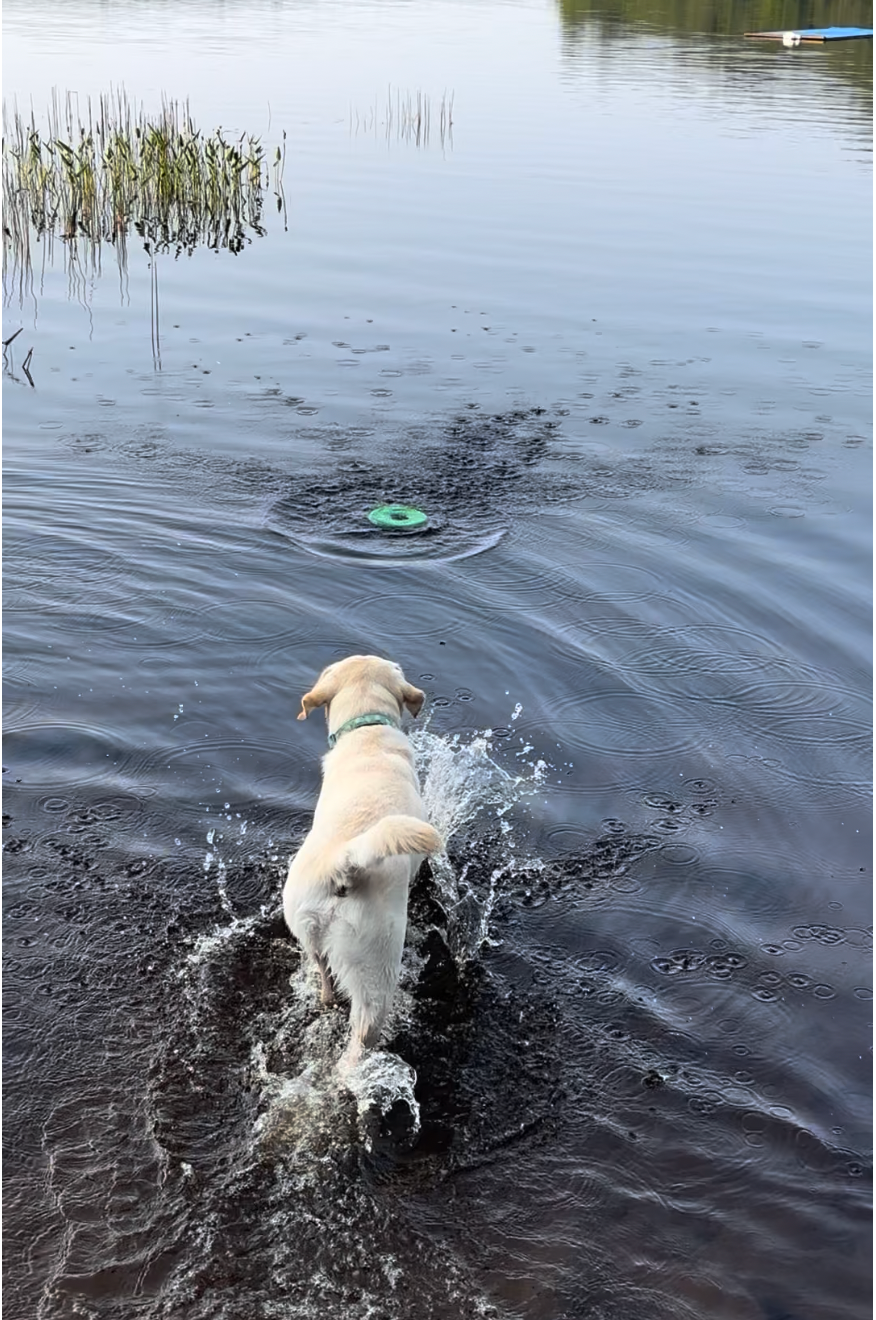
As the weather (slowly and inconsistently) gets nicer here in Ontario, dogs start to go swimming more. My dog, Ozzie (pictured below), is an embarrassment to the Labrador breed as he will not swim, but he’ll happily wade through water, as long as his feet don’t leave the ground (but he still manages to get thoroughly soaked).
It is also the time of year when the question inevitably comes up (yet again): Do topical parasite preventatives need to be re-dosed more frequently in dogs that swim or get bathed over the summer?
No, they don’t. (An easy answer, for once!)
We have lots of options for parasite control in dogs and cats, including oral, topical and injectable products. There are lots of different pros and cons to each, and I won’t wade into that quagmire but here’s the scoop on the topicals:
- Topical antiparasitics don’t “coat” the animal and stay on the skin or fur; topical is just the route of administration. These products are rapidly absorbed through the skin, and exert their effects through the body, not on the skin’s surface. A lot of of the absorption occurs within a couple of hours of being applied, and the drug can adhere to the skin and haircoat as the rest is absorbed, with peak serum drug levels occurring 2-7 days later. Once the drug is in the skin (even if it’s not yet in the bloodstream), it can’t be washed off.
- A 2016 study (Kilp et al.) evaluated “repeated intensive shampooing” starting 3 days after administration of a topical parasite preventative, and there was no effect on the ability of the drug to kill fleas or ticks on the dogs. In another study, (Taenzler et al. 2016) researchers “water immersed’” dogs 3, 21, 49 and 77 days after treatment, shampooed them for 6-8 minutes or did nothing (control group). There was no apparent difference in the efficacy of the anti-parasitic treatment between the three groups.
I just checked the labels for a couple products available in Canada: One said to keep the dog out of water for 72 hours after treatment, and another said that exposure to water (including swimming) starting 60 minutes after treatment, or bathing 90 minutes after treatment, doesn’t impact efficacy.
- I don’t know if the difference is because some products are absorbed quicker than others, some manufacturers are more conservative than others or because the products were simply studied / evaluated differently.
- It’s important to pay attention to those product labels though. If anything, they’re probably quite conservative, so if they say that the dog can get wet X hours after treatment, I’d follow that guideline, but if the dog gets rained on earlier than that, it’s likely not a problem. If the dog goes for a swim immediately after the product is applied, I’d be concerned the dog would need to be retreated.
In the absence of specific guidance, it’s reasonable to avoid water immersion or bathing for 48-72 hours after treatment; 24 hours is probably lots in most cases, but 48-72 hours gives a bit more margin of safety.
So, while it can take a little bit of planning and attention to make sure you don’t waste a dose of your dog’s topical preventative (particularly for dogs that swim every day), they only need to stay out of the water for a few days, after that swimming or bathing won’t have any detrimental effect on the treatment.