

When I was in general practice, we gave puppies and kittens their first rabies vaccine at 16 weeks of age. I didn’t ask why, it’s just what the clinic did, so as a new grad, that’s what I did. This practice is (unfortunately) still common in a lot of clinics; however, all rabies vaccines approved for use in dogs and cats in Canada are labelled for use in puppies and kittens starting at 12 weeks of age. In Ontario, it is legally required for all cats and dogs (and ferrets) to be vaccinated for rabies as of 3 months of age.
This begs two questions:
- Why is rabies vaccination still often not done until 16 weeks of age (even in Ontario)?
- Does it really matter if dogs and cats are vaccinated at 12 weeks vs 16 weeks?
The answer to the first question isn’t really clear, but there are a few possibilities:
- Habit. That’s what was done before, so that’s what we do now.
- The desire to make sure owners bring their pet back for the other core vaccines at 16 weeks of age. We need to give at least one dose of core vaccines (i.e. DAPP for dogs, FVRCP for cats) dose at 16 weeks of age or older, because antibodies from the animal’s dam can sometimes block response to those vaccines before a certain age (known as maternal antibody interference). Owners often focus on getting their pet an initial rabies vaccine (if they’re getting vaccines), so there’s some concern if they get it at 12 weeks, they might not come back for the critical 16 week dose of the core vaccines.
- Concern about adverse events. Some people want to avoid the extra vaccine at 12 weeks of age when the animal is younger, and smaller (even though we don’t know that actually helps).
Overall, we don’t have great reasons to wait to vaccinate pets until 16 weeks of age, but we have at least one very good reason (i.e. protection against a universally fatal viral disease) to vaccinate them as early as possible.
Does 12 weeks versus 16 weeks of age really matter? Sometimes yes.
I’ve been involved in a few situations where a puppy or kitten (usually a puppy) tangles with a wild animal (often a bat) and is considered at risk for exposure to rabies. The most unfortunate cases are the ones where the dog was old enough to have been vaccinated before the exposure happened, but vaccination was delayed. In Ontario, the difference in post-exposure management for a vaccinated versus unvaccinated puppy is huge (and the same is true in many other jurisdictions as well).
- After a potential rabies exposure, a vaccinated dog/cat that gets a rabies booster within 7 days only needs to be observed at home for 45 days, which is pretty easy to do, and the animal can still be socialized.
- After a potential rabies exposure, an unvaccinated dog/cat is considered at risk for developing rabies for 3 or 6 months, depending on whether the pet gets that critical post-exposure rabies vaccine within 7 days. This necessitates a much stricter “precautionary confinement period” (PCP), which can be really difficult to do with a puppy (or kitten), and dramatically limits the ability to properly socialize a young animal, which can have life-long consequences. In some situations the owner can’t effectively confine the pet, in which case they may (sadly) choose to euthanize the pet instead.
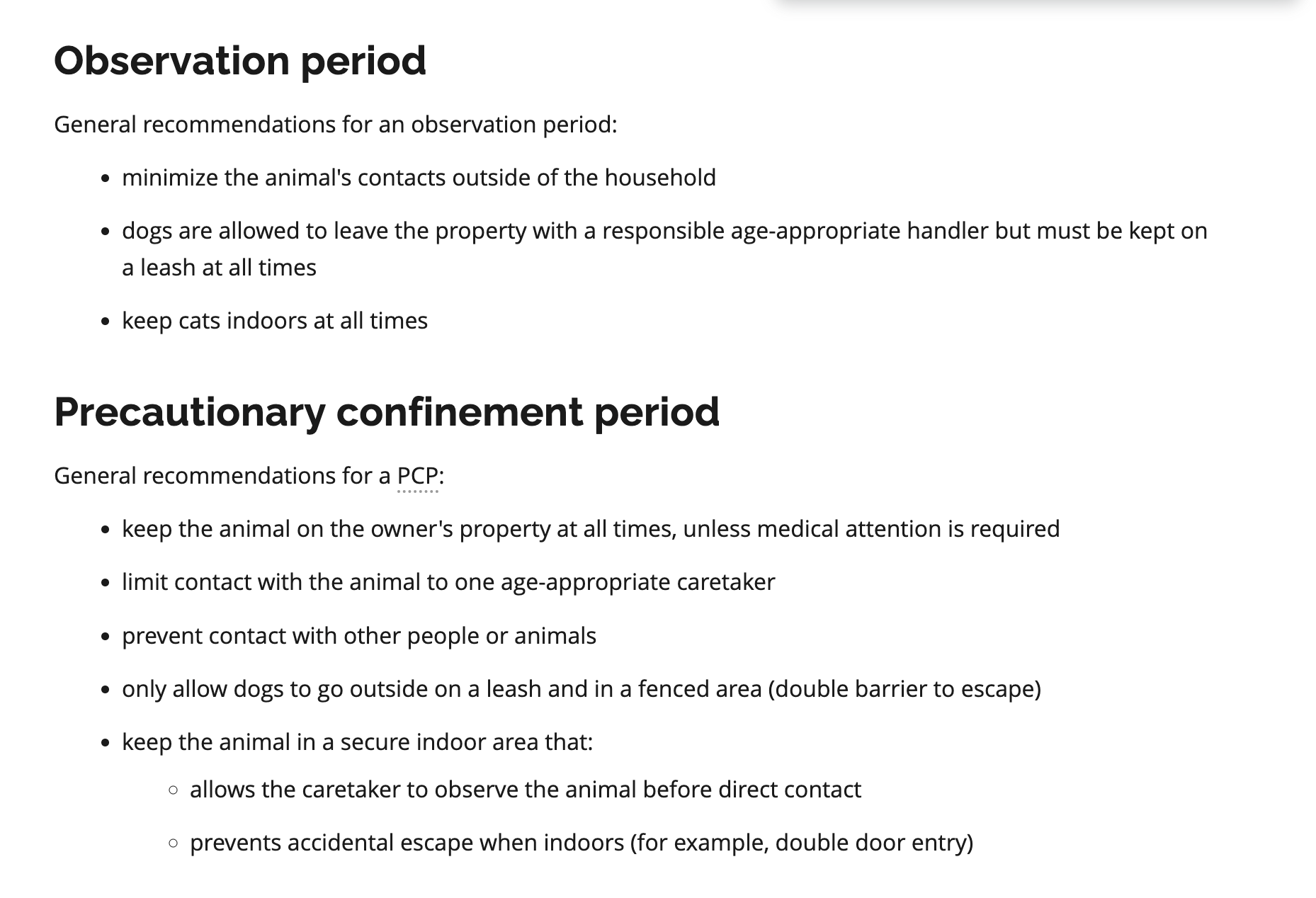
The general recommendations for an observation period versus a PCP in Ontario are shown below:
Why can we give a single dose of rabies vaccine at 12 weeks, but we can’t be confident in the response to other core vaccines at the same age?
Rabies vaccine is really good at what it does – it stimulates a great immune response. Rabies vaccine is also a killed vaccine, and killed vaccines are not impacted by maternal antibodies to the same degree as modified live or recombinant vaccines. Those vaccines usually contain a small amount of the modified or recombinant virus, which has to either replicate or induce expression of their target proteins to stimulate a protective response from the immune system. Maternal antibodies can neutralize this small amount vaccine virus, which limits or prevents the desired immune response. While there can be some maternal antibody interference with killed vaccines, it’s much less of an issue because of the large amount of antigen in the vaccines, and no need for it to replicate.
As a result, our default should be to vaccinate puppies and kittens (and ferrets) against rabies at 12 weeks of age. There may be rare circumstances where that’s not possible, but that should be the goal. At the same time, we have to do good client education to make sure they bring their pets back for the all-important 16 week core vaccines, because when I see parvovirus or distemper “vaccine failures,” it’s almost always dogs that got some puppy vaccines but stopped too early, before that 16 week dose.