Lifetime LymeGuest blog by Dr. Michelle Evason, DVM DipACVIM (as well as current PhD student and coordinator of our Lifetime Lyme Study)

In 2014, the Public Health Agency of Canada (PHAC) initiated a 3-year marketing campaign (news, advertisements, social media, collaboration with Parks Canada to post signage, etc.) to try to raise the general public’s awareness and educate them on the topic of Lyme disease. This (Lyme) isn’t exactly a low profile subject… and it’s become increasingly high profile in the past several years. Particularly in Canada, where ticks appear to be giving raccoons a solid run for the title of top non-human vector of disease causing pathogens.

Interestingly (and fairly forward thinking in my opinion), two studies (see below) were performed to look at the level of Lyme awareness in canucks and secondarily to assess whether PHAC’s targeted educational media blitz had any effect on understanding of Lyme disease and subsequent behavior changes regarding tick prevention. I suspect the study group was hopeful things would indeed improve and it would be considered dollars well spent… although some of us tend to be cynics about that sort of thing (and yes, that is my idea of subtle foreshadowing). Cutting to the chase… a bit strangely (and sadly) Canadian respondents’ correct answers for prevention or reduction of tick attachment, i.e. avoiding wooded areas or mowing one’s lawn regularly, appeared to decrease over the course of the media campaign. In other words, there were more correct survey answers before the educational intervention than after the 3 years of media coverage. Also (again a bit depressingly), questionnaire respondents tended to answer incorrectly more often if they lived in a Lyme “higher risk” zone or location.

Fortunately (maybe?) most Canadians who participated in the studies appeared to know about Lyme disease and also what medical symptoms are associated with illness. So, the “raise awareness” box did appear to get checked – which is wonderful. However…this didn’t appear to translate into knowledge regarding how to protect oneself from actually getting Lyme disease, such as regular tick checks, wearing protective clothing or using tick repellent.

I’ve never understood why knowing something doesn’t translate into actively doing something about it. Granted I have developed a few theories over the years, and I’m positive my family would be pretty quick to say that I don’t always make the best choices even when I know better also, so glass houses and all that. On the other hand, Lyme disease gets an awful LOT of attention, and it seems like focusing some of that energy on preventing it from happening might be good? And I suspect that would be true for all animals at risk, not just the ones who bark or whinny most believably.

Aenishaenslin, C., Bouchard, C., Koffi, J. K., Pelcat, Y., & Ogden, N. H. (2016). Evidence of rapid changes in Lyme disease awareness in Canada. Ticks and Tick-Borne Diseases. http://doi.org/10.1016/j.ttbdis.2016.09.007

Aenishaenslin, C., Bouchard, C., Koffi, J. K., & Ogden, N. H. (2016). Exposure and preventive behaviours toward ticks and Lyme disease in Canada: results from a first national survey. http://doi.org/10.1016/j.ttbdis.2016.10.006


rough collieThere were several more reports over the weekend in follow up to the canine influenza outbreak at dog shows in Florida early last week.  Unfortunately, but not surprisingly, associated cases were then found in North Carolina, and have now been reported in 11 states, no doubt  from dogs that were at the shows in Florida (and Georgia) and unwittingly brought the H3N2 canine influenza virus (CIV) home and spread it to local dogs.  Two deaths were even reported in North Carolina, but details were not provided so it’s difficult to determine exactly what role influenza may have played in these outcomes (i.e. these dogs could have had other complicating conditions resulting in more severe disease).

So the question now being asked is, what should dog owners do if they had plans to take their dogs to shows in the affected states, or anywhere else for that matter?

If owners want to go to such events, they have to accept that there is increased risk that their dog(s) could get sick.  Period.  But that actually applies to any canine group setting, anytime, anywhere, and CIVs is not the only infectious disease risk.  If they’re really worried about CIV then they probably shouldn’t go at all, but they should probably also never take their dogs to the dog park either in that case, because there are similar risks.  However, if attending a dog show or other group event there are some measures that can be taken to reduce the risk of infection.  One way to think about it is that dog flu is spread very much like human flu, so strategies to avoid it are very similar as well, such as:

  • Don’t let your dog have close contact with unknown dogs, especially dogs that are sneezing, coughing or otherwise sick (but remember that healthy dogs can shed CIV as well if they’re either incubating or recovering).
  • Don’t share food/water bowls, toys, blankets or grooming supplies with other dogs, as these items could be fomites for pathogens.  Washing or laundering such items can also help decrease contamination (especially, for example, upon returning home (or better yet, just before leaving the event)).
  • People can also be a fomite, so it’s important for the owners to pay careful attention to hand hygiene (e.g. use hand sanitizer often), especially if they  handle/touch other dogs, in order to avoid transferring pathogens to their own dog(s).
  • Vaccine is definitely worth considering, but this should be a discussion between veterinarian and owner in advance.  The CIV vaccine is certainly not perfect, and it does have its shortcomings (just like human flu vaccine), but it can still help and the risk associated with vaccination is otherwise low.  Dog(s) attending shows and other events should definitely by up-to-date on all their core vaccines as well (including rabies!).

Not all areas (in the US or otherwise) are the same risk for CIV.  Outbreaks tend to be localized, but as just demonstrated by the consequences of the Florida dog shows, outbreaks can very rapidly spread to other areas with the movement of dogs.  Owners should contact the organizers of the specific show to ask what the situation is in the area.  If there is an increased risk of CIV, the show organizers would ideally be alerting attendees and taking additional precautions at the show to decrease the risk of transmission (e.g. increased cleaning and disinfection protocols, management of participants to limit mixing of dogs, etc), assuming they decide that “the show must go on” despite the risk.

There is an excellent technical paper on risk reduction strategies at canine group events that was published last year (Stull et al, JAVMA 2016).  It is geared more toward organizers of such events, but would also be a good reference for veterinarians that may be involved in some way.  It covers infectious disease risks in general, including but not limited to CIV.

The other important thing to remember is that in most young, healthy dogs (hopefully most show dogs fit in this group) disease from CIV is relatively mild and resolves without complications, so even a dog did get sick, it usually just means giving the animal some down time at home and ensuring it does not come in contact with other dogs during the risk period for shedding (which could be a few weeks).  In reality, any time owners return with a dog from a show (especially outside of their local area), that dog should be kept separate from other dogs (both on and off the property) in case they picked something up but have not yet developed signs.  A couple of weeks would be ideal, but even a few days or a week (especially for CIV, which has a relatively short incubation period) would be better than nothing.

With canine flu, as for any infectious disease, there are always different factors that increase or decrease the risk of infection in a given situation, some of which we can control to some degree, and others which we can’t.  The key is to find the balance so that group events can still take place, but the risk is reduced to an acceptable level for the participants.  As several of the articles about this outbreak have mentioned, now is not a time to panic, but it is a time to take precautions.

green-germA new Clinical Consensus Guideline, coordinated through the World Association for Veterinary Dermatology, has been released: Recommendations for approaches to methicillin-resistant staphylococcal infections of small animals: diagnosis, therapeutic considerations and preventative measures. Clinical Consensus Guidelines of the World Association for Veterinary Dermatology

This large and comprehensive document is open access and can also be downloaded via the Veterinary Dermatology website as well as through the link above.

The recent H3N2 canine flu outbreak centred around dog shows in Florida has led to the usual round of questions and concerns.

How many dogs have been affected?

  • 3 dogs at parkHard to say. Cases aren’t carefully tracked and it is reasonable to assume that the majority of dogs that developed influenza (especially mild disease) were never diagnosed. Testing costs money and often doesn’t change how a dog with respiratory disease is managed, especially in the midst of an outbreak where influenza is assumed to be the cause. Therefore, a lot of cases get presumptively diagnosed but not confirmed. We keep working on ways to better track diseases like this but getting uptake is a challenge.

Is this a sign of a new problem?

  • No. Canine flu has been around for a while, although H3N2 canine flu is a relatively new arrival to the US. The virus causes sporadic larger-scale problems (like this outbreak), but then tends to retreat back to being a low-level disease. Outbreaks are always possible with a flu virus when it gets into a dog population with lots of close contact and limited immunity (not previously exposed or not vaccinated). A dog show is a great mixing vessel for viruses like influenza. All it takes is one infectious dog to cause an outbreak that can spread rapidly, as opposed to an infected household dog that has far fewer opportunities to infect other dogs during the relatively short infectious period.

Should my dog be vaccinated?

  • There’s rarely a yes/no answer to this question. Vaccination decisions should be based on a risk assessment, considering the likelihood that your dog will be exposed and the implications of infection. Things that increase the risk/need would include:
  1. Known presence of circulating canine flu in the area.
  2. Planned travel to an area where canine flu is present.
  3. Regular or upcoming interaction with lots of different dogs.
  4. Regular or upcoming interaction with dogs from areas where canine flu may be present.
  5. Dogs that are at increased risk of complications following infection.
  • This last factor is something I think is often overlooked (and we don’t have a lot of data to go on). Influenza infection is usually relatively benign, but it can be serious. In humans, we know that certain groups are at increased risk of complications. The same presumably applies to dogs, although it’s less well defined. For me, I get concerned about dogs with underlying heart and respiratory tract disease that might not tolerate infection well. I’m also concerned about elderly dogs and dogs with diseases that compromise their immune systems. These are groups of dogs that probably also have fairly low vaccination coverage rates in general.

What should I do if I live in an area where canine flu is present?

  • Know what’s happening, as much as you can. If an outbreak is largely confined to show dogs, average pet dogs are at lower risk, but show dogs may still interact with pet dogs at parks and other areas. If there are anecdotal reports of dogs getting sick from parks or other routine contacts, that’s useful to know (even though you have to take those types of reports with a grain of salt).
  • If there is known flu activity in the area (or vague reports of coughing dogs without a diagnosis), consider keeping you dog away from other dogs for a while. Influenza usually burns through a population fairly quickly, so we’re talking about days rather than weeks, in most situations. The less dog-dog contact, the less risk of flu spreading. To maintain an outbreak, the average dog with flu must encounter and infect another susceptible dog during the fairly short time it is shedding the virus.
  • If your dog develops signs consistent with influenza (e.g. cough, runny nose and eyes, lethargy, decreased appetite), keep it at home and away from other dogs. If you need to take it to the vet, call ahead so they can make a plan to prevent exposure of other dogs (e.g. examine your pet outside, bring it right into an exam room or isolation to prevent it from mixing with other patients).
  • Talk to your vet about vaccination.

What should I do if I live in an area where canine flu is not present?

  • Pretty much the same list as above. “Not present” really means “Not present at the moment” or “Not known to be present,” since any dog you pass on the street could potentially be infected. The risks are obviously much lower in areas where flu activity hasn’t been reported, but disease reporting in dogs is pretty lax.

Can cats be infected?

  • Yes, although it’s much rarer in cats than dogs.

Is there a risk to people?

  • I should say there’s “no risk” since that makes my life easier, but the answer is probably more accurately “there’s virtually no risk.” Infectious diseases like to do odd things ,and while there’s no evidence that H3N2 is a zoonotic disease concern, I can’t say with complete confidence that there’s not a rare subset of people who would be susceptible (usually with mild infection). Most likely, lots of people have been exposed and some have had the virus enter their bodies, where their immune system took care of it with no problems. Rare mild disease may not be occurring or may easily be overlooked. The bigger concern is the potential for a dog or other species to be infected with H3N2 and another flu virus at the same time, creating a new virus that could be more virulent in people. This is always a concern, but the odds of this happening are very low. The fact that it’s past peak human flu season probably helps too, reducing the odds of a co-infection.

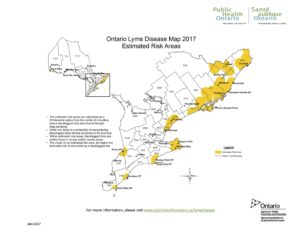
To continue the map-posting binge that I’ve been on lately, Public Health Ontario has just posted their updated Lyme Disease Risk Areas map for 2017.  For comparison, you can still also access the 2016 map too, and you can see that the risk areas have indeed expanded somewhat, particularly in Eastern Ontario.

  • The estimated risk areas are calculated as a 20 km radius from the centre of a location where blacklegged ticks were found through active drag sampling.
  • While low, there is a probability of encountering blacklegged ticks almost anywhere in the province.
  • Within estimated risk areas, blacklegged ticks are mainly found in woody and/or brushy areas.

For more information about how these maps are generated and how areas are selected for active tick dragging, download the complete pdf document here, or check out the PHO Lyme Disease website.

Lyme_disease_risk_areas_map_2017 copy 2

Our online Pet Tick Tracker continues to receive lots of submissions, so here are some interesting maps showing some of the preliminary information compiled so far.  The maps show where the ticks are being reported, but remember that they’re not necessarily reflective of the true overall picture, since it depends on who is reporting and who isn’t reporting. However, it’s still useful for looking for trends, e.g. where certain ticks are more common. We’re also looking for outliers, e.g. tick reports from areas where we don’t expect to find them.  Outliers can potentially be followed up with active tick surveillance to see what’s there.  Most submissions so far have been from Ontario, so I’ve only posted those maps.

Map 1: Dermacentor (American dog tick, green) and Ixodes scapularis (black legged tick, purple).

  • Here, not surprisingly, we see Ixodes predominating in eastern Ontario, with Dermacentor predominating around Toronto and to the west.

Derm Ixodes 0removed copy

Map 2: Hot spot analysis of Ixodes scapularis reports

  • This is an analysis of the data that shows “hot spots” – places where Ixodes ticks are under- or over-represented

hot spot ixodes with legend copy

More to follow. Please keep the submissions coming!  Visit PetTickTracker.


Whapmagoostui-Kuujjuarapik_1695Two rabid dogs have been identified in Whapmagoostui, a Cree community in a remote region of northern Quebec. Rabies is very rare in dogs in Canada, and in recent years, much of the concern has revolved around rabies in dogs from northern communities. Rabies is endemic in Arctic foxes, and dogs can be infected from contact with such animal, and then act as a bridge for transmission to other dogs and people. Rabid dogs have also inadvertently been shipped to more southern regions of Canada as part of rescue programs.

Whapmagoostui, along the east coast of Hudson Bay, has many of the typical challenges of northern communities based on its remote location, with access only by plane or seasonally by boat, no veterinarian and a roaming dog population. The presence of packs of roaming dogs appears to be new, as indicated by public health officer Reggie Tomatuk in a CBC interview. “When I listen to our elders, they said to me ‘we never let our dogs loose in the community. That never happened before. It’s not just Whapmagoostui, but it’s all over the Cree Nation.”

While challenges in the north are different than in the south, the same big issues create risk, including unvaccinated, roaming animals. Increasing rabies vaccination coverage in dogs in the north is important but can be difficult and expensive. Reducing roaming and encounters with wildlife requires efforts in (and directed by) communities. These cases also highlight the need for care when transporting dogs, whether it’s importing from another country or from a region with different disease risks within the same country.

800px-Perameles_gunniA playground in New South Wales, Australia, has been closed because its sandpit was linked to salmonellosis in two children. Sandboxes are a potential source of a few different infectious diseases since they can be used as litterboxes by animals such as cats, raccoons, and apparently, bandicoots.

In the Australian incident, two kids were diagnosed with salmonellosis and public health’s investigation presumably identified the sandpit as a common exposure. The kids were infected with Salmonella Java, a type that’s been found in various animals and has been linked to bandicoots in AustraliaSalmonella Java has previously been implicated as the cause of a sandbox-associated outbreak in Australia, along with an outbreak associated with beaches.

It’s not clear from the news report whether there was confirmation of the sandbox as the source. It says the sandbox was tested, but not whether it was positive. Given the Salmonella serovar and the sandbox link, it would be a fairly solid presumptive diagnosis even without a confirmed bacterial culture.

Prevention of sandbox-associated disease can be difficult, depending on the situation. Covering sandboxes is ideal, but not always feasible (and not an option for a beach, obviously). Additional protective measures such as paying attention to hand hygiene, supervising kids so they don’t put sand or sandy objects in their mouths (sometimes easier said than done!) and paying extra attention to hygiene if they are eating in/around sand make sense and are practical. These measures don’t remove all the risk, but zero risk isn’t a realistic goal.

More information about reducing the risk associated with sandboxes can be found in the Sandbox infosheet on the Worms & Germ Resources – Pets page.

Image: Eastern barred bandicoot, Australia (credit: JJ Harrison 2010)

Dog in grassOver the years, we’ve tried a variety of new approaches to promote awareness (among the public, veterinarians and others) and to collect relevant research information. Some (like this blog) have taken on a life of their own and exceeded our expectations. Some didn’t go very far. Our most recent initiative is the PetTickTracker, a website designed to collect information about ticks found on animals. The goal is to raise awareness, see where ticks are being found currently, see if ticks are being reported in areas where they haven’t been in the past, and identify movement of new tick species in the area. This type of information can help inform where and what education campaigns might be needed, or identify specific areas where targeted tick dragging might be useful to follow up on interesting results.

That was the thought, at least.  It was launched two weeks ago, and I had no idea what to expect.

So far, we’ve had over 1100 responses… that’s way more than I thought we’d get, and great news. We’re in the process of looking at the data now, and hopefully we’ll have some mapping data to present soon. In the interim, here are some interesting tidbits:

  • Most reports were ticks from dogs, accounting for 84% of responses. That’s probably a reflection of their likelihood of exposure, their close observation by owners and the overall number of households with dogs.
  • The black legged tick (Ixodes scapularis) was most commonly reported, accounting for the majority of identified ticks. Dermacentor variabilis, the American dog tick, was the second most common. “I don’t know” was the next most common, showing how more tick ID education and resources are needed (there is a chart included on the PetTickTracker site itself).
  • The Lone Star tick (Amblyomma americanum) was reported 20 times in Ontario. That’s a tick type we’re watching in case it’s establishing itself in the province.
  • 70% were thought to be adult ticks. Age wasn’t certain for 22% of submission, and 8% were identified as nymphs.
  • Approximately 17% of animals had travelled over 20 km from home in the past 2 weeks. This shows how mobile out domestic animal populations are and how it’s possible for them to move ticks around between regions.

TickTracker short QR codeKeep the submissions coming! Access the PetTickTracker here, or copy the link below into your web browser, or scan the QR code with your smart phone. https://uoguelph.eu.qualtrics.com/jfe/form/SV_8pEFcT8xAEyK6hv


scruffy-puppyEvery few weeks I get a call or an email about travel-associated rabies exposure concerns. It’s usually from someone traveling to southeast Asia or India who has been bitten by a stray dog. Most of the time, it’s an unvaccinated person and the dog isn’t available for monitoring or testing. Since rabies is endemic in dogs in those areas and there’s no way to rule it out if the dog isn’t identified, it has to be considered a possible rabies exposure and is an indication for post-exposure prophylaxis (PEP). Sometimes PEP can be done in the country being visited, but often it’s done when the person gets home. In most situations, rabies exposure is best considered a medical urgency not a medical emergency. The incubation period for rabies is pretty long, and as long as PEP is started in a reasonable period of time, rabies is virtually 100% preventable. There are some situations where very prompt treatment is indicated, such as a bad bite to the head or neck, since rabies virus can move through the nerves to the brain much quicker in such a case given the close proximity.  With most exposures, there’s usually ample time to organize things and get home for treatment, often without needing to change travel plans.

Unfortunately, lack of awareness leads to rabies deaths. That’s a big problem in developing countries where the virus is endemic and thousands die ever year, but public awareness of what to do is still poor.

It’s also an issue with travelers. People often don’t go to travel clinics before visiting these regions or if they do, they don’t want to pay the rather expensive cost of pre-exposure rabies vaccination. Most often, they get away with it. However, travel associated rabies deaths occur occasionally.

A recent example is a person from Virginia who contracted rabies from a dog bite in India. I haven’t seen many details about the case, but I expect more information will come in the form of a CDC publication in the future.

Regardless, it’s a reminder that this disease is a major concern in many parts of the world, particularly areas in Asia, India and Africa. Vaccination isn’t cheap, but it’s a highly effective preventive measure for an almost invariably fatal disease.

It’s also a reminder that travelers need to know the risks and what to do. Without vaccination, rabies is still almost completely preventable if post-exposure prophylaxis is started, even weeks after exposure.

Thinking about things that can kill you isn’t at the forefront of people’s minds when planning a trip, but a little prevention can go a long way.