

Whether it’s dealing with an individual patient or developing international antimicrobial use guidelines, one of the bigger challenges we face in regard to antimicrobial treatments for dogs and cats is determining how long different infections need to be treated.
Unfortunately the treatment durations most commonly used are not evidence-based. We have very little data to go on, but well-established dogma that’s often largely based on something someone said or wrote (without evidence) possibly decades years ago. (This phenomenon is also not unique to veterinary medicine!)
It’s not that the traditional (old) approaches are inherently wrong, but we have to realize they’re not necessarily right, and we have to be open to change. Most antimicrobial treatment durations currently used in dogs and cats (and sometimes other species) are probably way too long; when we compare them to what’s done in human medicine for comparable conditions (for which they have a lot more large-scale studies), some of the differences are striking. But people are often (understandably) reluctant to change, even when there’s little or no evidence to support current practices, and we have circumstantial evidence (and basic principles) that suggest we’re treating patients for too long. We’re afraid of the risks of not treating long enough, but treating for too long also has risks, especially when it comes to antimicrobial resistance.
As the clinical antimicrobial treatment guidelines field advances, we’re underpinning new guidelines with evidence syntheses, particularly systematic reviews, to help change people’s minds and ultimately (hopefully) prescribing practices.
A new systematic review entitled “Shorter versus longer durations of antibiotic treatment for pneumonia in dogs and cats: a systematic review and meta-analysis” (Emdin et al. 2025) should help us revise our treatment guidance for pneumonia in dogs and cats. Veterinarians sometimes make recommendations for very long treatment courses for pneumonia in pets, which is in stark contrast to what’s done in humans and other species such as cattle.
Unsurprisingly, the systematic review only found a small number of studies (3) for dogs and none for cats. Two of the canine studies were randomized controlled trials (yay!) and one was an observational study (which provides lower level evidence and is more prone to bias, but still important to consider since we have such limited data in veterinary medicine). Meta-analysis showed no significant difference in outcomes (both clinical cure and recurrence) between animals treated with shorter (10-14 days) versus longer (21-28 days) courses of antimicrobials (see tables below or the full review for more details).
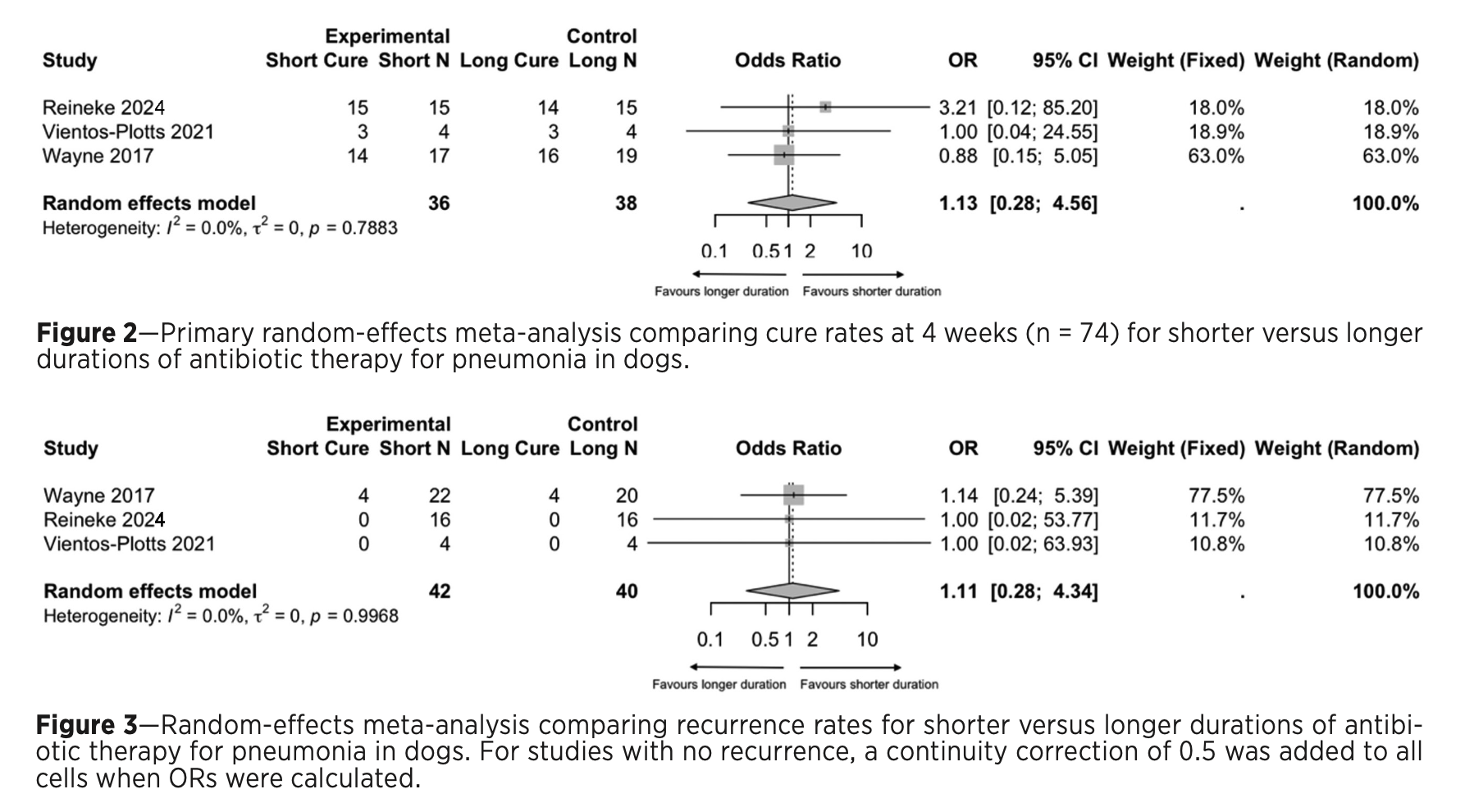
BUT there are lots of provisos. There were only 3 studies, and they were fairly small (only 74 dogs in total), so the assessment of the certainty of evidence was deemed very low (details in table below).
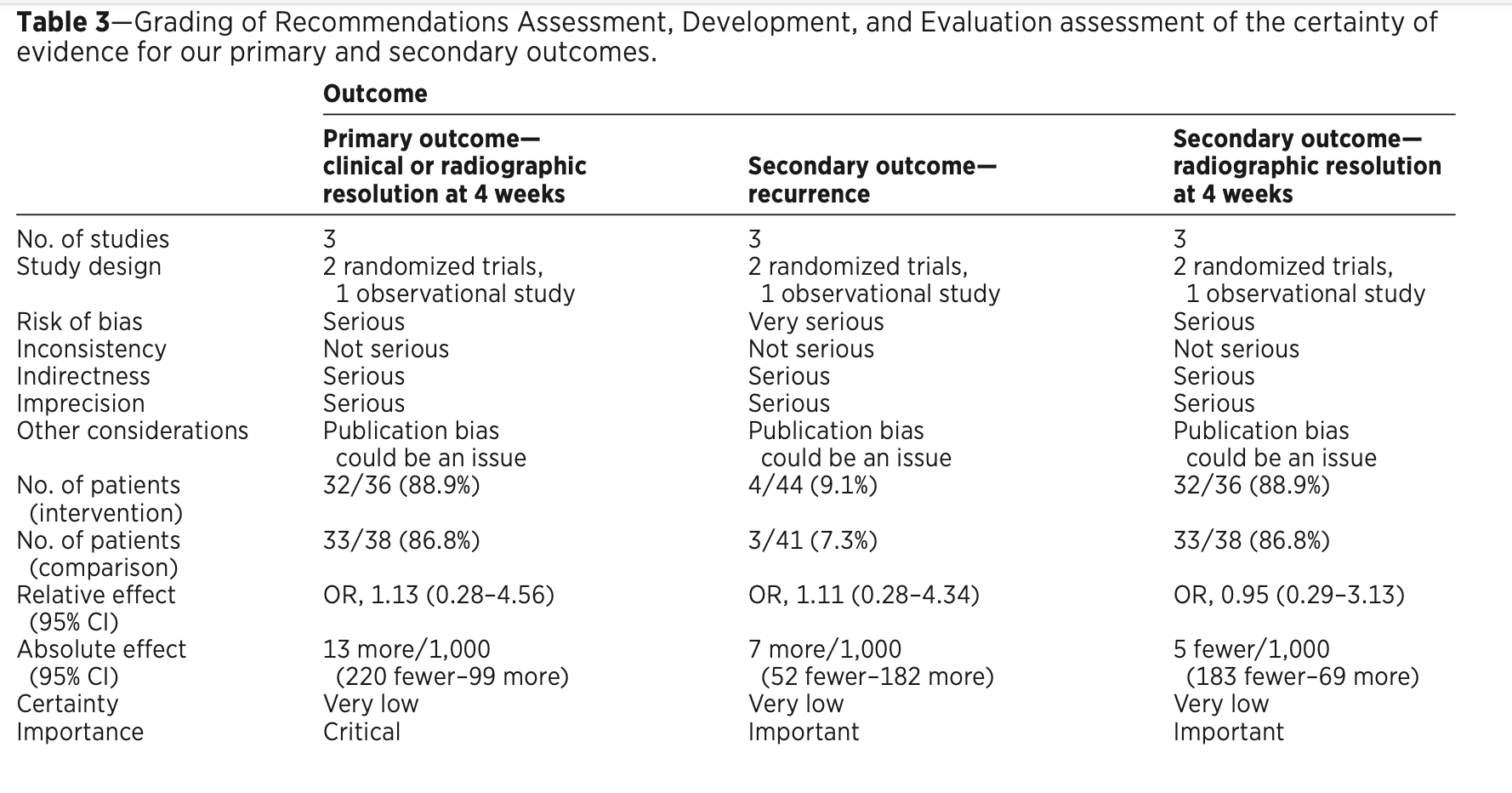
Despite the limitations in the data, this study suggests that we can use shorter treatment durations for pneumonia in dogs. It also highlights yet again that we need more data and better studies. We also need to study even shorter treatment courses to see if they’re effective. In humans with community-associated pneumonia (i.e. not acquired in hospital), there are numerous controlled trials showing 3-5 days of antimicrobials is just as effective as longer courses (check out Dr. Brad Spellberg’s “Shorter is better” website for more details). In cattle, we also we use much shorter treatment courses, typically only a few days, or a single dose of a long-acting drug that provides coverage for 3-8 days.
While this review suggests that we don’t need to treat pneumonia is dogs for longer than 10-14 days, but doesn’t tell us if even shorter courses would be just as effective. I suspect that if we had a study looking at 5 versus 14 days of treatment, we’d see they are equivalent. My current standard recommendation for treatment duration in these animals is 5 days; although this is admittedly based on no direct evidence in dogs and cats, we have enough indirect evidence that I’m comfortable with it as long as the patient responds clinically over those first 5 days.
Fortunately, the fields of evidence synthesis and guideline development are advancing in veterinary medicine. Unfortunately, we have many, many areas in which data are still limited or non-existent. That means we have lots of low-hanging fruit for future studies; more data will help us make more robust and reliable guidelines.