Titres… ugh. I spend a lot of time answering questions about titres, with little data to go on.

What are titres?

Titres are a measure of antibody levels in the bloodstream. Antibodies are produced by the body in response to infection or vaccination.

What do titres tell us?

Titres indicate whether a specific antibody is present in the blood, and how much (or a relative idea of the amount of antibody that is present). No more, no less. It doesn’t mean that the antibodies are actually useful, or that the amount present is enough to prevent infection. It just tells us whether or not the specific antibodies we’re assessing are there.

What do titres not tell us?

Titres don’t tell us anything about other parts of the immune system, most importantly the components that make up what’s called “cell-mediated immunity.” I won’t get too far into the immunology here, but basically there are two main arms of the immune system, humoral immunity and cell-mediated immunity. Humoral immunity is driven by B cells (a type of white blood cell) that produce antibodies to specific antigens. Cell-mediated immunity is driven by the action of T cells (a different type of white blood cell) and does not involve antibodies. Both are very important for fighting infections, but measuring antibodies tells us nothing about cell-mediated immunity.

What is a “protective titre?”

By definition, a titre that is known to be high enough to protect against infection after exposure to a specific pathogen would be considered “protective.”  This can be determined through prospective studies following animals with known titres that are naturally exposed to the pathogen, or through experimental studies in which animals are exposed in a laboratory setting, and then watching/testing to see which animals still get sick or stay healthy. However, we don’t have much data about protective titres for disease in animals (and almost nothing that applies to field situations).

But labs report “cut-offs” for titres, so that’s the protective titre, right?

Here’s a statement from the 2022 AAHA Canine Vaccination Guidelines:

  • “…, at best, the determination of “protective titers” has been based on limited data. These data were thoroughly reviewed 20 years ago. Nothing more substantive has become available since then. ELISA-based in-clinic antibody detection tests have been available for CPV and CDV for more than 20 years. HI and VN tests, respectively, were used as “gold standards” to determine their sensitivity and specificity, as it relates to a “protective titer.” Commercial ELISAs have been applied in shelter populations outside of the laboratory and further compared with HI and VN tests. Such applications have provided no further basis for a determination of “protective titers,” primarily because the titers or amounts of antibody were not correlated with clinical outcomes. Recognizing these limitations, no values for “protective titers” are indicated in these guidelines, although some commercial laboratories will provide them.

Some labs will report cut-offs, but it’s not clear from where those values came, and it’s exceedingly unlikely they are based on any study of protection from actual disease.

Here’s another statement from the 2022 AAHA Canine Vaccination Guidelines:

  • Altogether, a titer, almost regardless of the amount, is not necessarily indicative of protection or susceptibility. Rather, it is more complicated than that. Disease in the individual animal results from the interaction of host, pathogen, and environmental cofactors. It can be misleading to forecast an outcome on the basis of one cofactor: a titer.

All that said, the presence of a detectable titre is probably a good sign and, in general, higher is better. However, what specific titres mean in terms of protection is impossible to say. No one should ever interpret a titre as indicating there’s no risk or no need to vaccinate. Similarly, a very low titre shouldn’t be interpreted as zero protection. We simply don’t know what those values mean.

Can titre testing be use lieu of vaccination?

This is the most common question about titres, and I’m not overly comfortable with it. It’s an appealing approach in some situations (although more costly that vaccinating). A high titre probably means good protection. A low titre might mean protection is poor, but it’s quite possible that the animal is still protected because there’s still sufficient antibodies and/or cell-mediated immunity (which we can’t measure directly). If there’s reason to consider stopping routine vaccination (e.g. adverse reactions, vaccine hesitancy), I focus less on titres and more on the animal’s vaccination history (i.e. number of previous doses and timing) and the animal’s ongoing risk of exposure. Rarely would a titre change what I’d recommend.

I’m required by law to have my pet vaccinated against rabies. Does a positive titre mean I can get an exemption?

No (or at least not anywhere that I know about). Rabies vaccination is required in many jurisdictions, including in Ontario for all dogs, cats and ferrets over 3 months of age. Sometimes exemptions can be made for pets that have a medical reason that vaccination should be avoided. However, that only exempts the pet from the legal requirement to be vaccinated, it doesn’t exempt it from the implications of a potential rabies exposure. If a dog or cat is exposed to a rabid animal, its vaccination status is a key determinant in what happens, ranging from a short observation period to 6 months strict quarantine (or even euthanasia). It doesn’t matter why the dog wasn’t vaccinated or if it has a high rabies antibody titre. A good titre would be some reassurance that the dog is likely protected, but it’s not enough of a guarantee to change the post-exposure management requirements.

There are specific titre tests for rabies that are required by some countries for importation of dogs. Those should be good, right?

“Good” in terms of accurate, with well-described, standard methods? Yes.

“Good” enough to prove that an animal has been vaccinated against rabies? Yes.

“Good” enough to show the animal is protected against rabies? Not necessarily.

While there is a standard cut-off for rabies titres for the purposes of international travel, it does not guarantee the animal is protected from  infection.  For good reasons, no one has done live animal studies looking at what titres protect dogs and cats from rabies virus infection. The 2022 AAHA Canine Vaccination Guidelines state “Antibody titer levels as correlates of protection have not been established for rabies, and serologic testing is not considered a substitute for vaccination.” So, rabies titres are best to prove that an animal has been vaccinated and provides a reasonable suspicion that they would be protected, but are far from a guarantee. That’s why we want to vaccinate whenever possible.

What is titre testing good for?

To me, titre testing is useful to say whether an animal has been vaccinated or has previously been infected. It’s probably of most use in a shelter situation where animals often come in with no vaccination history. If they have a titre, they have either been vaccinated or been previously infected (and are quite possibly immune to reinfection, at least for a while). That can be useful information for managing the animal (e.g. where to house it, whether to foster it, priority for vaccination, isolation approaches), particularly in situations where there’s an outbreak or high disease exposure risk.

There might also be value in testing dogs and cats whose last “core” vaccine was at 16 weeks of age. That’s the age where we assume they’ll respond to the vaccine, but some don’t. Personally, if in doubt, I’d rather just give another dose at 20 weeks (as per guidelines) but if there’s a reason to avoid vaccination, titres could be considered to see if there’s been a response to any of the earlier vaccines. I’d be looking at a yes/no versus a number, as with shelter admissions.

Beyond that, I’m less convinced and think the following series of questions provides more insight into immune status and the need for vaccination:

  • How old is your dog/cat?
  • With what has it been vaccinated and when?
  • What is your pet’s lifestyle, including exposure to other animals?

With those, I can have a pretty good idea about immune protection and disease risk, maybe as much (or more) than if I had a titre measurement.

I think this concludes our vaccination question series, but if there are other questions, send them my way, and we can move on to Part 6.

A busy hockey weekend delayed this topic. I thought this would be a quick one, but there are some interesting and complex issues…and as we move deeper into the vaccination series, there’s even less information on which to base decisions.

This post deals with issues surrounding vaccination at or near the time of surgery. Typically, we try not to load up on different procedures at the same time, but sometimes surgery may coincide with optimal timing for vaccination, or the time of surgery might be one of the few (or only) times an animal is seen by a veterinarian and thus the only opportunity to vaccinate (e.g. trap/neuter/release programs, barn cats).

When thinking about if/when/how to vaccinate, we need to consider a variety of factors, including impact on vaccine efficacy, risk of adverse events, ability to detect and manage adverse events, and practical components.

In humans, there’s no clear evidence that vaccination at the time of surgery is associated with a poorer vaccine response or increased risk of adverse events. An older review of the effects of anesthesia on vaccinationin children (Seibert et al. 2007) stated “We conclude that the immunomodulatory influence of anesthesia during elective surgery is both minor and transient (around 48 h) and that the current evidence does not provide any contraindication to the immunization of healthy children scheduled for elective surgery. However, respecting a minimal delay of 2 days (inactivated vaccines) or 14-21 days (live attenuated viral vaccines) between immunization and anesthesia may be useful to avoid the risk of misinterpretation of vaccine-driven adverse events as postoperative complications.”

The latter part of that statement is a common recommendation, i.e. avoiding vaccination close to the time of surgery to avoid situations where there’s a try to differentiate whether a fever or other non-specific issue is the result of a developing post-surgical complication (that might lead to something more serious and needs more investigation) or a common typically transient vaccine reaction (that might just need a dose or two of an anti-inflammatory). That’s relevant to veterinary procedures to some degree, but probably a lot less than in humans, since we don’t tend to recognize mild reactions like malaise as commonly or easily in our patients. It’s still something we have to consider if a patient has a surgery and a vaccine, and is a little bit off the next day… is something brewing, or is it just from the vaccine? However, I’d say those circumstances are pretty rare.

My take home message is that it’s probably better to space out surgery and vaccines if we can, but we don’t want to miss an important opportunity to vaccinate. If there’s concern that we might not see the animal again, I’d vaccinate (especially for an important vaccine that is needed asap). If the owner is committed to bringing the animal in later (e.g. we can vaccinate at the time of suture removal or shortly thereafter), then that’s probably ideal. However, we don’t want to let perfection to be the enemy of the good, so we should err on the side of making sure the vaccine gets administered, one way or the other.

So if we decide to vaccinate around the time of surgery, when do we do it?

  • Before surgery?
  • After the procedure but while still under anesthesia?
  • During anaesthetic recovery?
  • After the animal is awake but before the animal goes home?

Here are my thoughts:

Before surgery

  • Nope. The procedure is probably more important than the vaccine. We don’t want to risk having to abandon the procedure because of a vaccine reaction. There’s also the potential that any less serious reaction could impact response to anaesthesia, particularly blood pressure.

After the procedure while still under anesthesia

  • The pros are it’s easy to vaccinate an unconscious animal. We likely still have airway and IV access in the rare event that something really bad happens.
  • The cons are we can’t necessarily identify reactions as effectively if the animal is not fully awake.
  • I’ve seen some guidance on vaccination during anesthesia in humans that recommends avoiding vaccination under anesthesia apart from some select circumstances (e.g. certain developmental or behavioural disorders, or people with extreme anxiety or needle phobia). The analogy in the veterinary world would be an animal that is very difficult to handle and vaccinate, and the risks to the animal and handlers from vaccination while the animal is conscious outweigh any minor concerns about vaccination during anesthesia (e.g. vaccination of feral cats).

During anaesthetic recovery

  • There’s a lot of overlap between this option and vaccinating while the animal is still fully anesthetized (see above). We still hopefully have IV access (but not necessarily, depending on the clinic and procedure), so it’s easier to manage a serious complication. However, anesthetic recovery is already a complex time physiologically and it might be harder to identify early signs of an adverse reaction.

After the animal is awake but before the animal goes home

  • The pros are the animal has recovered from anesthesia and is getting back to normal physiologically, and we have a better ability to detect any complications that develop. The cons are the animals has to be handled more and poked after going through a procedure. Those concerns are minor for most animals, but the additional downside (which may be the main issue) is probably logistics and the risk of forgetting to give the vaccine.

Considering all these factors, it probably makes the most sense to vaccinate after anesthetic recovery, as long as the animal can be safely handled. Ideally that’s well after anesthetic recovery, but not as the patient’s walking out the door, so there’s a bit of time to observe the animal after vaccination. If the animal is getting an anesthetic in the morning, and is going home in the evening, vaccination an hour or two before discharge might be the sweet spot.

Like a lot of issues pertaining to vaccination, our decisions should be based on consideration of costs and benefits, but are complicated by the fact that we have almost no hard data on those costs and benefits. Some common sense can guide us; while I think my comments above are pretty reasonable, they are undeniably light on evidence.

The first two parts of this series covered our approaches to vaccination of “healthy” animals. We focus on healthy pets because they comprise the majority of the pet population, and because vaccines are typically labelled for use in healthy pets, e.g. “This product is recommended for the vaccination of healthy dogs…”.

Vaccine labels don’t say not to use them in “unhealthy” pets, but they also don’t give any guidance for vaccine use in such animals.  That’s because manufacturers aren’t going to test vaccine effectiveness and safety in animals with a wide range of different health problems, which would be vastly complex and very expensive (and might require use and euthanasia of lots of animals if an experimental study was done).

That means we’re left in a grey area with little guidance, and often that means we default to being conservative, i.e. “let’s only vaccinate healthy animals.”

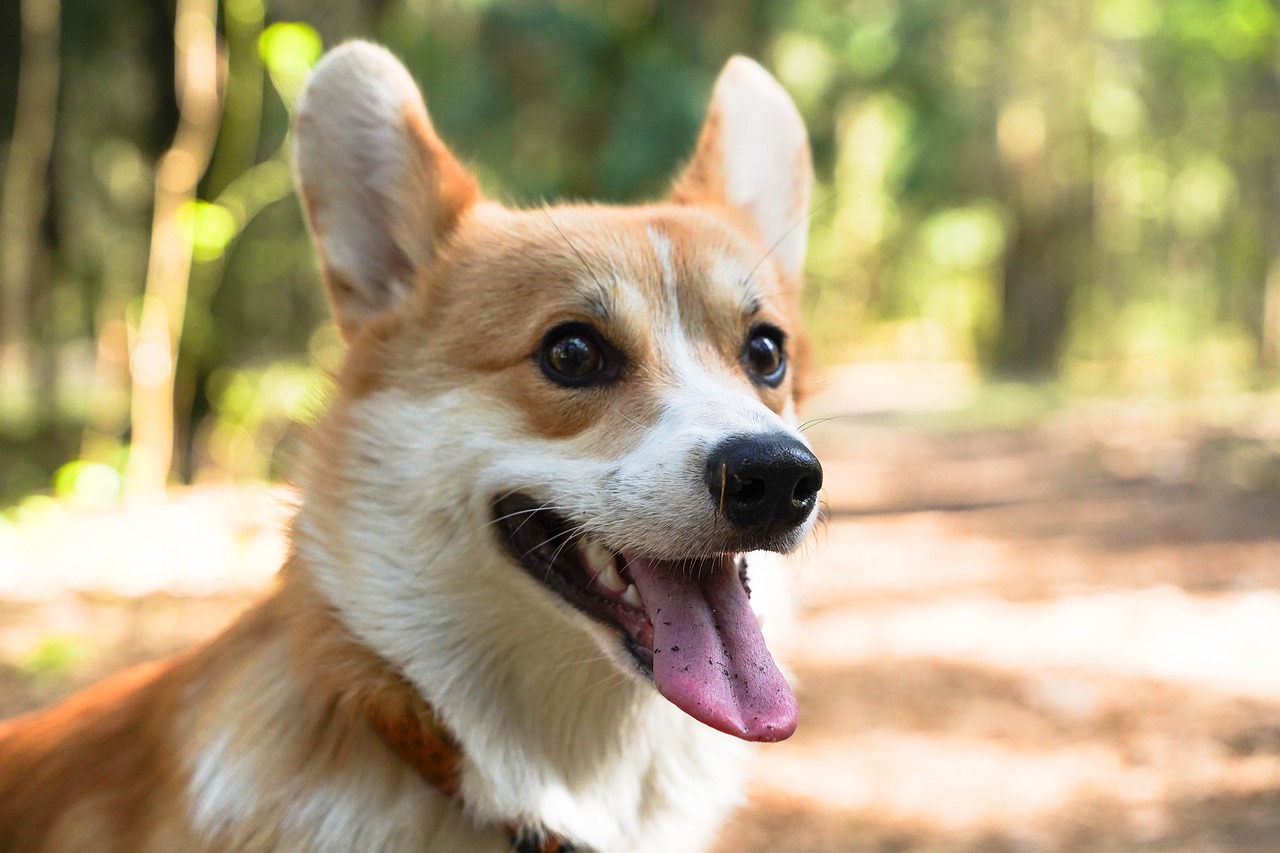
However, there are lots of unhealthy animals at any given time and some of these need to be vaccinated. So, what do we do if an animal isn’t the picture of health? (Note that the picture is an update on Ozzie – he’s not sick (as far as we know) but is definitely a drama queen.)

“It depends” is the answer, unfortunately.

While veterinarians often shy away from vaccinating sick animals, we can look to human medicine, where there’s much more information. Let’s think about COVID-19 for a minute. Did we say “let’s not vaccinate people who are sick (for other reasons)”? No. We said “let’s prioritize vaccinating people who are sick.” (e.g. those who have other illnesses and may be more vulnerable to complications from COVID-19). This is done with the recognition that some people may not respond well to the vaccine, but a poor response to a vaccine is still better than no vaccine, and people who are otherwise compromised already are at greater chance of severe disease.

Back to pets… what are the concerns with vaccinating sick animals?

There are two main issues.

  • One is the potential impact of illness on vaccine response. If the animal’s immune system can’t respond adequately, the vaccine may not work or may not work as well as desired.
  • The other is the potential for adverse events. The risk of an adverse response to a vaccine is probably not much greater in most sick animals compared to healthy animals, however, the impact of an adverse event in an animal that’s already ill could be worse than the impact in a healthy animal.

We have no data about this, though. While we don’t want to cause more harm to a sick animal, we also don’t want to skip a useful vaccine because of unfounded fears. That means we have to do a cost-benefit assessment, thinking about things like:

  • Risk of an adverse vaccine response
  • Impact of an adverse vaccine response
  • Likelihood of exposure to the disease
  • Impact of the disease
  • Severity of underlying disease
  • Underlying disease course and duration

Let’s consider a couple of scenarios:

  • Dog with bacterial pneumonia. This dog could be pretty sick and maybe wouldn’t respond to a vaccine as well as a healthy dog, and we’d rather not add the potential for a vaccine complications on top of the existing disease. Also pneumonia should be a temporary condition. Presumably the dog is being treated and will get better. Unless the risk of exposure to vaccine-preventable diseases in the short term is particularly high, I’d postpone vaccination until the dog has recovered. How long after recovery? That’s a guess, but if the vaccines are considered important, I’d be happy giving them 2-4 weeks after recovery.
  • Cat with chronic kidney disease. While we have management strategies for kidney disease, this cat will never be “normal.” It will always have some degree of disease, and it’s likely that it will progress over time. Therefore, we need to think about whether vaccines are needed, considering exposure risk, vaccination history, age and other factors. Odds are probably high we can skip most “core” vaccines, but we still wouldn’t want to skip rabies. So, we might decrease the number of vaccines but still give some. Unless the cat’s in an acute crisis that’s being managed and its condition will likely be better in the near future, I’d vaccinate it any time.
  • Dog that is being heavily immunosuppressed because of immune mediated disease. A modified live vaccine (a common format for most core vaccines) would best be avoided, since it’s possible that the attenuated viruses in these vaccines could cause disease in a highly immunocompromised animal. Beyond that, response to other vaccines might be poor. Hopefully, the dog’s immunosuppressive treatment will be tapered over the short term, so the risks might decrease over the next few weeks or months. So, I’d rather avoid vaccinating for now, and catch up when the dog’s less immunosuppressed. However, I’d consider the risk of exposure and overall vaccine history. If this was a young dog that didn’t have good initial parvo and distemper vaccination, and its lifestyle is such that exposure is a realistic concern (e.g. meets lots of dogs at off-leash dog parks, contact with imported dogs), I’d be more inclined to use a non-modified live vaccine to try to get some added protection.

Ultimately, decisions need to be made based on a discussion between the veterinarian and pet owner, considering all the health issues, management strategies and risk aversion, as well as feasibility of other risk management strategies (e.g. can/will owners do things to reduce the risk of exposure in lieu of vaccination, or is that not possible?). Like lots of things with infectious diseases (and vaccination in particular), we’re often flying blind with limited data, but we can typically still come up with a good and reasonable plan thinking about the issues outlined above.

Next up: Vaccinating animals at the time of surgery, and, how (or if) to use titres to make vaccination decisions.

I’ll start this off with an introduction to Ozzie, our new-ish pup (he got introduced on Twitter earlier but I haven’t used him for blog material yet).  We got him at 7 weeks of age, a day after he was vaccinated, and we need a vaccination plan going forward. It’s ultimately pretty simple, but it’s worth going over some of the common issues.

Yesterday’s post talked about when we vaccinate young animals against rabies. Today I’ll write about the other “core” vaccines. These other species-specific core vaccines are recommended for all dogs or cats, and are typically combined into a single injection containing multiple modified live viruses – viruses that are still alive and induce a nice immune response but are attenuated so they shouldn’t cause disease. For dogs, core vaccines include those for canine parvovirus, distemper virus and adenovirus (with parainfluenza tagging along). For cats, it’s feline herpesvirus, calicivirus and panleukopenia virus. These can be devastating diseases and we want all dogs and cats vaccinated against them, and we want them protected as early in life as possible. Fortunately, these modified live vaccines are really effective and can provide protection even with a single dose – under the right circumstances.

These core vaccinations can be started as early as 4 weeks of age in dogs and 6 weeks of age in cats, but most often pets are vaccinated at 8, 12 and 16 weeks, +/- another shot at 20 weeks. That’s often interpreted as “we need to make sure they get a series of doses spaced out monthly for the vaccine to work.” For some vaccines, we need an initial priming dose and then a properly time booster. However, that’s not the case with these modified live vaccines.  In reality, the reason for the series is “we need to vaccinate them until we’re sure they’re old enough to respond properly to the vaccine.”  Here’s why:

  • Puppies and kittens get antibodies from their mothers. Most often, that will include antibodies against these core diseases. That’s good for protection for when they’re very young, but those antibodies can also inhibit vaccines.
  • We vaccinate young animals knowing those initial doses might not work.  If they do, great, and we’ve helped protect the pet at a young age. If not, we vaccinate again later. We keep doing that until we hit an age where we can be confident that antibodies from mom have waned enough that the vaccine will work and will stimulate the puppy or kitten’s own immune system.
  • Once they hit 16 weeks, we’re pretty confident about that. So, we want to make sure they get a dose at 16+ weeks. If it’s a higher risk situation (e.g. shelter, dog that will be exposed to lots of other dogs), then another dose at 20 weeks provides an extra level of assurance. It may not be needed, but it’s a good backup plan.

So, it’s not that we need to give puppies and kittens lots of vaccines, with an initial shot and then a series of boosters to get adequate immunity. A single dose of these vaccines at the right time will do it. It’s a matter of needing a dose to work at some point, but trying to protect that animal as best we can during that uncertain period before then.

Is that just a matter of semantics? Does it matter if we’re giving series because of timing or a need for multiple doses?

  • Under normal circumstances, no.
  • Where it becomes in issue is when we get off schedule (e.g. missed dose), when we start late (e.g. don’t see the animal until 16 weeks of age) or when we’re starting with an adult (e.g. imported dog, dog with no known vaccination history).

In those situations, we don’t necessarily need a 3 or 4 dose vaccine series, and we don’t need to try to squeeze young animals back into an 8/12/16/20 week schedule. We just need to get one or two doses of vaccine into them at a time when the vaccine will work.

Here are some examples of how core vaccination of a dog can be adjusted:

Adult dog with no vaccine history

  • One dose will probably be fine, but a second dose is often recommended to provide additional assurance of protection.

Puppy that starts its vaccination series late

  • Missed earlier doses don’t matter. If the animal comes it for the first time at 12 weeks, it gets the 12 week (plus a rabies vaccine!), then 16 week +/- 20 week dose. There’s no need to “catch up” on that 8 week dose. It was simply a missed opportunity and we move on.

Puppy that misses a dose in its vaccination series

  • If the dog was vaccinated at 8 weeks of age, and it doesn’t come back until 16 weeks, the 12 week dose is just ignored. It would get its 16 week dose (plus a rabies vaccine!) and then likely a 20 week dose. We don’t care about the time between doses (unlike some of our killed vaccines, where we want a properly spaced initial series.

Back to Ozzie. He was vaccinated at 7 weeks. Does that mean he still needs an 8 week dose? Does he get his next dose at 12 weeks or is that too long?

  • His 7 week vaccine was to try to get him early protection. I’ll vaccinate him next at 11-12 weeks. I’m not hung up on a month spacing so it will be somewhere in that vicinity. He’s a pretty low risk dog given where we live and his encounters with other dogs, but I want to make sure he’s protected.
  • After his 11-12 week dose, he’ll get one at 15-16 weeks. If I was going to stop at that dose, I’d make sure it was at 16+ weeks. However, I will probably err on the side of caution and give him a 20ish week dose so it doesn’t matter if this dose is at 15 or 16 weeks. After his ~20 week dose, he’s done until next year.

The key points:

  • Start vaccinating puppies and kittens early to protect them from these devastating diseases.
  • Make sure they get one or more doses at an older age where we’re confident the vaccine will work.

Next up on the blog: some vaccine dogmas that don’t have any foundation. Stay tuned.

For some reason, I’ve been spending a lot more time lately discussing vaccination, so I figured I’d write about a series of vaccine issues, questions and dogmas (that are often non-evidence-based or just downright wrong).

Age for first rabies vaccine

Here in Canada at least, rabies vaccines are licensed for use in dogs and cats (and ferrets) that are 12 weeks of age or older. In Ontario, provincial regulations require rabies vaccination of dogs, cats and ferrets at this age and beyond. Yet, dogs and cats often receive their first rabies vaccine at 16 weeks of age.  That’s even what I did when I was in general practice (eons ago) before specializing.

Why do so many veterinarians wait until 16 weeks to vaccinate puppies and kittens for rabies?

  • Not sure.
  • Maybe it’s just a habit we (as a profession) have gotten into.
  • Maybe it’s because we think clients are motivated to give their pets a rabies vaccination, but less so to give other vaccines, and we want to make sure they come back for their 16+ week “core” vaccine shot (more on the timing of core vaccines in another post in this series). In that event, holding off on rabies vaccination until the final puppy/kitten vaccine might help make sure they come back.

Consider the cost of waiting.

One issue is the potential for the animal to get infected with rabies, obviously. Waiting creates a longer period of time when the pet is susceptible to rabies. What are the odds the dog/cat will be exposed to rabies and get infected in that extra one month period? Low, but it’s an avoidable delay (and consider the insatiable curiosity of many puppies and kittens which may make them more apt to “play” with certain rabies reservoir species, like bats).

The other issue, and in many ways the bigger issue, is the necessary response to a potential rabies exposure. While rabies in dogs and cats is relatively rare in Canada, potential rabies exposure via pet-vs-wildlife interactions, particularly with rabies reservoir species, is very common. If a dog or cat tangles with a wild animal and rabies can’t be ruled out through testing or other means, or if rabies is confirmed in that wild animal, that pet may be considered exposed. The post-exposure management of a dog or cat in this situation depends on the pet’s vaccination status.

The approach to rabies post-exposure management in dogs and cats in Ontario is similar to elsewhere:

Dog/cat/ferret that is unvaccinated (or received its first rabies vaccine less than 28 days before exposure):

  • If the pet gets a rabies vaccine within 7 days, the pet gets a 3 month “precautionary confinement period” (PCP)It’s not called “quarantine” in Ontario since that term has different legal connotations, but it’s essentially the same thing. See the table at the bottom of the post for details.
  • If the pet does not get a rabies vaccine within 7 days, the pet gets a 6 months precautionary confinement period.

Dog/cat/ferret that has received primary vaccination for rabies (i.e. one dose, and not yet due for a 2nd dose):

  • If the pet gets a rabies vaccine within 7 days: no formal confinement period, but a 45 day home observation period
  • If the pet does not get a rabies vaccine within 7 days: 3 month precautionary confinement period

As you can see, there’s a big difference in the management if a puppy or kitten has had even one dose of rabies vaccine prior to a rabies exposure.  A vaccinated puppy/kitten that gets a booster get a pretty easy observation period. Much stricter quarantine of a puppy/kitten is required for the precautionary confinement period, is tough to do and can have major impacts on the pet’s social and behavioural development. Sometimes pets are even euthanized because owners are unwilling or unable to manage the strict isolation. I’ve dealt with multiple situations where a puppy/kitten was potentially exposed to rabies and unvaccinated (or too recently vaccinated) when it could have been protected if it had its rabies vaccine given at 12 weeks of age. They’re horrible situations when people have to decide whether to euthanize their young pet, or isolate it from almost everyone for months, all for lack of giving one vaccine a few weeks earlier.

So, puppies and kittens should be vaccinated at 12 weeks of age, regardless of what’s happening with other vaccines.  In Ontario it’s the law, but it is an equally sound recommendation in any other region (in Canada or elsewhere) where rabies is a risk.

As the weather cools down and wildlife of various kinds become less active (as do many pets and people!), we tend to see a decline in the number of rabies cases detected in the province.  It doesn’t mean the risk is no longer there, it just means we’re less likely to encounter the animals that most commonly carry the virus (i.e. skunks, raccoons, foxes, and especially bats).  So far in 2022, bat-variant rabies has been confirmed in 27 bats across the province (very typical number at this point in the year).  Raccoon-variant rabies has been confirmed in 15 skunks and 5 raccoons, remarkably all in one very small area in and around St. Catharines.  There was also one case of bat-variant rabies in a skunk in Waterloo region, which again emphasizes that we always need to be vigilant for this disease, even in areas where it hasn’t been recently detected in non-bat wildlife.  The only domestic animal diagnosed with rabies so far in 2022 was a dog that had been imported from Iran that was carrying canine-variant rabies.

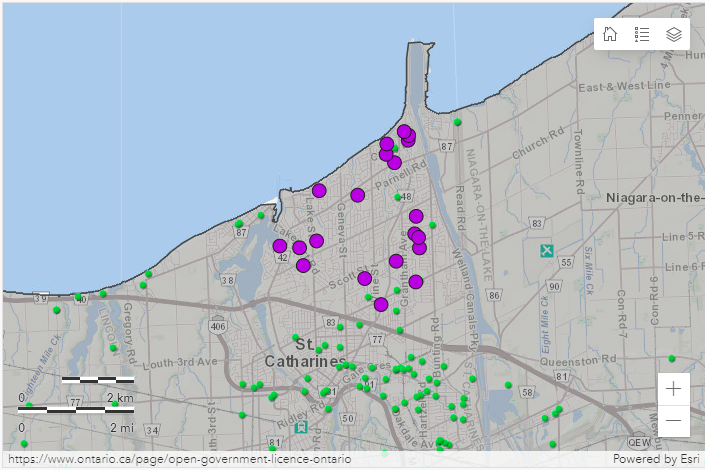
The Ontario Ministry of Natural Resources and Forestry (MNRF) has just launched a new interactive map to help provide more information about where active (within the last two years) and expired (more than 2 years ago) rabies cases have been detected in Ontario, and where wildlife testing has been done.  The map lets you select the year (or multiple years) of testing, and can be zoomed in to your own municipality (but still protects the confidentiality of where specific animals were found).  You can also click on individual case dots for more information.  The image below is a screen shot of the map showing the cases that were detected in St. Catharines in 2022.  The map does NOT show cases of bat-variant rabies, because the risk from bats is present across the province, and is not higher or lower in a given area based on whether there have been recent detections.

Remember: It’s still important to keep your pets up-to-date on their rabies vaccination every 1-3 years (depending on the vaccine product) – and it’s legally required for ALL dogs, cats and ferrets over 3 months of age in Ontario – even if they never go outside (because bats can and do get inside!).  More information about rabies and rabies response in Ontario can be found on Ontario.ca/rabies and on the OMAFRA rabies webpage.

With any new, changing or inadequately investigated infectious disease, we need to first understand the scope of the problem, including the range of species that can be infected. The ongoing human monkeypox outbreak has raised concern about spillback of monkeypox virus into animals from humans since, we don’t know much about susceptible animal species.

A recent paper in Eurosurveillance (Shepherd et al. 2022) describes investigation of monkeypox in animals from UK households with one or more persons infected infected with monkeypox.  Affected pet owners were asked if their animals were sick, and if so, that prompted discussion about whether it might be due to monkeypox or another cause, and whether testing for monkeypox was indicated. That’s an easy way to investigate something like this, but it has a few weaknesses:

  • Mild disease might be missed by pet owners. While raging pox-like skin lesions would hopefully be noticed, subtle skin lesions, enlarged lymph nodes or some other potential signs of monkeypox wouldn’t likely be detected by the average pet owner.
  • Owners might be fearful of the implications of infection in their animal (e.g. quarantine) and therefore not want to disclose potential issues.

Nonetheless, it’s useful to see the results of this study.

154 animals from households with a person with monkeypox were investigated. That included 42 dogs (including one household with 13 dogs), 26 cats (from 14 households), as well as 5 “rabbits or guinea pigs,” one group of 7 unspecified “mammalian livestock,” one group of 64 poultry, and a smattering of tropical frogs, a snake and one “unspecified” animal. We can largely disregard the poultry, reptile and amphibian data, since there’s not much reason to think those species are of any concern with regard to monkeypox infection.  That leaves us with 80 mammals of different species, none of which showed any evidence of overt disease due to suspected monkeypox infection, despite household exposure to the virus. Good news.

The other big thing that is missed using this methodology is assessment of subclinical infections, i.e. where the animal is infected (and maybe infectious) but is not showing any signs of illness. That’s a particular concern for potential reservoir species.

What can we take home from this study?

The big thing this study suggests is that serious infection with monkeypox virus in pets is unlikely. It doesn’t prove it can’t happen, since the numbers are relatively small, but it shows that transmission to pets and subsequent serious disease is probably uncommon, if it occurs at all.  That’s useful information.

It’s still just one step on our path to understanding more about the potential for human-to-animal (and human-to-animal-back-to-human) transmission, as well the range of species that are susceptible to monkeypox.

While there are limitations to this study that are easy to pick apart, the results are still important and useful, and help us think about next steps. To figure out more, we need more intensive studies with veterinary examination and testing of exposed animals, including larger numbers of animals and diverse species. Getting animals examined and tested isn’t a cheap, easy or fast process (we’ve had a really hard time recruiting for our own monkeypox surveillance efforts), so quick basic studies like this can help fill in some preliminary gaps.

Things have been pretty quite regarding monkeypox in domestic animals lately. Whether that’s because human-to-animal infection is truly rare, and human case numbers are dropping, or whether it’s because there’s not enough surveillance in domestic animals that have been exposed to the virus isn’t clear. I suspect it’s a combination of the two. Our surveillance has been really slow since it’s been hard to recruit participants, but I doubt that human-pet transmission of monkeypox is very common.

However, uncommon doesn’t mean irrelevant.

For veterinarians, it brings up a new round of questions about potential occupational risks for veterinary staff and the potential for veterinary clinics to become hubs where the virus could spread. Those concerns aren’t without foundation, since pet-to-veterinarian transmission of monkeypox was identified in the 2003 prairie dog-associated outbreak in the US.

When we don’t have much data, it can be a challenge to provide clear guidance on how to prevent virus spread, but realistically we still have a good idea of what control measures are likely important based on basic our understanding of monkeypox virus and principles of infection control.

Like we did for SARS-CoV-2, we’ve teamed up to release some interim guidance for veterinarians about handling animals that may have been exposed to monkeypox, this time in conjunction with the Canadian Veterinary Medical Association. It’s also available in pdf format.

As always, guidance might change as we get more information on what is (and is not) a significant risk). Changing guidance is actually a good thing – it shows we’re learning and improving. However, while we’re gathering more data, this is a good starting point to reduce the risk of monkeypox transmission to and from veterinary patients.

As H5N1 avian flu ramps up again across Canada with the fall wild bird migration, we’re likely going to see more situations where more unique populations of captive birds are affected, beyond the usual large or small poultry flocks. The CFIA’s standard response to highly pathogenic avian flu (like the current H5N1 strain) is “All infected flocks are humanely destroyed, and carcasses are disposed of in an environmentally acceptable fashion.

As would be expected, this response is based primarily on commercial poultry, where if one bird in a flock is infected, you can be pretty sure the virus is widespread in the group. However, other kinds of birds that can still be infected may be housed very differently, and management and infection control measures may affect their risk if an infected bird is found on the property.  Other factors to consider are the ability to contain the risk from potentially exposed birds (which may include financial costs), and the importance of some birds in terms of conservation or genetics.

The standard approach is understandable with poultry that are highly susceptible to the virus and housed in a manner that transmission can be rampant.

However, given how widespread this virus now is in the wild bird population in North America, and the wide variety of captive birds that can be affected, could a one-size-fits-all approach perhaps cause more harm than good in some situations?

  • Maybe.

The main issue relates to non-commercial birds (those not raised primarily for food), particularly pet birds and birds in rehab facilities.

Sometimes, exposure of the entire group is likely and a whole-group response (euthanasia) might be indicated.

  • Risk assessment should play a role in this.
  • If a rehab facility has waterfowl and raptors (and maybe some pet birds in the house), and those groups are kept separate, does it make sense to depopulate all the birds on the property? Maybe not, at least all the time.
  • It comes down to the risk of exposure. Often, there can be pretty good  physical and procedural separation.

We shouldn’t realistically aim for “is there absolutely, positively, no chance that the birds were exposed?”. We can never hit that bar. Rather, we should aim for “are these birds at any greater risk than any other birds in the area, when we know that H5N1 flu is circulating in wild birds?”. That changes things a bit and recognizes that there might be some degree of risk, but it might not be any more than is inherently present with a virus that’s currently fairly widely distributed in nature.

Another major concern I have with any strict policy is driving things underground. If bird owners know a positive test means all their birds will be killed, they’re more likely to try to ride out a problem and not get testing done. That means we lose valuable information, don’t get a chance to respond to help contain the issue, and we can miss the ability to manage disease properly if it’s something other than flu. I can absolutely see non-commercial bird owners avoiding testing if stories of mandatory depopulation of birds like theirs increase. We need to know the extent of the spread of this virus so we can take other steps to control it, and driving things underground doesn’t help.

I fully admit it’s a tough situation. It requires people to change standard approaches, make decisions on the fly and do risk assessments without much information (at a time where CFIA is certainly not overflowing with resources).

We want to contain this virus for both human and animal health reasons. But, we have to realize this is an unprecedented avian flu situation in North America. We’ve never had this degree of sustained and widespread infection of wild birds.

I’m certainly not saying we should surrender and say ‘it’s endemic, we’re done, good luck.” but a more risk-based approach than has previously been considered is warranted, based on the risks to people and animals in the broader context. That’s a challenge, and we absolutely have to prioritize protecting human health.  As we enter human flu season (which is shaping up poorly), we don’t want mixing of avian and human flu viruses. We also need to minimize the risks to commercial poultry operations, which can affect thousands of birds at a time and can have ripple effects on the entire agri-food supply chain.

However, does a one-size-fits-all approach that requires euthanasia in every situation make sense? I don’t think it does.

What are the challenges to a risk based approach?

  • Lack of data to guide risk assessments in more unique situations.
  • Overloaded regulatory personnel (most veterinarians can relate to this right now too).  Case-by-case assessments and tailored responses typically take more time and resources than using the one-size-fits-all approach.
  • Often unclear or unreliable information on premises about what’s done and what the risks might be.
  • Perceived risk and risk aversion (e.g. the safest thing for regulators to do from a risk standpoint is euthanize any potentially exposed birds. Doing something different, even for good reasons, can increase risk to people or other animals, and then regulators may get blamed if things go wrong).

I think it’s time to try to implement some risk assessment-based approaches to control of this virus in some unique collections of captive birds. Often, euthanasia will still be the result if transmission between birds cannot be controlled, and that makes sense. However, there may be some situations where it can be argued that not all groups on a property are at the same risk for exposure.

What about hold and test?

  • That’s a consideration but it brings in some challenges.
  • Some tests are better than others, but no test is 100%.  It’s not as straightforward as it may first appear. However, with serial tests in a group, I think we can be pretty confident whether flu is or isn’t in a group of birds. That’s what we’re really looking to say. We want to say “are one or more birds in this specific group infected” vs “is this individual bird infected’. We can design logical testing strategies to do that.
  • Testing takes time, and also involves cost and that would be on the facility/owner. Cost concerns might certainly prevent this approach from being viable in some situations, and risks need to be carefully controlled while testing is undertaken.
  • Human exposure risks also need to be considered. If we’re collecting samples from birds, we’re potentially getting exposed to this flu virus. We can do things to reduce the risk, and any testing approach would require people that are properly trained and willing to accept the risk (like we, as veterinarians, do regularly). Fortunately, the current H5N1 seems very low risk for causing disease in people, but flu viruses are notorious for changing and low risk doesn’t mean no risk. We also want to make sure potentially infected birds don’t get exposed to human flu, another reason for careful handling during sampling.

Although the safest (and easiest) way to eliminate an “animal problem” is to eliminate the animal, euthanasia of any captive birds that might possibly be exposed to this virus when a positive is detected may not be the “best” approach in all cases.  It will be interesting to see if and how the CFIA adjusts their approach as they continue to deal with this unprecedented outbreak of avian flu.

Since rabbit hemorrhagic disease virus type II (RHDV2) made its first incursion into Canada, and again more recently with the first detection of this virus in Ontario, there’s been a lot of interest in vaccination of rabbits (rabbits and hares are the only species known to be affected). Effective vaccines are available for this highly transmissible and fatal rabbit virus, but they are not licensed in Canada. To access the vaccine, Canadian veterinarians therefore have had to apply to the Canadian Centre for Veterinary Biologics (CCVB) for an import permit (which takes some time) and then source a vaccine from Europe (which takes time and money). It’s doable, but it makes it hard to get vaccine quickly, which can hamper response in a potential outbreak.

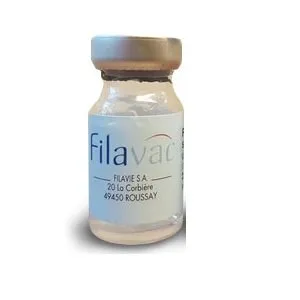
Better access to RHDV vaccine is on the horizon, though, as one of the European vaccines, Filavac VHD C+V, now has market authorization in Canada through Ceva Animal Health. It’s currently available to veterinarians from some of the key purchasing groups, and should be available through others very soon. So, veterinarians should now have relatively easy access to this vaccine through their normal purchasing channels, should they have a need for it.

PS: I don’t usually write about specific products or companies, but this is an important issue and not a matter of one product vs another – it’s something that’s now available that wasn’t before. At Worms&Germs, we try hard to be independent and not have any external influences, perceived or otherwise. We don’t have advertising on the blog, we don’t have any sponsors, we control all our content, and the few thousand dollars a year that it takes to pay for the site come from the University of Guelph’s Centre for Public Health and Zoonoses.