
Tularemia is a nasty bacterial disease. The bug that causes it, Francisella tularensis, is a category A bioterrorism agent (along with things like anthrax, botulism, plague, smallpox and Ebola virus). It’s classified as that because it’s highly transmissible and causes serious disease, so it’s something you definitely don’t want.

The bacterium circulates in the wild, most often associated with rabbits and rodents. Human infections are usually associated with exposure to these types of wild animals (including things like – gross as it is – running over a wild rabbit with a lawnmower and aerosolizing the bacterium). However, one complicating factor with this bug is that it can be spread a lot of different ways, including via tick and fly bites, water and minor contact with infected animals (e.g. just touching their skin).

Among domestic pets, cats are most commonly implicated in human infection, because cats with outdoor access tend to hunt species that harbor tularemia (fitting with the “it’s better off for cats to be indoors if they tolerate it” statement I made in my last post… that got lots of comments both for and against), and because they are fairly susceptible to infection when they get exposed. However, a variety of animals can harbor and transmit the bacterium.

Dogs are lower risk but not no risk, as a recent paper in Zoonoses and Public Health (Kwit et al. 2018) explains. They looked at US tularemia surveillance data from 2006-2016, and focused on the 24 cases that were deemed dog-associated. Whether those were all truly from dogs can’t be guaranteed, and it’s possible that some of the other cases were dog-associated but the link wasn’t investigated or identified.

Among the highlights:

  • Most cases were from Missouri, Colorado and Kansas, consistent with what we know about tularemia in general in the US.
  • Outcome was known for 20 of the affected people. Two died.
  • 50% of cases were thought to be from direct contact with dogs, including bites or scratches, but also contacts such “face snuggling” and licking
  • 33% of people were exposed from contact with carcasses brought home by their dogs.
  • 17% of cases were associated with ticks thought to have been brought in by dogs. Implicating dogs as a “source” of ticks in a household is tough, because if a dog is exposed to ticks, people in the same area have a similar risk of being exposed if they’re outside. The bigger risk might be an increased tendency to spend time in tick-infested areas when walking said dogs.
  • Not much dog-health information was reported. Four people had contact with “ill” dogs but it’s not clear how many dogs might have had tularemia vs been infected without signs of disease vs been contaminated by the bacterium but not infected (and been “ill” from something else entirely).
  • One dog was diagnosed with tularemia. That’s not too surprising since dogs tend not to get sick or at least not get very sick from tularemia (as opposed to cats), so it’s easy to miss a potential dog case.

The take-home messages are pretty straightforward. Tularemia is very rare and very low of my list of disease concerns when it comes to dogs. However, avoiding tularemia involves common sense practices that should help reduce a lot of other risks at the same time.

  • Reduce roaming of dogs, especially dogs that are able to or like to interact (e.g. chase, hunt) wildlife like rabbits.
  • If your dog brings back a carcass, handle it with care. Try to avoid touching it and, if you have to, wear gloves, then wash your hands after removing the gloves. Avoid contact with the dog’s mouth for a while (who knows how long… maybe a couple hours?) if it had a carcass in its mouth.
  • Reduce tick exposure as much as possible (for dogs and people).
  • Use tick preventives in dogs to reduce the risk of tickborne disease exposure. A variety of ticks can transmit F. tularensis, including the dog tick (Dermacentor variabilis), the wood tick (Dermacentor andersonii) and the Lone Star tick (Amblyomma americanum).
  • Mention rabbit and rodent exposure potential to your veterinarian if your dog gets sick.
  • Mention your dog ownership, your dog’s potential contact with wildlife, and any contact you have had with wildlife (dead or alive) to your physician if you get sick.


The indoor vs outdoor cat debate never seems to end.

Some decry outdoor cats as the world’s most destructive “invasive species.”

  • Some say that outdoor cats do what outdoor cats (and any other carnivores) do… they hunt to eat.

Cats kill large numbers of birds every year.

  • So do lots of other things.

In an ideal world, we’d have no feral cats and all pet cats would live happily inside.

  • We don’t live in that world.

I have one indoor cat (Finnegan) and two outdoor cats. They’re outdoor cats out of necessity. The first one (Rumple) was adopted through the Guelph Humane Society’s working cat adoption program. Basically, these are cats that are deemed unadoptable as house pets or that otherwise wouldn’t do well in a household situation. Rumple’s a major suck and might tolerate an indoor/outdoor lifestyle (although Finnegan would disagree with that notion). So, despite nominally being a barn cat, he spend his summer’s on our deck and winters in his heated house in the garage. Yes, he hunts (although probably not too much since he’s well fed). He’s vaccinated, dewormed, neutered and microchipped. He has an ecological impact but it’s pretty minimal in the grand scheme.The other outdoor cat (Alice) was a wayward feral female cat that Rumple adopted. She started hanging around, Rumple took her in and she had a litter of kittens shortly thereafter. They were adopted into homes, she was spayed, vaccinated, dewormed and microchipped and she’s getting fat, living the good (outdoor life). We can pet her on her terms but there’s no way she’d tolerate an indoor lifestyle.

Yes, I realize they have an ecological impact. Yes, I realize (and have constant concern) that there are risks from cars, coyotes and other critters. However, this is the lifestyle that suits them and it’s a balance I accept.

Anyway, that’s a very long and somewhat philosophical introduction to the topic of this post: introduction of feline leukemia virus (FeLV) into endangered Florida panthers. A recent paper in Emerging Infectious Diseases (Chiu et al. 2018) describes multiple introductions of this virus into the panther population, which is a significant concern for a species with such small numbers.

Feline leukemia virus is an important cause of disease in domestic cats and periodically spills over into wild felids (members of the cat family), sometimes with high rates of illness and death. In Florida, an outbreak of FeLV was identified in panthers between 2001 and 2004. Between 2004 and 2010, FeLV was not identified in any of 125 panthers tested in the state. However, since 2010, 6 panthers that were found dead tested positive. One of those might have died because of the virus. The other 5 were killed on the road but were infected. It may seem like a small number, but it’s a relevant number in a such a small, endangered population.  It’s also it’s impossible to monitor and test all animals, so 6 infected animals in an under-estimate of the prevalence in the whole population.

Genetic testing of the virus was used to sort out why this was happening, and to determine how linked the infections were. The viruses from the 2001-2004 and 2010-2016 outbreaks were distinct, indicating separate introductions into the panther population. Presumably, panthers were infected by cats on at least two different occasions, likely when domestic cats were preyed on by panthers.

Transfer of FeLV from cats to panthers is probably a rare event, considering the number of cats that are encountered (it’s been estimated that “domestic” cats account for ~5% of the panther diet). However, as we know with many diseases and many species, all it takes is a single encounter for a new pathogen to establish itself in the population.

My take home messages from all this are:

  • It’s better for domestic cats to be indoors if they tolerate it. It reduces the risk to them and wildlife.
  • Not all cats can live solely (or partly) indoors.
  • We should optimize the health of cats that go outdoors and make sure that the best preventive medicine program is in place for them, to reduce the risk to them and the risk of them passing something on to other cats or other species.
  • Cats known to be harbouring important pathogens such as FeLV and FIV should be kept inside if at all possible.
  • Owners of cats that go outside should talk to their veterinarian about risks (to the cat and others) of being outside and determine an appropriate preventive medicine program. (They should absolutely be spayed or neutered.)
  • Particular care must be taken in areas where there are wild felids, particularly endangered species.

As is typical for this time of year, the annual US rabies report has been published in the Journal of the American Veterinary Medical Association (Ma et al, 2018).

Here are some highlights:

  • 4454 rabid animals were identified across the country. This is certainly a marked underestimate of the actual number since most rabid animals aren’t seen or tested.
  • This number is down 9% from 2016. I’m not sure what that means (or if it means anything). Rabies numbers can be impacted by true changes in rabies cases, or they can increase or decrease based on how intensively people are looking. Changes in surveillance can result in changes in numbers, even when the disease is unchanged (this is known as surveillance bias).
  • The most commonly affected species were the usual suspects and the known rabies reservoir species:
    • Bats: 32%
    • Raccoons: 29%
    • Skunks: 21%
    • Foxes: 7%
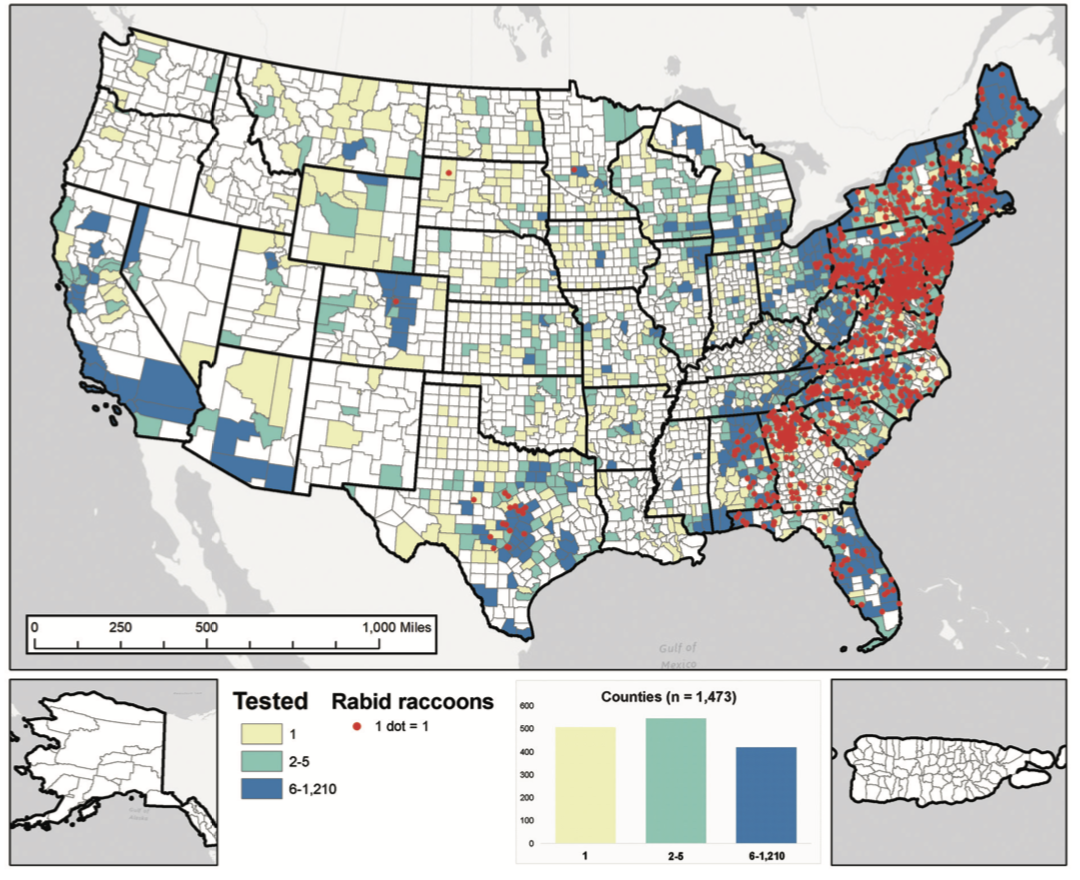
  • There were regional differences in the predominant rabies virus strains (fox, raccoon, etc.), as shown in the figures below. Raccoon rabies diagnoses were concentrated along the eastern part of the US, consistent with the past.
  • As usual, cats led the rabid domestic animals, accounting for 6% of cases, followed by dogs (1.4%) and cattle (0.8%). The higher number of affected cats likely reflects large numbers of stray cats and cats with uncontrolled outdoor access, their tendency to tangle with rabies reservoir species and low overall vaccination rates. Cats were mainly identified in the northeast.
  • Two human cases were identified during the year. One had been bitten by a dog while travelling in India, a country where canine rabies is rampant. The other acquired rabies in the US from a bat.

Rabies remains an ever-present threat in the US, like many other countries. The bad thing about rabies is that it’s almost invariably fatal. The good thing is that it’s almost completely preventable.

Keys to rabies prevention include:

  • Avoiding contact with wildlife.
  • Vaccinating domestic animals, both for their health and because they can act as a bridge between wildlife and people.
  • Providing post-exposure prophylaxis to potentially exposed individuals.
  • Educating the public so they know more about rabies, how to avoid it and when to seek healthcare. This is a critical aspect that’s often the weak link. People get rabies because they don’t seek healthcare after an exposure.

More information about rabies can be found on the Worms & Germs Resources -Pets page.

No, we haven’t changed to a cooking blog, I’m talking about bites of the canine variety. I can’t think of any specific data that would show it, but I wonder whether bites are more common around the holidays, with disrupted schedules and more visitors (and a potential midnight intruder in a red suit).

The rabies-related response to a bite is nothing new, but it still causes a lot of confusion so I’ll re-hash it here. Rules vary a bit (no pun intended) by jurisdiction so relevant personnel (e.g. public health, animal health) should be contacted,  but here’s the general response when a dog bites a person.

What’s the concern?

  • Rabies exposure from dog bites in areas where canine rabies is widespread (e.g. Africa, India, China) is a major concern. In other areas (e.g. Canada, the US), rabies is very rare in dogs. However, since rabies is almost invariably fatal in people, we don’t mess around. The immediate concern is to figure out whether the dog might have been shedding rabies virus in saliva at the time of the bite.
  • Rabies isn’t the only problem, as trauma from the bite and various other infections diseases are also of concern, but we’ll focus on rabies here.

What happens to the dog?

  • A 10 day observation period is pretty much universal. This can be a strict quarantine or less formal confinement, with the key being to keep the dog under control and make sure it’s normal 10 days after the bite.

What is the purpose of the observation/quarantine period?

  • Shedding of rabies occurs quite late in course of infection. The virus has to travel  through the body from where the dog was bitten, via nerves, to the brain, and then through nerves down to the salivary glands, at which point the dog becomes infectious to others. Therefore, by the time rabies virus can be shed in saliva, it’s already been in the brain for a little while. When it reaches the brain, signs of rabies develop pretty soon thereafter due to damage caused by the infection. So, if a dog is still neurologically normal 10 days after the bite, it would not have had rabies virus in its  saliva when the bite occurred.

What if the dog is vaccinated against rabies?

  • It doesn’t really matter. The vaccination status does not generally impact the response to a dog that bites someone (it does change the response if a dog is bitten by something else (e.g. fight with a raccoon) and is potentially exposed to rabies).
  • Rabies vaccination is very effective but given the severity of rabies, we can’t assume that it’s impossible for a vaccinated dog to have rabies.

What happens if the dog is not available for observation/quarantine?

  • If the dog can’t be identified and quarantined, you can’t rule out rabies. Therefore, it ends up being a discussion of the likelihood of rabies and whether post-exposure prophylaxis is indicated. Usually, the default is to treat it as exposure even if it’s very unlikely, since post-exposure prophylaxis is very effective and rabies is very bad.

What if the dog can’t be observed/quarantined?

  • If there’s a health or safety reason that quarantine can’t be done, euthanasia is indicated. This allows for testing of the animal’s brain, which is the only definitive way to determine if the dog had rabies at the time of the bite. Quarantine is preferred from a dog welfare standpoint, obviously, and it’s also best for the person in most situations. If the dog is alive and clinically normal in 10 days, rabies is not an issue. If the dog is euthanized, there is always the low (but possible) chance of an equivocal test, or, as I wrote about last year, a brain that gets lost in transit.

What else?

  • The big thing that often gets overlooked is consideration of why the bite happened in the first place. This is important to help prevent it from happening again.  It involves thinking about potential health or behavioural problems in the dog, poor supervision or poor handling on the part of the people involved. Bites shouldn’t be dismissed as an unavoidable consequence of dog contact.

I’m once again prepared to call Ontario (and Canada) canine influenza-free… for now, at least. The latest cluster, associated with another importation of the virus from China, seems to have been contained.

The last new positive case was identified October 30, with the likely date of exposure being October 23. We are now beyond the 28-day shedding window that we use for H3N2 canine flu, plus some extra time tacked on to give us time to identify new cases that might have been exposed near the end of the last dog’s shedding period.

The apparent abrupt halt in new positive cases, within two weeks of the first case, once again shows how this highly contagious virus can be contained with quick identification (astute primary care vets), quick response (testing, contact tracing and communication) and responsible ownership (complying with requests to keep infected dogs away from other dogs).

Will canine flu come back?

  • Probably. It’s widespread in Asia and parts of the US. We import a lot of dogs from those areas.

Can we reduce the risk?

  • Yes. Quarantine and testing of new dogs after they have been imported from high risk areas is a fairly straightforward measure that is used too uncommonly.

What else about imported dogs?

  • We need to figure out more about the risks associated with importing dogs and how we can contain those risks. While I’d like to see importations decrease, I’m not naive enough to think that’s going to happen anytime soon, and at this point, I’d rather work with importers to reduce the risk. More on that soon.

A recent article from the Veterinary Information Network (VIN) News Service describes a strange cluster of feline tuberculosis (TB) cases in the UK, with a possible link to food. In cats, TB is rare and usually caused by Mycobacterium bovis, a bacterium most often associated with cattle and bovine TB. M. bovis is present in the UK and circulates in some wildlife species. TB can be a nasty disease, and without treatment, it’s fatal (in humans and animals). While potentially treatable, the prognosis is still guarded and months of antibiotics are required. There is also some (but poorly understood) risk to owners of infected animals, since M. bovis can infect people too. Cat-human infections are rare (or rarely identified) but it’s still a concern.

The cluster of cases in the UK is unusual for a few reasons:

  • One is that it occurred at all, since TB is cats is rare.
  • Another is that it affected young cats with no history of outdoor access. Typically, cats get infected outside from bites and scratches that occur when hunting.
  • All cats were fed the same brand of a commercial frozen raw diet.
  • Some of the cases were in cats living in low risk areas of the UK.

In cats, M. bovis usually causes skin and soft tissue infections, a testament to the typical route of exposure in this species (i.e. bites). However, the cases in this report had intestinal disease, characterized by signs such as weight loss, abdominal masses and diarrhea, consistent with exposure through ingestion of contaminated food.

Dr. Danielle Gunn-Moore of the University of Edinburgh is leading the investigation and emphasizes a few points:

  • Veterinarians in the UK should be aware of TB in cats, as infected animals may show non-specific signs of infection.
  • If TB is a possible reason for a cat’s illness, diagnostic testing should be performed ASAP.
  • Food history should be questioned in potential cases, with particular attention to raw diets.
  • Veterinarians in the UK that suspect they have a case of feline TB should contact Dr. Gunn-Moore.

I’ve been behind on posts so here’s a quick update: things seem to be going well in the latest Canadian H3N2 canine influenza outbreak. Here’s the rundown:

  • After eradicating the last outbreak in the spring, cases were identified again in mid-October, associated with more importation of dogs from Asia.
  • The last new positive dog was identified October 30th.
  • All infected dogs that have been identified in the latest cluster have  close ties to the index site and have been from one area. One of these dogs left the region but has (hopefully) been kept quarantined for 28 days (as have the rest of the infected dogs).
  • Most of the infected dogs that we have been able to follow serially (i.e. test multiple times) are no longer shedding the virus.

We can’t call this over yet, since our last new case was October 30. Dogs can shed the virus for a few weeks after infection (even if they look healthy). Currently, we use 28 days as the potential shedding period. So, we’re looking at ~November 26 as the end of the window for the last known case. I tack on a week or so to give us time to find any cases that might have been infected at end of that period. Odds are quite low at this point that there will be more transmission from this outbreak, but we need a bit more time and testing to be sure. By early December, we can hopefully declare this over.

This is hopefully another example of our ability to eradicate this highly infectious virus with astute primary care veterinarians, quick testing, good communication and responsible owners who will quarantine infected animals. I’m always wary of speaking to soon (or jinxing it), but it’s important to know this approach can be successful. It’s not often done (explaining why flu continues to spread in some regions) but with some effort, diseases like this can be contained.

At the same time, the effort required and the potential for such a virus to spread beyond our control can’t be ignored. That’s why we need to be careful when importing dogs from areas where canine influenza is widespread.

Things have been quiet over the past few days. That’s good news (but always makes me a bit antsy, because I want to be sure it’s because there are no new cases vs we’re just not finding them). Documented infections have been confined to one region, with the exception of a dog that travelled out of the area, and which is (hopefully) being kept under quarantine for 28 days at its new location. We’re still testing and getting negative results, and veterinarians in the area are still looking out for potentially infected dogs, so hopefully the situation is being contained. The next week or so will tell us more, as we continue to test and as initially infected dogs start to eliminate the virus.

At a minimum, we want to go 35 days or so after the last new infection before we say we might be in the clear again. Since some dogs can shed the virus for over 3 weeks, I use 28 days as the upper end of the shedding period. I then tack on an additional week, since it takes some time for a newly exposed dog to get sick and be tested. So, if our last known dog was infected Oct 23 (to pick a random but reasonable date), it could shed until Nov 20. Add on a week, and we get to Nov 27. If there are no new cases by then and we still have excellent surveillance by vets and dog owners, we would suspect that the virus has again been contained. If we find any new cases, the clock restarts each time. (I hesitate to write about containment at this point because it sounds like I’m inviting bad luck, but I get a lot of questions about this).

To contain the current cluster of canine influenza we need:

  • Continued diligence by veterinarians and dog owners
  • Continued testing of exposed dogs and any other suspected cases
  • Compliance with quarantine recommendations so infected dogs don’t pass on the flu to other dogs

So far, so good, but time will tell.

We’ve known for some time that there are human health risks from feeding pets raw meat-based diets. Most of the evidence of this has been anecdotal, as published reports have been sparse. A few better documented reports have started to appear, including the fatal E. coli O157 infection I wrote about recently.

A few days ago, the CDC released a report about an outbreak of Salmonella Infantis infections in the US. It involved 92 people from 29 US starts and was linked to raw chicken products. Raw chicken-based pet food was among the raw chicken products from which the outbreak strain was isolated, and one person got sick after their pets ate chicken-based raw food.

This isn’t particularly surprising since Salmonella contamination is an inherent risk with raw poultry. Human disease can occur when people ingest Salmonella from undercooked meat or from contamination of their hands or environmental surfaces (e.g. in the kitchen). When it comes to raw pet food, people can be exposed from handling the food, cross contamination of food or surfaces, contamination of the food bowl or exposure to Salmonella in in feces of the pet.

CDC’s recommendation is pretty straightforward: “CDC does not recommend feeding raw diets to pets. Germs like Salmonella in raw pet food can make your pets sick. Your family also can get sick by handling the raw food or by taking care of your pet”.

I have the same recommendation, but am realistic enough to know that it’s still going to be done by some people. It definitely shouldn’t be done in households with very young, very old, pregnant or immunocompromised people or animals.

If you are going to feed raw diets to your pet, do it wisely. More information about this is available on the Worms & Germs Resources – Pets page.

As expected, a few more cases have been identified in the most recent cluster of canine influenza virus (CIV) identified in Ontario. So far, there are about 20 confirmed or suspected cases. To date, we’re still only finding cases that have a link to another infected dog or facility. That’s good news. If we start getting cases of unknown origin and/or cases outside the currently affected area, I’ll be more concerned (specifically about the prospects of containing the cluster). A couple of dogs that were potentially exposed and left the area already are being tracked.

Continued diligence by pet owners and veterinarians will help contain this virus. The key is finding all the potentially infected (and infectious) dogs, testing them and keeping them quarantined until they’re no longer a risk to others.

A 28 day quarantine is recommended because of the potentially long shedding period of this virus. In the previous outbreak (as in this one), we sampled positive dogs repeatedly, and some shed the virus for over 3 weeks. So, even a 28 day quarantine doesn’t leave a lot of cushion, but the longer the quarantine period, the greater the risk of non-compliance. Getting people to keep their dogs away from other dogs for 28 days often isn’t easy to do. We like to complain about the weather in Canada, but it will probably help in this situation. It’s forecast to be few degrees above freezing with mixed precipitation over the next few days, something that may help keep dogs from congregating outdoors, buying more time to sort out the problem.

More details to follow.