Another emerging disease we’ve been paying attention to lately is canine lungworm. Lungworm is a generic name for infection caused by one of a few different parasites that live in the respiratory tract. A variety of different lungworms can cause disease in different species, and there tends to be a lot of regional variation.

Recently, lungworm cases have been identified in dogs in Ontario. For more details about the geographical distribution, go to WormsAndGermsMap.com (use the filter box on the left side to select lungworm). You’ll see cases distributed over a wide range of the southern and eastern parts of the province. Lungworms (Crenosoma vulpis, the fox lungworm, and Angiostrongylus vasorum, theFrench heartworm”) are already well known in Atlantic Canada, but the movement into Ontario seems new.

lungworm copy

So far, only Crenosoma vulpis has been found in Ontario. That’s good since it’s a less severe and more readily treatable parasite than A. vasorum, the other one we’re worried about entering the province.

As with many parasites, Crenosoma vulpis has a life cycle that involves multiple species (see the picture below from Bayer Animal Health). Foxes are the normal host. The adult parasite lives in the bronchi (large airways in the lungs). Their larvae move up the trachea (windpipe) to the mouth and are swallowed. These tough little larvae survive the entire intestinal tract and are passed in feces. When ingested by a snail, they continue to develop, and foxes are infected by eating snails. After ingestion, the larvae penetrate the wall of the stomach, get into the bloodstream and travel to the lungs, where the whole process starts again.Fox Lungworm
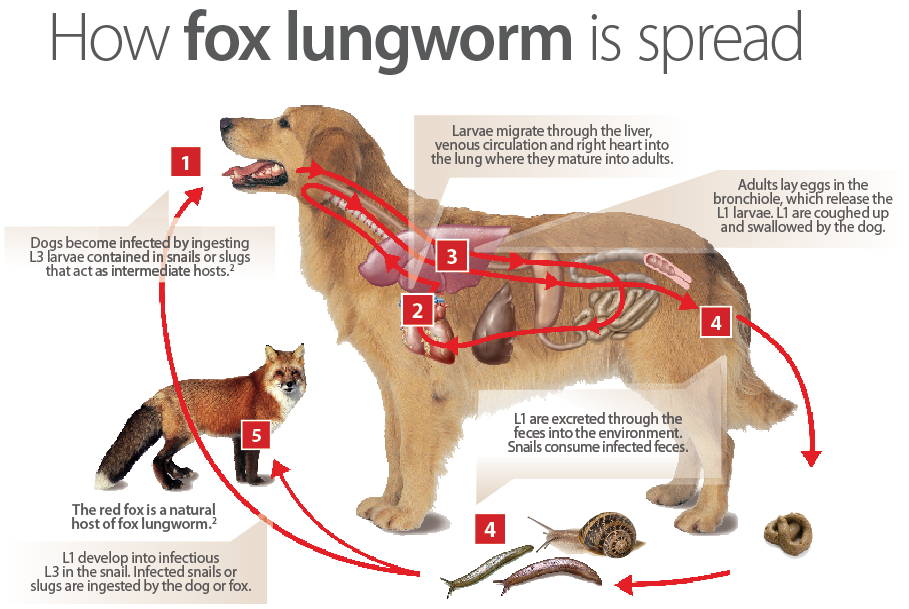
As close relatives of foxes, the same thing happens in dogs that eat infected snails (probably something that occurs more often than people like to think). Disease tends to be mild; most often a chronic cough caused by inflammation in the bronchi where the adult parasite hangs out.

Now that we know this parasite is present in Ontario, it’s something that should be considered in dogs with chronic cough. Diagnosis involves finding C. vulpis larvae in feces, usually through a “Baermann” test, which looks for parasite larvae (as opposed to a standard fecal flotation test that is used to look for parasite eggs from intestinal worms).

The good thing about lungworm, at least Crenosoma, is that it can be treated with antiparasitic medication and the prognosis is very good. The key is considering it as a possible cause so that a diagnosis can be made. That can be a challenge with emerging diseases when people don’t think about them.

Surveillance through veterinary clinics is ongoing to find out where lungworms are in Ontario and how often they cause disease.

mechanical-mosquitoI’ve been getting a lot of questions about Zika virus and animals. It’s great to see that people are thinking more broadly about infectious diseases (but it isn’t doing much for my productivity this week).

To recap, Zika virus is a mosquito-borne virus related to West Nile virus and dengue virus. Most people that are infected don’t get sick at all, and when they do, they usually get only mild signs of illness that resolve on their own. In the past few years, Zika virus has emerged in the Americas, particularly Brazil. Very recently, a link (still unproven) between infection of pregnant women and birth defects (babies born with small heads and brains (microcephaly)) has been reported, predominantly in Brazil.

Can animals get infected with Zika virus?

  • It depends on what you include in “animals.” We could be technical and say that humans are animals.
  • Beyond that, non-human primates are susceptible. Zika was first identified in 1947 when yellow fever researchers working in the Zika forest in Uganda stumbled onto it. They had a macaque in a cage and it developed a febrile illness from something that was transmissible. The virus was described as Zika virus in 1952 and then found in people a couple of years later.

But can domestic animals get infected with Zika virus?

  • Again, we need to think about the question. Infected means they get exposed to the virus and it replicates in the body. That may occur, but we don’t have any evidence of it at this point.
  • The more relevant question is whether animals can get sick from Zika virus exposure, and there’s also no evidence of that to date.
  • A third aspect is whether infected (but potentially healthy) animals could be a reservoir for the virus, being able to pass it on to mosquitoes. There’s no evidence of that, either.

So, the clearest answer is probably “maybe.” When it was a flu-like illness confined to some regions in Africa, Zika wasn’t a high priority so research hasn’t been extensive. The risk to pets in areas where the virus is circulating (areas where there are Aedes egpyti and Aedes albopictus mosquitoes) is probably very low. It would be good to look into the risks associated with domestic animals, including their susceptibility to disease and potential roles as reservoirs, but the likelihood that there is a relevant issue with either of these is probably remote.

Rabies_Surveillance_and_Control_Basemap_Jan25It seems to be a bit of a slow month for zoonoses.  Finally getting some cold weather here in Ontario certainly helps keep many bugs at bay (and people indoors).  Nonetheless, rabies continues to keep us hopping.  The Ministry of Natural Resources and Forestry (MNRF) is continuing with its surveillance efforts around the cluster of rabid raccoons detected in the Hamilton area in December. They’ve done considerable testing in the wider surveillance zone to try to find the “edges” of the incursion, and have now gone back to test more animals in areas closer to the other positive cases.  Ten (10) more cases have been detected, all in the original control zone that was baited in December.

It’s important to remember that this isn’t a sudden spike in cases – these raccoons were collected over several weeks from Dec 21 to Jan 13 and were tested in a batch.  Potentially rabid animals that have had contact with a person or domestic animal are tested right away (through either the local public health unit or a local veterinarian or animal control, with assistance from OMAFRA), because a person may require post-exposure prophylaxis, or an animal revaccination +/- confinement if the test is positive.  For these surveillance samples, however, testing does not need to be done immediately.

The key messages remain the same: stay away from wildlife, keep pets vaccinated against rabies (yes, even indoor pets and dogs that only walk on leashes!), and if a person or pet has any contact with suspicious wildlife, contact your local public health unit or veterinarian (respectively) as soon as possible.

An updated map of cases and the current MNRF control zone is available on the OMAFRA website.  The map also shows the surveillance zone around the recent case of fox-variant rabies diagnosed in a calf in Perth county.

backyard chickenA reasonable question, expanding on the recent discussion about urban chickens and disease risks, is: why don’t we know how often people get sick from urban chickens?

To answer the question, we need to think about how diseases are diagnosed and reported.

Let’s say I decide to raise some chickens in my backyard. (Very hypothetical since it’s not going to happen. Raising chickens at my place would simply be creating a poultry buffet for coyotes and foxes, but let’s pretend.) If I get a disease from them, who will find out?

Here’s what’s involved if I get Salmonella from my imaginary chickens.

  • I have to get sick (the easy part)
  • I have to be sick and/or motivated enough to go to a doctor.
  • The doctor has to ask for a fecal sample for testing.
  • I have to actually collect the sample and drop it off.
  • The lab has to grow Salmonella from the sample.
  • That gets reported to Public Health.
  • Public Health investigates and finds out I have chickens.

Then what? Even if all these steps occur, which happens in the vast minority of cases, will this be tracked?

Probably not.

I would be a single case on a line-listing of people with salmonellosis. Single events like this tend not to attract much attention. Typically, attention is paid to situations where the same strain of Salmonella is isolated from a lot of people or where a lot of people get sick at once. Sporadic disease doesn’t get the same attention (for good reasons). Disease caused by a range of different strains also gets less attention since it’s unlikely to have a common source that needs to be addressed. In the study I talked about in Part I, there were 31 distinct Campylobacter types among the 72 samples, showing how much diversity can be present.

So, there could be a lot of people getting infected with Salmonella, Campylobacter or other zoonotic pathogens from backyard chickens. Or there could be none.

Reality is probably somewhere in the middle. Unless someone specifically goes searching for backyard chicken-associated disease (and has access to databases to do this), we won’t know. Even then, without knowing much about how common backyard chickens are, putting results into context is difficult.

If there are 4 infections identified by a health unit in a summer, what does that mean?

  • If it’s 4 infections from 4000 houses with chickens, that’s different than if it’s 4 infections from 8 houses with chickens.
  • It’s also much different if it’s 4 chicken owners vs 4 neighbours of chicken owners (who didn’t choose to have chickens).

As is common, a lack of good data doesn’t help the decision-making process.

feeding-the-chickenUrban chickens continue to be in the news, with debate about instituting (or enforcing) bylaws banning or restricting the raising of chickens in backyards running next to articles on how to raise your own backyard flock.

People have various concerns, including:

  • Noise
  • Attracting wildlife, including predators such as coyotes
  • Smell
  • Infectious diseases
  • Animal welfare

But, what is the real risk?

The simple answer is: we don’t know.

We know what the concerns are, but how do those correspond to tangible risks to people? That’s the hard part to answer.

A recent paper in the journal Zoonoses and Public Health (Pohjola et al 2016) doesn’t answer the question, but provides some more information.

In the study, the researchers looked at 51 backyard chicken “farms” in Finland in 2012-2013. Ninety-four percent (94%) of these “farms” had less than 50 birds, so probably similar to the urban chicken situation in North America. Cloacal (rectal) samples were collected from 457 chickens from these farms and tested for Salmonella, Listeria, Yersinia and Campylobacter, bacteria that can cause gastrointestinal disease in people (and animals). They also collected environmental samples from the properties and tested them for the same bugs.

Here are the highlights of their findings:

  • Campylobacter was found on 45% of farms.
  • Listeria was found on 33% of farms.
  • Salmonella and Yersinia were isolated on only 1 farm each. Salmonella was only cultured in the environment, not chickens, on the positive farm. However, Salmonella was detected by PCR (which looks for the bacterium’s DNA instead of trying to grow the bugs) in two chickens.
  • Overall, 13% of chickens were positive for Campylobacter.

The (reasonable) conclusion was the backyard flocks represent a potential source of pathogens, particularly Campylobacter.

Does that mean they cause disease?

I’ll get to that next in Part II.

Horse in paddockA horse in South Carolina was recently diagnosed with rabies. While rabies is common in some animal species in some regions, it’s a pretty rare disease in horses, so it’s a noteworthy event.

This case has a couple of important takeaway messages.

  • Rabies can be sneaky. Rabies (especially in horses and cattle) isn’t always obvious at the start. Affected animals can have vague signs that point to other types of disease, such as colic (intestinal tract disease). (I’ve had a few cases in the past in which we took a horse to surgery for severe abdominal pain, nothing was found, then in recovery it started to act neurologically abnormal. That’s an “oh crap” moment when you start thinking about how many people have been exposed. Fortunately, none of those ended up being rabid, but I know of cases just like that in which the horse was rabid). In this case, the horse was reported to be lame the day before the onset of obvious neurological disease. Rather than real orthopedic pain, that was likely actually the onset of signs of rabies. That’s not to say that every horse with a sore leg or belly should be considered a rabies suspect. It means that we have to be aware that rabies doesn’t always occur in textbook form.
  • Rabies in horses is a public health risk. Yes, that’s a given. However, in horses, the main risk is probably being injured or killed from a neurologically abnormal horse that might attack or fall on someone. I’m not aware of any case of transmission of rabies from horses to people, but I am aware of people who have been killed by rabid horses. In this case, two people were exposed and are undergoing post-exposure prophylaxis.
  • Rabies vaccination is cheap protection. It always surprises me that some people are reluctant to vaccinate against rabies. It’s a rare disease but it kills. The vaccine is cheap, effective and safe. By nature of their lifestyle, horses are at almost constant risk of exposure to wildlife (the main source of rabies in North America). So, why every horse isn’t vaccinated is beyond me. Rabies vaccination is a minuscule fraction of the cost of keeping a horse and should be standard of care.

CalfIn a rather unusual development, a calf in Ellice Ward, Ontario has been diagnosed with rabies. It’s the first case of rabies in any animal species in Perth County since 2012, and looking at the Canadian Food Inspection Agency surveillance records, it’s the first rabid bovine in Ontario since 2011.

Rabies has been in the news a lot in Ontario recently with the identification of raccoon rabies in the Hamilton region for the first time in December 2015. This case is unrelated, as the rabies strain that was identified was the Arctic fox variant, not the raccoon variant. How the calf was exposed would be interesting to know, since this is well south of the typical Arctic fox range.  However, it is in the same district as the last known pocket of the Arctic fox variant rabies in southern Ontario.

Unlike the Hamilton situation, where there’s significant concern that this could be a sign of an emerging and serious problem, this is probably a rare, single event that won’t lead anywhere. However, it’s a good reminder of the ever-present risk of rabies in endemic regions, including species where rabies is uncommonly found. Any mammal that is potentially exposed to wildlife has some risk of rabies exposure. Vaccination of livestock against rabies is highly effective but uncommonly done, in part because of cost and awareness. It’s widely recommended to “consider” vaccinating livestock but beyond horses, that’s not very commonly applied.

Rabies_Control_Zone_Dec22The incursion of raccoon rabies in the Hamilton ON area reached a total of 10 confirmed cases as of last week.  A map of the current MNRF control zone is available on the OMAFRA website.  This is the area where the Ministry of Natural Resources and Forestry (MNRF) has spread oral rabies vaccine (ORV) baits to help vaccinate the local wildlife (particularly raccoons, but also foxes and skunks) to try to contain the virus to as small an area as possible.  Now that colder weather and some snow have finally arrived in southern Ontario, any further baiting efforts will likely be put off until the spring when these animals become active again.

Every time baiting is done, there are always members of the public that ask the obvious question: Will the baits work on other animals, like dogs and cats?  This week I received a question regarding whether the baits could be used to vaccinate animals in a feral cat colony.  While we certainly strive to get as many animals vaccinated as possible – particularly cats (even feral ones) and dogs that are more likely to have direct contact with people than most wildlife – the baits cannot be used to vaccinate domestic animals.

  • The oral baits are specially engineered and tested to provide prot ection for foxes, raccoons and skunks.  The developers of the vaccine and the baits have done extensive testing (which is ongoing) to show that these species will respond at particular levels in areas where baits are dropped.  This requires special attention to the design of the bait (in order to attract these animals and get them to bite into the bait) and the vaccine itself (to make sure they get the right dose and in a way that produce an adequate immune response).
  • While there is some interest in developing an oral vaccine for dogs for use in areas of the world where feral dog populations pose a major threat to people in terms of rabies transmission, there is still a lot of work to be done to design a bait and vaccine that will be safe and effective for this.
  • Oral baits (to my knowledge) have never been tested in cats.  Although cats certainly can get rabies and transmit it to people, they are not a rabies reservoir species, so research efforts with oral baits have focused elsewhere.  It would be considered a poor use of resources to spread baits for cats rather than concentrating oral baiting efforts on the reservoir species in which we know the baits are effective.  Also, because the baits are not designed to attract cats and are likely not an ideal size for many of them, it’s unknown if feral cats would chew on the baits in such a way that they would be exposed to an adequate dose of the vaccine – and of course we have no idea what an adequate dose for a cat is.

Injectable vaccines available for cats (and dogs) are extremely effective, and vaccinating feral cats that are captured for any reason in this way is the best way to protect them.  Ensuring members of the public do not handle feral cats is also extremely important, as is making sure they contact public health if they are bitten by a feral cat.  Vaccinating pet/house cats is one of the most important measures, as these cats have the most contact with people.

If you find a rabies bait, use gloves or a plastic bag (so you don’t get your scent on it) and move it to an area where wildlife are likely to find it.  If your pet finds a rabies bait and you are concerned that it has been chewed, contact your veterinarian.  OMAFRA has also put together a bulletin for veterinarians about the baits, as well as currently available (new!) options for rabies vaccination programs.

Happy New Year!

Street dog2Rabies is a hot topic around here lately, with the recent identification of raccoon rabies in the province. The virus probably inadvertently arrived in Hamilton via a raccoon hitching a ride across the border. Intentional importation can also lead to introduction of rabies to different areas – I don’t mean intentionally importing rabies (people do strange things, but that’s pretty extreme), but importing dogs that are subsequently diagnosed with rabies.

The most recent edition of the CDC’s Morbidity and Mortality Weekly Reports describes a case of canine rabies that was imported into the US, and some associated issues that we keep talking about on this site.

The short version:

  • On May 30, 2015, a group of dogs (8) and cats (27) from Egypt arrived at JFK Airport in New York. They were then sent to various animal rescue groups in several states. The next day, 4 of the dogs arrived in Virgina and were distributed to 3 foster homes.
  • On June 3, one of these 4 dogs became sick, and developed signs consistent with rabies (e.g. hypersalivation, paralysis). The dog was euthanized June 5 and rabies was confirmed.
  • An investigation of human and animal contacts ensued. Typically, animals with rabies are considered potentially infectious for a period starting 10 days prior to the onset of signs of disease. It was determined that there was contact with only 1 of the other imported dogs, a puppy that shared a crate with this dog and was collected of the streets of Cairo at the same time. However, 7 other dogs had contact with the infected dog at its new home.
  • Tracing all human contacts is cases like this is a huge challenge, since it includes people in the dog’s household, other people it might have interacted with and people at various stages of the travel and importation process. 18 people ended up getting post-exposure prophylaxis.
  • The infected dog had a rabies vaccination certificate, as did 2 of the other dogs. It was subsequently determined that the certificate had been falsified ‘to avoid exclusion of the dog from entry under CDC’s current dog importation regulations.” It doesn’t say who falsified the record and what is being done to them (hopefully something, including a bill for the thousands of dollars of post-exposure prophylaxis).

An excellent closing statement from the report:

This report underscores the current difficulties in verifying any imported dog’s rabies vaccination certificate and health status. The United States also is vulnerable to an increasing risk for rabies introduction and spread from other imported domestic animals, such as cats and ferrets. Considering the public health risk posed by importation of animals for the purposes of placing them in adoptive homes in the United States, and the current oversupply of adoptable animals already in the United States, persons and organizations involved with importing pets for the purposes of adoption should consider reevaluating, and potentially redirecting, their current efforts. Globally, animal welfare stakeholders should consider focusing their efforts on supporting local organizations that provide adoptive homes, along with health care services, for street animals in their own countries. In addition, although this report focuses on imported dogs and rabies, all animals pose a risk for transmission of zoonotic diseases (e.g., brucellosis, leishmaniasis, campylobacteriosis, leptospirosis, giardiasis, and cutaneous or visceral larva migrans). Documentation of overall health status, not just rabies vaccination, is critical to minimizing the risk from importing animals carrying zoonotic diseases.